A Coordinate Geometry case study asks you to read points accurately, calculate distances and use midpoint or section formulas. These 26 selected cases cover maps, parks, gardens, shapes and points dividing line segments. Try each part before opening its solution.
26 distinct cases · 48 board-paper appearances + 6 official-sample appearances Solutions prepared by Team TutorVertex Verified by Siddharth Sir · 26 October 2026
Which formula?
What is asked?
Use
Distance between A and B
AB = √[(x₂ − x₁)² + (y₂ − y₁)²]
Midpoint of AB
(, )
P divides AB in AP : PB = m : n
P = (, )
T is equidistant from A and B
Set TA² = TB². Use T(x,0) on the x-axis or T(0,y) on the y-axis.
A = (x₁,y₁), B = (x₂,y₂). For internal division, keep A and B in this order: m multiplies B’s coordinates and n multiplies A’s.
Diagonals of a parallelogram bisect each other. Use midpoint and distance results to justify a shape.
Check every calculated point against the stated ratio, axes and pictured region.
Find a case study
Showing all 26 cases
No cases match these filters. Change a selection or use Reset to show all cases.
Basic4 marks
Case 1. A rectangular campaign board
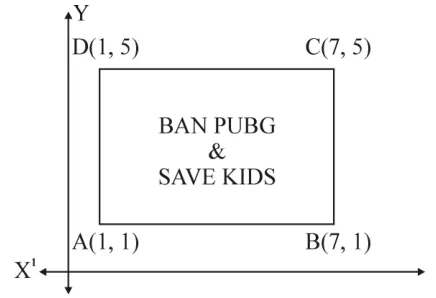
Use of mobile screen for long hours makes your eye sight weak and give you headaches. Children who are addicted to play “PUBG” can get easily stressed out. To raise social awareness about ill effects of playing PUBG, a school decided to start ‘BAN PUBG’ campaign, in which students are asked to prepare campaign board in the shape of a rectangle. One such campaign board made by class X student of the school is shown in the figure.
Original CBSE case illustration.
Describe the figure
The rectangular board has vertices A(1,1), B(7,1), C(7,5) and D(1,5). Its message reads “BAN PUBG & SAVE KIDS”.
Appeared in: 2023 · Basic · Main
(i) Find the coordinates of the point of intersection of diagonals AC and BD. [1 mark]
Show answer and solution
(4, 3)
The diagonals of a rectangle bisect each other.
Their intersection is the midpoint of AC.
Midpoint = (, ) = (4, 3).
(ii) Find the length of the diagonal AC. [1 mark]
Show answer and solution
2√13 units
By the distance formula, AC = √[(7 − 1)² + (5 − 1)²].
AC = √(36 + 16) = √52 = 2√13 units.
(iii)(a) Find the area of the campaign Board ABCD. [2 marks]
Show answer and solution
24 square units
AB = 7 − 1 = 6 units.
BC = 5 − 1 = 4 units.
Area of rectangle ABCD = AB × BC = 6 × 4 = 24 square units.
OR
(iii)(b) Find the ratio of the length of side AB to the length of the diagonal AC. [2 marks]
Show answer and solution
3 : √13
AB = 6 units and AC = 2√13 units.
AB : AC = 6 : 2√13 = 3 : √13.
Basic4 marks · Accessible paper
Case 2. Identifying a quadrilateral
The coordinates of the vertices of a quadrilateral ABCD are given as A(3, −1), B(4, 4), C(−1, 3) and D(−2, −2). Find the following to know what type of quadrilateral it is:
All four sides are equal and the diagonals are unequal, so ABCD is a rhombus.
OR
(c) Find the mid-points of AC and BD. [2 marks]
Show answer and solution
Both midpoints are (1, 1).
Midpoint of AC = (, ) = (1, 1).
Midpoint of BD = (, ) = (1, 1).
Standard4 marks
Case 3. A square inside Jagdish’s field
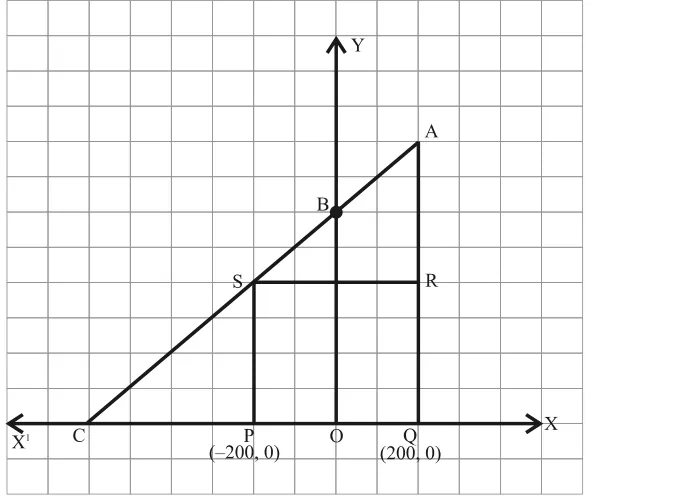
Jagdish has a field which is in the shape of a right angled triangle AQC. He wants to leave a space in the form of a square PQRS inside the field for growing wheat and the remaining for growing vegetables (as shown in the figure). In the field, there is a pole marked as O.
Original CBSE case illustration.
Describe the figure
O is the origin. P(−200,0) and Q(200,0) are the lower corners of square PQRS. R is directly above Q, S directly above P, and the outer triangle has C(−600,0) and A(200,800).
Appeared in: 2023 · Standard · Main
(i) Taking O as origin, coordinates of P are (−200, 0) and of Q are (200, 0). PQRS being a square, what are the coordinates of R and S? [1 mark]
Show answer and solution
R(200, 400), S(−200, 400)
PQ = 200 − (−200) = 400 units.
The square lies above PQ, so its upper vertices have y-coordinate 400.
R = (200, 400) and S = (−200, 400).
(ii)(a) What is the area of square PQRS? [2 marks]
Show answer and solution
1,60,000 square units
Side PQ = 400 units.
Area of square PQRS = 400² = 1,60,000 square units.
OR
(ii)(b) What is the length of diagonal PR in square PQRS? [2 marks]
Show answer and solution
400√2 units
PR = √[(200 − (−200))² + (400 − 0)²].
PR = √(400² + 400²) = 400√2 units.
(iii) If S divides CA in the ratio K : 1, what is the value of K, where point A is (200, 800)? [1 mark]
Show answer and solution
K = 1
From the figure, C = (−600, 0) and S = (−200, 400).
Using the section formula on CA, 400 = .
400K + 400 = 800K.
K = 1.
Standard4 marks · Accessible paper
Case 4. Students in morning assembly
Morning assembly is an integral part of every school’s schedule. In the assembly, students always stand in rows and columns and this makes a coordinate system.
In a school, there are 200 students and they all assemble for prayer in 10 rows. 4 students are at A, B, C and D with the following positions of the coordinate system: A(3, 4), B(6, 7), C(9, 4) and D(6, 1).
Appeared in: 2023 · Standard · Supplementary
(a) Find the distance between A and B. [1 mark]
Show answer and solution
3√2 units
AB = √[(6 − 3)² + (7 − 4)²].
AB = √18 = 3√2 units.
(b) Find the distance between C and D. [1 mark]
Show answer and solution
3√2 units
CD = √[(6 − 9)² + (1 − 4)²].
CD = √18 = 3√2 units.
(c) Show that ABCD forms a parallelogram. [2 marks]
Show answer and solution
ABCD is a parallelogram.
AB = CD = 3√2 units.
BC = √[(9 − 6)² + (4 − 7)²] = 3√2 units.
AD = √[(6 − 3)² + (1 − 4)²] = 3√2 units.
Both pairs of opposite sides are equal, so ABCD is a parallelogram.
OR
(c) Find the mid-point of the line segments AC and BD. [2 marks]
Show answer and solution
Both midpoints are (6, 4).
Midpoint of AC = (, ) = (6, 4).
Midpoint of BD = (, ) = (6, 4).
Basic4 marks
Case 5. A hexagonal tabletop
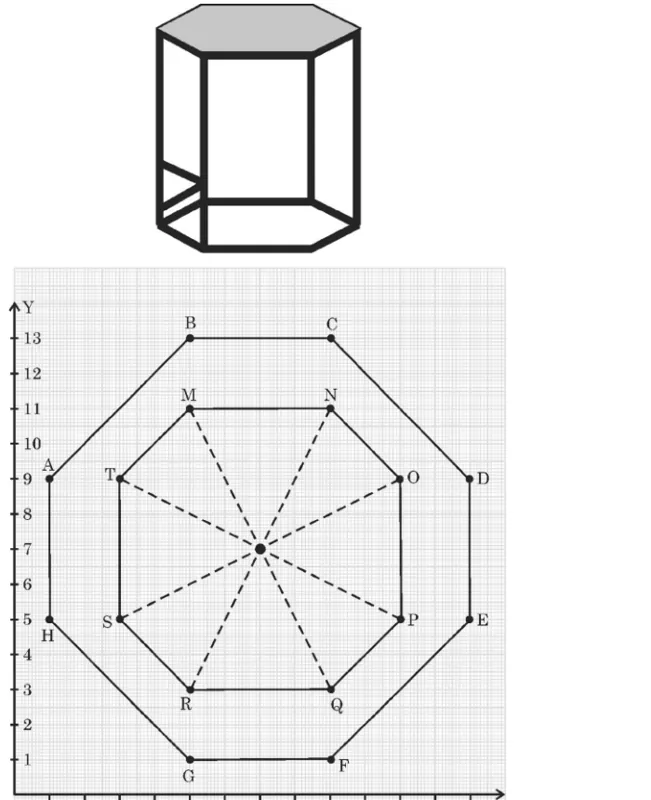
The top of a table is hexagonal in shape.
Original CBSE case illustration.
Describe the figure
The source includes a tabletop illustration and a coordinate diagram. The outer labelled outline has A(1,9), B(5,13), C(9,13), D(13,9), E(13,5) and F(9,1), with further boundary labels as printed. The inner points used here are M(5,11), N(9,11) and Q(9,3).
Appeared in: 2024 · Basic · Main
(i) Write the coordinates of A and B. [1 mark]
Show answer and solution
A(1, 9), B(5, 13)
Read the horizontal coordinate first, then the vertical coordinate.
A = (1, 9) and B = (5, 13).
(ii) Write the coordinates of the mid-point of line segment joining C and D. [1 mark]
Show answer and solution
(11, 11)
C = (9, 13) and D = (13, 9).
Midpoint of CD = (, ) = (11, 11).
(iii)(a) Find the distance between M and Q. [2 marks]
Show answer and solution
4√5 units
M = (5, 11) and Q = (9, 3).
MQ = √[(9 − 5)² + (3 − 11)²].
MQ = √80 = 4√5 units.
OR
(iii)(b) Find the coordinates of the point which divides the line segment joining M and N in the ratio 1 : 3 internally. [2 marks]
Show answer and solution
(6, 11)
M = (5, 11) and N = (9, 11).
By the section formula, the point is (, ).
Therefore, the point is (6, 11).
Basic4 marks
Case 6. Electric poles in a society park
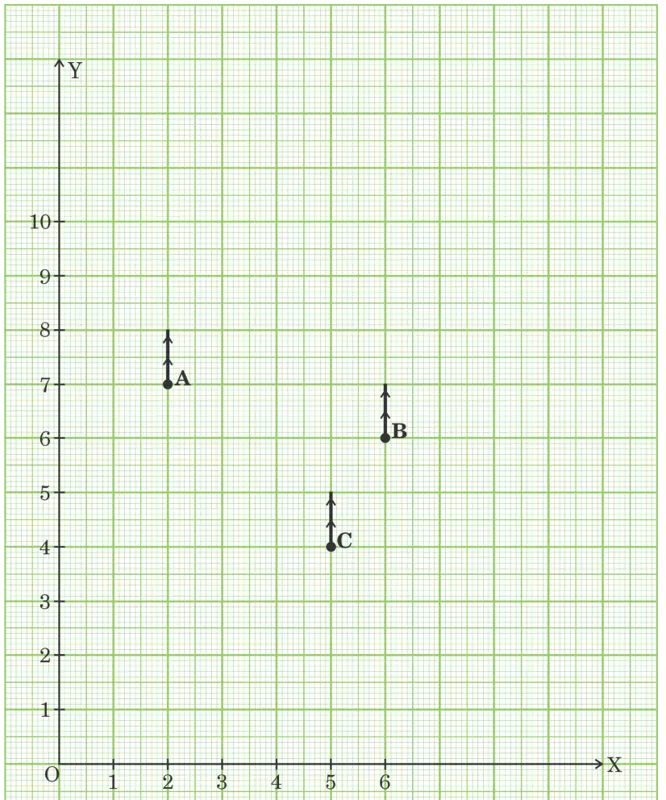
Resident Welfare Association (RWA) of Gulmohar Society in Delhi, have installed three electric poles A, B and C in the society’s common park. Despite these three poles, some parts of the park are still in the dark. So, RWA decides to have one more electric pole D in the park. The park can be modelled as a coordinate system given below.
Original CBSE case illustration.
Describe the figure
The grid shows O(0,0) and poles A(2,7), B(6,6) and C(5,4). A fourth pole D is to be located.
Appeared in: 2024 · Basic · Main
(i) What is the position of the pole C? [1 mark]
Show answer and solution
C(5, 4)
Read the point C from the grid: x = 5 and y = 4.
C = (5, 4).
(ii) What is the distance of the pole B from the corner O of the park? [1 mark]
Show answer and solution
6√2 units
O = (0, 0) and B = (6, 6).
OB = √[(6 − 0)² + (6 − 0)²] = √72 = 6√2 units.
(iii)(a) Find the position of the fourth pole D so that the four points A, B, C and D form a parallelogram ABCD. [2 marks]
Show answer and solution
D(1, 5)
Let D = (x, y).
The diagonals of a parallelogram bisect each other.
Midpoint of AC = (, ) = (7/2, 11/2).
Midpoint of BD = (, ).
6 + x = 7, so x = 1.
6 + y = 11, so y = 5.
D = (1, 5).
OR
(iii)(b) Find the distance between the poles A and C. [2 marks]
Show answer and solution
3√2 units
A = (2, 7) and C = (5, 4).
AC = √[(5 − 2)² + (4 − 7)²].
AC = √18 = 3√2 units.
Standard4 marks
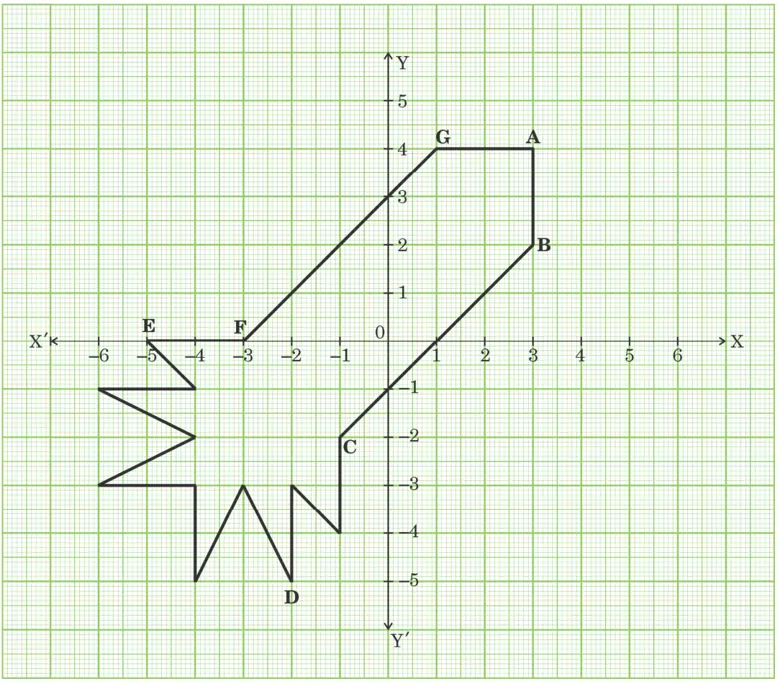
Case 7. Ryan’s rocket design
Ryan, from a very young age, was fascinated by the twinkling of stars and the vastness of space. He always dreamt of becoming an astronaut one day. So he started to sketch his own rocket designs on the graph sheet. One such design is given below:
Original CBSE case illustration.
Describe the figure
The rocket outline is drawn on a coordinate grid. Points needed for the questions are A(3,4), B(3,2), C(−1,−2), D(−2,−5), F(−3,0) and G(1,4).
Appeared in: 2024 · Standard · Main
(i) Find the mid-point of the segment joining F and G. [1 mark]
Show answer and solution
(−1, 2)
F = (−3, 0) and G = (1, 4).
Midpoint of FG = (, ) = (−1, 2).
(ii)(a) What is the distance between the points A and C? [2 marks]
Show answer and solution
2√13 units
A = (3, 4) and C = (−1, −2).
AC = √[(−1 − 3)² + (−2 − 4)²].
AC = √52 = 2√13 units.
OR
(ii)(b) Find the coordinates of the point which divides the line segment joining the points A and B in the ratio 1 : 3 internally. [2 marks]
Show answer and solution
(3, 7/2)
A = (3, 4) and B = (3, 2).
By the section formula, the point is (, ).
Therefore, the point is (3, 7/2).
(iii) What are the coordinates of the point D? [1 mark]
Show answer and solution
D(−2, −5)
Read point D from the grid: x = −2 and y = −5.
D = (−2, −5).
Standard4 marks
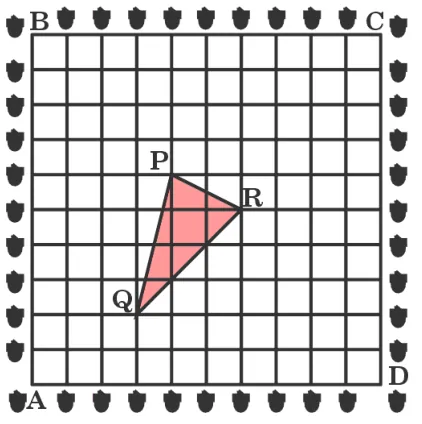
Case 8. Rose plants in a square garden
A garden is in the shape of a square. The gardener grew saplings of Ashoka tree on the boundary of the garden at the distance of 1 m from each other. He wants to decorate the garden with rose plants. He chose a triangular region inside the garden to grow rose plants. In the above situation, the gardener took help from the students of class 10. They made a chart for it which looks like the given figure.
Original CBSE case illustration.
Describe the figure
A is the lower-left corner and the chosen origin. Consecutive boundary saplings are 1 m apart. The triangle’s vertices are P(4,6), Q(3,2) and R(6,5).
Appeared in: 2024 · Standard · Main
(i) If A is taken as origin, what are the coordinates of the vertices of △PQR? [1 mark]
Show answer and solution
P(4, 6), Q(3, 2), R(6, 5)
Count horizontal and vertical grid intervals from A.
P = (4, 6), Q = (3, 2) and R = (6, 5).
(ii)(a) Find distances PQ and QR. [2 marks]
Show answer and solution
PQ = √17 m; QR = 3√2 m
PQ = √[(3 − 4)² + (2 − 6)²] = √17 m.
QR = √[(6 − 3)² + (5 − 2)²] = √18 = 3√2 m.
OR
(ii)(b) Find the coordinates of the point which divides the line segment joining points P and R in the ratio 2 : 1 internally. [2 marks]
Show answer and solution
(16/3, 16/3)
By the section formula, the point is (, ).
Therefore, the point is (16/3, 16/3).
(iii) Find out if △PQR is an isosceles triangle. [1 mark]
Show answer and solution
No; △PQR is scalene.
PQ² = 17 and QR² = 18.
PR² = (6 − 4)² + (5 − 6)² = 5.
All three side lengths differ, so △PQR is not isosceles.
Basic4 marks
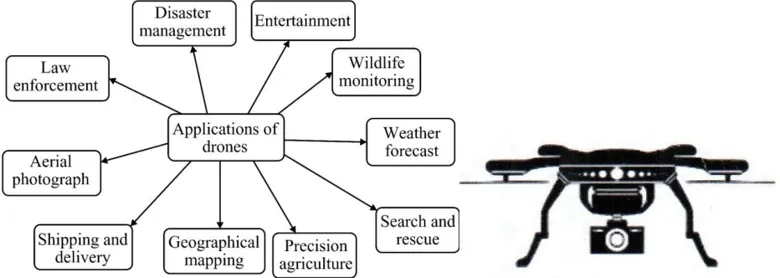
Case 9. A drone above a rectangular field
Drones are used by military for surveillance purposes. These days, drones are also used by individual entrepreneurs, SMEs and large companies to accomplish various other tasks.
A drone is flying over a rectangular field with vertices at A(−100, 0), B(100, 0), C(100, 150) and D(−100, 150). The drone captures an image at a location (x, y).
Original CBSE case illustration.
Describe the figure
The original case illustration is a drone-use infographic and a drone picture. The field coordinates are stated in the passage, not plotted in that illustration.
Appeared in: 2024 · Basic · Supplementary
(i) Find the dimensions of the rectangular field. [1 mark]
Show answer and solution
200 units × 150 units
AB = 100 − (−100) = 200 units.
BC = 150 − 0 = 150 units.
(ii) Find the distance between points A and C. [1 mark]
Show answer and solution
250 units
AC = √[(100 − (−100))² + (150 − 0)²].
AC = √62500 = 250 units.
(iii)(a) If a drone captures the image of an object P(x, y) on the rectangular field, find the relation between x and y such that PA = PC. [2 marks]
Show answer and solution
4x + 3y = 225
PA² = PC².
(x + 100)² + y² = (x − 100)² + (y − 150)².
400x + 300y = 22500.
4x + 3y = 225.
OR
(iii)(b) If a drone captures the image of an object at a point Q whose x coordinate is 0 and it is equidistant from points A and D, find the coordinates of Q. [2 marks]
Show answer and solution
Q(0, 75)
Let Q = (0, y).
QA² = QD².
100² + y² = 100² + (y − 150)².
300y = 22500.
y = 75, so Q = (0, 75).
Standard4 marks
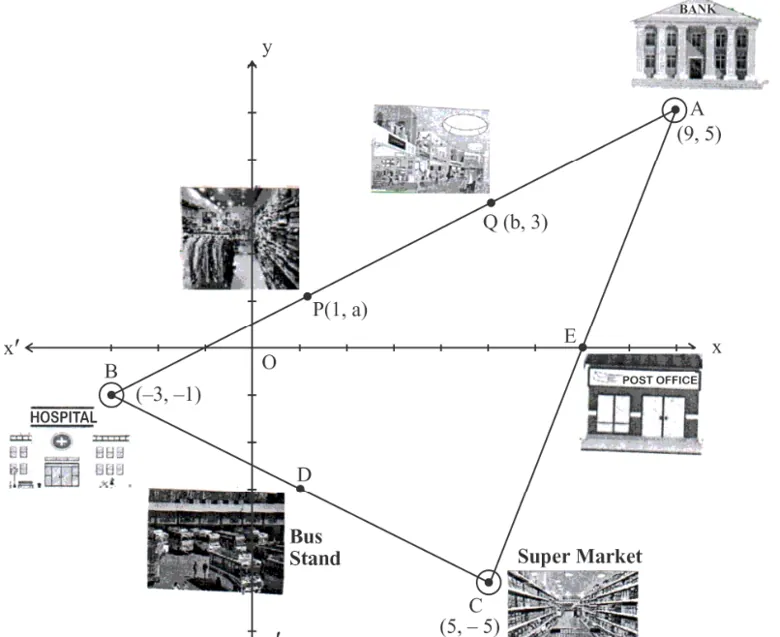
Case 10. A bank, hospital and supermarket
Partha, a software engineer, lives in Jerusalem for his work. He lives in the most convenient area of the city from where bank, hospital, post office and supermarket can be easily accessed. In the graph, the bank is plotted as A(9, 5), hospital as B(−3, −1) and supermarket as C(5, −5) such that A, B, C form a triangle.
Original CBSE case illustration.
Describe the figure
The original coordinate map includes photographs of the bank, hospital, supermarket and other services. A(9,5), B(−3,−1) and C(5,−5) are the triangle vertices. E lies on AC, D on BC, and P and Q on BA.
Appeared in: 2024 · Standard · Supplementary
(i) Find the distance between the bank and the hospital. [1 mark]
Show answer and solution
6√5 units
AB = √[(−3 − 9)² + (−1 − 5)²].
AB = √180 = 6√5 units.
(ii) In between the bank and the supermarket, there is a post office plotted at E which is their mid-point. Find the coordinates of E. [1 mark]
Show answer and solution
E(7, 0)
E is the midpoint of AC.
E = (, ) = (7, 0).
(iii)(a) In between the hospital and the supermarket, there is a bus stop plotted as D, which is their mid-point. If Partha wants to reach the bus stand from the bank, then how much distance does he need to cover? [2 marks]
Show answer and solution
8√2 units
D is the midpoint of BC.
D = (, ) = (1, −3).
AD = √[(1 − 9)² + (−3 − 5)²].
AD = √128 = 8√2 units.
OR
(iii)(b) P and Q are two different garment shops lying between the bank and the hospital, such that BP = PQ = QA. If the coordinates of P and Q are (1, a) and (b, 3) respectively, then find the values of a and b. [2 marks]
Show answer and solution
a = 1; b = 5
B, P, Q and A occur in that order with equal gaps.
P is the midpoint of BQ, so a = = 1.
Q is the midpoint of PA, so b = = 5.
Basic4 marks
Case 11. Two fountains in a circular park
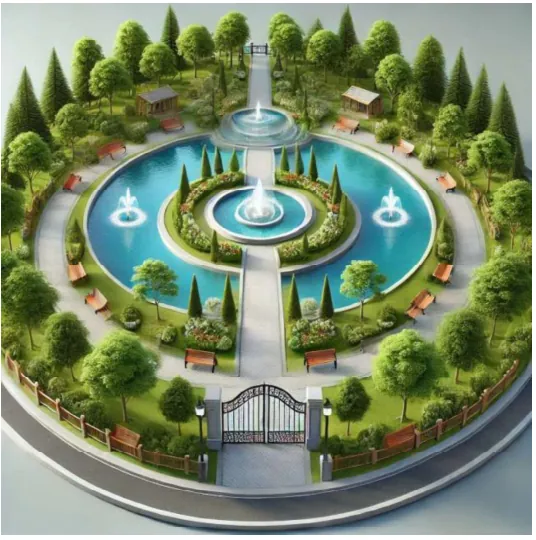
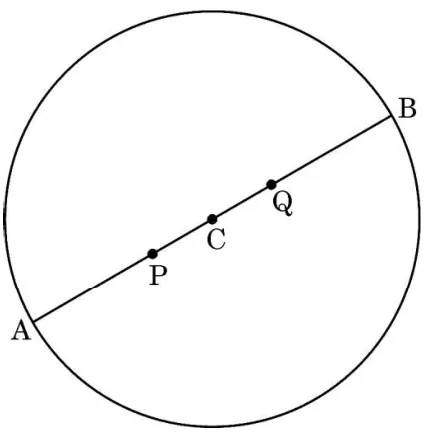
In a society, there is a circular park having two gates. The gates are placed at points A(10, 20) and B(50, 50), as shown in the figure below. Two fountains are installed at points P and Q on AB such that AP = PQ = QB.
Original CBSE case illustration.Original CBSE case illustration.
Describe the figure
The original park photograph accompanies a circle diagram. AB is a diameter, C is its centre, and P and Q trisect AB in the order A, P, C, Q, B.
Appeared in: 2025 · Basic · Main
(i) Find the coordinates of the centre C. [1 mark]
Show answer and solution
C(30, 35)
C is the midpoint of diameter AB.
C = (, ) = (30, 35).
(ii) Find the radius of the circular park. [1 mark]
Show answer and solution
25 units
CA = √[(30 − 10)² + (35 − 20)²].
CA = √625 = 25 units.
(iii)(a) Find the coordinates of the point P. [2 marks]
Show answer and solution
P(70/3, 30)
AP : PB = 1 : 2.
By the section formula, P = (, ).
P = (70/3, 30).
OR
(iii)(b) Find the distance of the fountain at Q from gate A. [2 marks]
Show answer and solution
100/3 units
AB = 2 × 25 = 50 units.
AQ = (2/3)AB = = 100/3 units.
Basic4 marks
Case 12. Anita’s route across a field
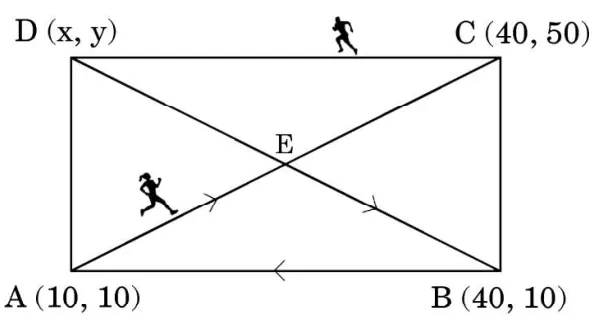
A field is in the form of a rectangle. The coordinates of the rectangular field ABCD are A(10, 10), B(40, 10), C(40, 50) and D(x, y). Anil and Anita, two friends decided to have a race. Anita started from point A and moved to point E along the diagonal AC, where E is the point of intersection of both the diagonals of ABCD. From point E, she moved to point B along the other diagonal DB and then moved back to point A along BA. While Anil started from point C and ran to point A via D along the boundary of the field.
Original CBSE case illustration.Original CBSE case illustration.
Describe the figure
The source has an illustration of runners and rectangle ABCD with diagonals AC and DB meeting at E. Anita follows A–E–B–A; Anil follows C–D–A.
Appeared in: 2025 · Basic · Main
(i) Find the coordinates of point E. [1 mark]
Show answer and solution
E(25, 30)
The diagonals of a rectangle bisect each other.
E = (, ) = (25, 30).
(ii) Find the distance between the points B and C. [1 mark]
Show answer and solution
40 units
B and C have the same x-coordinate.
BC = 50 − 10 = 40 units.
(iii)(a) Find the coordinates of point D and the distance BD. [2 marks]
Show answer and solution
D(10, 50); BD = 50 units
For this rectangle, D has A’s x-coordinate and C’s y-coordinate.
D = (10, 50).
BD = √[(10 − 40)² + (50 − 10)²].
BD = √2500 = 50 units.
OR
(iii)(b) Find the total distance travelled by Anita. [2 marks]
Show answer and solution
80 units
AE = √[(25 − 10)² + (30 − 10)²] = 25 units.
EB = √[(40 − 25)² + (10 − 30)²] = 25 units.
BA = 40 − 10 = 30 units.
Total distance = AE + EB + BA = 25 + 25 + 30 = 80 units.
Basic4 marks
Case 13. Saplings in a semicircular park
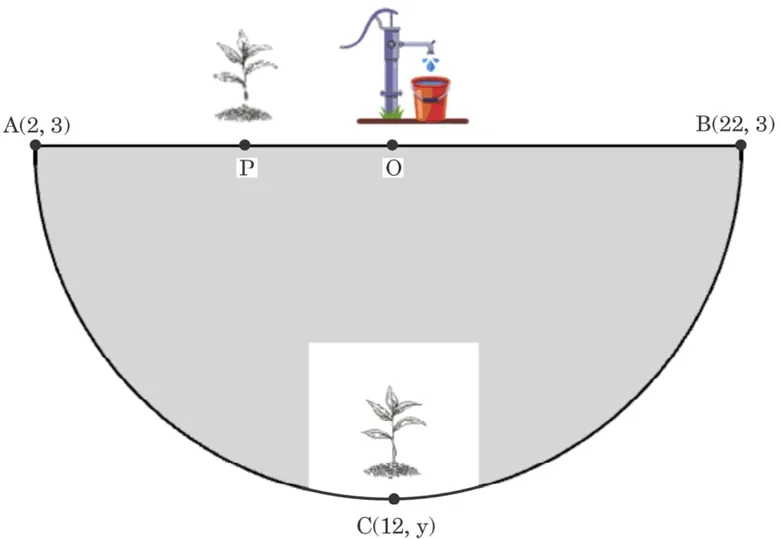
There is a semicircular park in Aman’s society. He wishes to plant saplings along the boundary of the park. There is a borewell at the centre O of the park along the diameter AB as shown in the figure below.
Original CBSE case illustration.
Describe the figure
The semicircle lies below diameter A(2,3)–B(22,3). O is the midpoint of AB. P lies between A and O. C(12,y) is the lowest point of the pictured semicircular arc. The borewell and sapling illustrations are retained.
Appeared in: 2025 · Basic · Main
(i) Find the coordinates of point O. [1 mark]
Show answer and solution
O(12, 3)
O is the midpoint of AB.
O = (, ) = (12, 3).
(ii) Find the radius of the semicircular park. [1 mark]
Show answer and solution
10 units
AB = 22 − 2 = 20 units.
Radius = AB/2 = 10 units.
(iii)(a) One sapling is kept at point C(12, y). Find the coordinates of C. [2 marks]
Show answer and solution
C(12, −7), for the pictured semicircle.
OC = 10 units.
(12 − 12)² + (y − 3)² = 100.
y − 3 = ±10, giving y = 13 or y = −7.
The figure places C below AB, so y < 3.
Therefore, C = (12, −7).
Source note: the 2025 Basic 430/3/1 Q38(iii)(a) marking scheme, page 20, lists both (12,13) and (12,−7). Only (12,−7) lies on the semicircle shown.
OR
(iii)(b) One sapling is kept at point P along AB so that PA = PB. Find the coordinates of P. [2 marks]
Show answer and solution
P(7, 3)
AP : PB = 1 : 3.
By the section formula, P = (, ).
P = (7, 3).
Basic4 marks
Case 14. A robot paints a coordinate path
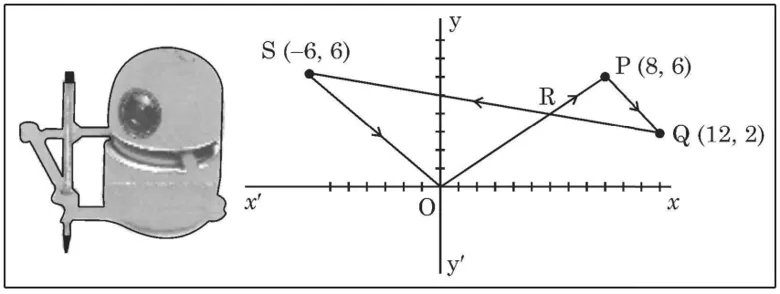
Gurveer and Arushi built a robot that can paint a path as it moves on a graph paper. Some co-ordinate of points are marked on it. It starts from (0, 0), moves to the points listed in order (in straight lines) and ends at (0, 0).
Arushi entered the points P(8, 6), Q(12, 2) and S(−6, 6) in order. The path drawn by robot is shown in the figure.
Original CBSE case illustration.
Describe the figure
The robot picture accompanies the path O(0,0)–P(8,6)–Q(12,2)–S(−6,6)–O. R lies on OP and has x-coordinate 4.8.
Appeared in: 2025 · Basic · Main
(i) Determine the distance OP. [1 mark]
Show answer and solution
10 units
OP = √[(8 − 0)² + (6 − 0)²].
OP = √100 = 10 units.
(ii) QS is represented by equation 2x + 9y = 42. Find the co-ordinates of the point where it intersects y-axis. [1 mark]
Show answer and solution
(0, 14/3)
On the y-axis, x = 0.
2(0) + 9y = 42.
y = 42/9 = 14/3.
The intersection is (0, 14/3).
(iii)(a) Point R(4.8, y) divides the line segment OP in a certain ratio, find the ratio. Hence, find the value of y. [2 marks]
Show answer and solution
OR : RP = 3 : 2; y = 18/5
Let OR : RP = k : 1.
4.8 = .
4.8k + 4.8 = 8k.
k = 3/2, so OR : RP = 3 : 2.
y = = 18/5.
OR
(iii)(b) Using distance formula, show that = . [2 marks]
Show answer and solution
PQ/OS = 2/3
PQ = √[(12 − 8)² + (2 − 6)²] = 4√2 units.
OS = √[(−6 − 0)² + (6 − 0)²] = 6√2 units.
= = .
Standard4 marks
Case 15. Saplings forming a quadrilateral
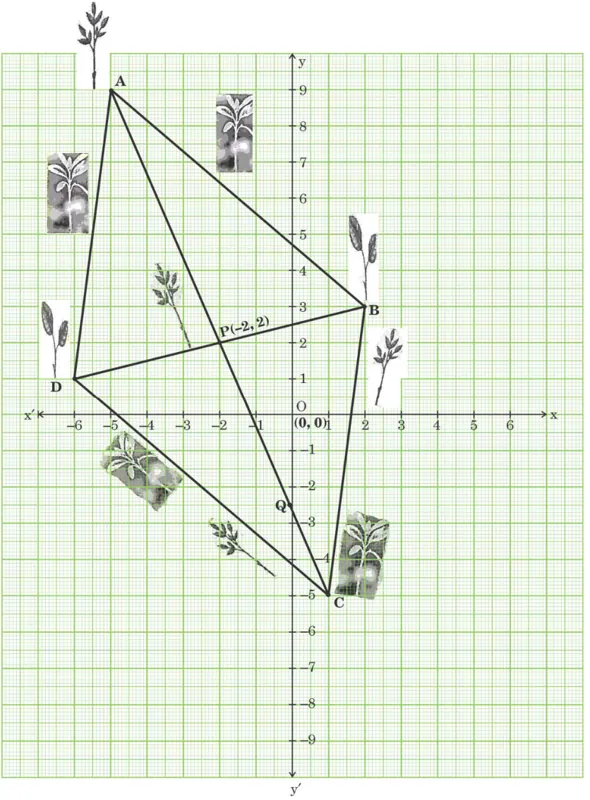
Trees act the natural filters. By planting trees in and around school premises, we create cleaner and healthier air for students and local residents, reducing respiratory problems. A school in Noida has proposed and organised a community drive on tree plantation under the title “Save Earth, Plant Trees”. Students of that school have planted saplings in the field such that it formed a quadrilateral as shown in the figure ABCD.
Original CBSE case illustration.
Describe the figure
The coordinate diagram has A(−5,9), B(2,3), D(−6,1) and the diagonal intersection P(−2,2). C is to be determined. The original sapling pictures and grid are retained.
Appeared in: 2025 · Standard · Supplementary
(i) Find the distance between the two saplings at A and D. [1 mark]
Show answer and solution
√65 units
A = (−5, 9) and D = (−6, 1).
AD = √[(−6 − (−5))² + (1 − 9)²] = √65 units.
(ii)(a) One student plants one sapling at the mid-point of AD. Then he moves along a straight line parallel to DB and sows another sapling on AB. What are the coordinates of the positions of these two new saplings? [2 marks]
Show answer and solution
(−11/2, 5) and (−3/2, 6)
Midpoint of AD = (, ) = (−11/2, 5).
In △ADB, the line through this midpoint parallel to DB meets AB at its midpoint.
Midpoint of AB = (, ) = (−3/2, 6).
OR
(ii)(b) A new sapling is kept at a point M on DB such that DM : MB = 3 : 1. Find the coordinates of M. [2 marks]
Show answer and solution
M(0, 5/2)
D = (−6, 1) and B = (2, 3).
By the section formula, M = (, ).
M = (0, 5/2).
(iii) The line segments AC and BD bisect each other at P(−2, 2). Find the coordinates of C. [1 mark]
Show answer and solution
C(1, −5)
Let C = (x, y). Since P is the midpoint of AC,
= −2 and = 2.
x = 1 and y = −5.
C = (1, −5).
Basic4 marks · Accessible paper
Case 16. A circular park with a variable centre
A park is designed in the form of a circle with centre O. There is a fountain at the centre of the park and the entry gate is at point A on the boundary of the park. Let the coordinates of centre O be (2a − 1, 7) and the coordinates of point A be (−3, −1).
Appeared in: 2025 · Basic · Supplementary
(i) If a = 1, determine the radius of the circular park. [1 mark]
Show answer and solution
4√5 units
For a = 1, O = (1, 7).
Radius OA = √[(1 − (−3))² + (7 − (−1))²].
OA = √80 = 4√5 units.
(ii) If the centre of park is on y-axis, then find the value of a. [1 mark]
Show answer and solution
a = 1/2
The x-coordinate of a point on the y-axis is 0.
2a − 1 = 0.
a = 1/2.
(iii)(a) If the radius of the circular park is 10 units, then find the possible values of a. [2 marks]
Show answer and solution
a = 2 or a = −4
OA² = 100.
(2a − 1 + 3)² + (7 + 1)² = 100.
(2a + 2)² = 36.
2a + 2 = 6 or 2a + 2 = −6.
a = 2 or a = −4.
OR
(iii)(b) If B is another point on the boundary of the park such that OB ⊥ OA, and the radius of the circular park is 10 units, then determine the length of the chord AB. [2 marks]
Show answer and solution
10√2 units
OA = OB = 10 units and ∠AOB = 90°.
By Pythagoras theorem, AB² = OA² + OB².
AB = √(100 + 100) = 10√2 units.
Basic4 marks · Accessible paper
Case 17. Flower plants in a school garden
In the school garden, Arun (A), Babu (B), Chandra (C) and Daya (D) planted flower plants of Sunflower, Rose, Champa and Jasmine respectively at point A(2, 8), B(7, 8), C(9, 3) and D(2, 3) respectively.
Appeared in: 2026 · Basic · Main
(i) Find the distances AB and AD. [1 mark]
Show answer and solution
AB = AD = 5 units
AB = 7 − 2 = 5 units.
AD = 8 − 3 = 5 units.
(ii) Find BC − CD. [1 mark]
Show answer and solution
√29 − 7 units
BC = √[(9 − 7)² + (3 − 8)²] = √29 units.
CD = 9 − 2 = 7 units.
BC − CD = √29 − 7 units.
This is a signed difference, so a negative value is possible.
(iii)(a) If Varun wants to plant his flower plant at a point M such that DM : MC = 3 : 2, find the coordinates of M. [2 marks]
Show answer and solution
M(31/5, 3)
D = (2, 3) and C = (9, 3).
M = (, ).
M = (31/5, 3).
OR
(iii)(b) If N divides the line segment AC in the ratio 2 : 3, find the coordinates of N. [2 marks]
Show answer and solution
N(24/5, 6)
N = (, ).
N = (24/5, 6).
Standard4 marks
Case 18. A coordinate map of Jaipur
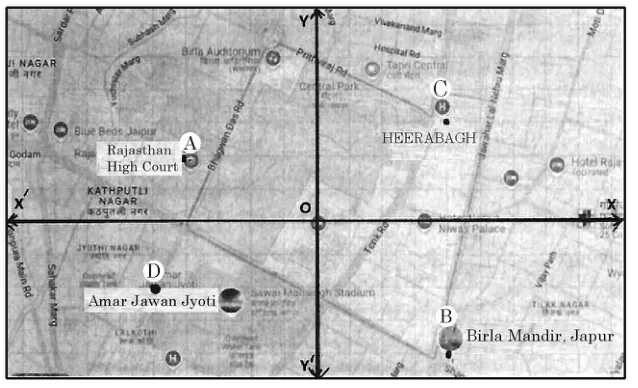
Observe the map of Jaipur city placed on a Cartesian plane. Taking Rambagh Palace as origin, the location of some places are given below:
Point A: (−4, 2) Rajasthan High Court. Point B: (4, −4) Birla Mandir. Point C: (4, 3) Heera Bagh. Point D: (−5, −2) Amar Jawan Jyoti.
Original CBSE case illustration.
Describe the figure
The original Jaipur map is overlaid with coordinate axes. O is Rambagh Palace; A(−4,2), B(4,−4), C(4,3) and D(−5,−2) mark the stated landmarks. Use the stated coordinates rather than estimating geographical distances.
Appeared in: 2026 · Standard · Main
(i) Advocate Rehana stays at Heera Bagh. How much distance she has to cover daily to go to the court and coming back home? [1 mark]
(ii) There is a crossing on X-axis which divides AD in a certain ratio. Find the ratio. [1 mark]
Show answer and solution
1 : 1
Let the ratio be k : 1. The crossing has y-coordinate 0.
0 = .
−2k + 2 = 0, so k = 1.
The ratio is 1 : 1.
(iii)(a) Is Birla Mandir equidistant from Heera Bagh and Amar Jawan Jyoti? Justify your answer. [2 marks]
Show answer and solution
No; BC = 7 units and BD = √85 units.
BC = |3 − (−4)| = 7 units.
BD = √[(−5 − 4)² + (−2 − (−4))²] = √85 units.
Since 7 ≠ √85, Birla Mandir is not equidistant from the two places.
OR
(iii)(b) Using section formula, show that points A, O and B are not collinear. [2 marks]
Show answer and solution
A, O and B are not collinear.
If O lay on AB, its zero x-coordinate would place it internally between A and B.
Let AO : OB = k : 1.
From the x-coordinate, 0 = , giving k = 1.
From the y-coordinate, 0 = , giving k = 1/2.
A single division point cannot have two different ratios.
Therefore, A, O and B are not collinear.
Basic4 marks · Accessible paper
Case 19. A new student joins the class
By drawing two mutually perpendicular lines on a plane, we can mark the position of any point on the plane. The horizontal direction is commonly called the x-axis and the vertical direction is commonly called the y-axis. Read the following passage and answer the questions that follow, using the above information:
In a classroom, four students Aneesh, Bijender, Chaman and Dinesh are sitting at A(1, 6), B(4, 9), C(7, 6) and D(4, 3), respectively. Then a new student Ravi joins the class.
Appeared in: 2026 · Basic · Second Board Examination
(i) Find the distances AC and BD. [1 mark]
Show answer and solution
AC = BD = 6 units
AC = 7 − 1 = 6 units.
BD = 9 − 3 = 6 units.
(ii) Find the mid-points of AC and BD. [1 mark]
Show answer and solution
Both midpoints are (4, 6).
Midpoint of AC = (, ) = (4, 6).
Midpoint of BD = (, ) = (4, 6).
(iii)(a) Show that ABCD forms a square. [2 marks]
Show answer and solution
ABCD is a square.
The diagonals have the same midpoint, so ABCD is a parallelogram.
AB = √[(4 − 1)² + (9 − 6)²] = 3√2 units.
BC = √[(7 − 4)² + (6 − 9)²] = 3√2 units.
A parallelogram with equal adjacent sides is a rhombus.
Its diagonals AC and BD are equal, so it is also a rectangle.
Therefore, ABCD is a square.
OR
(iii)(b) If Ravi wants to sit in the middle of the four students, find the position of Ravi and justify your answer. [2 marks]
Show answer and solution
(4, 6)
The diagonals of the square meet at (4, 6).
The distances from this point to A, B, C and D are each 3 units.
Ravi should sit at (4, 6).
Standard4 marks · Accessible paper
Case 20. Three friends, a school and a library
Arun, Ravi and Promod are three friends living on the same street. The position of their houses on the street are represented by points A, R and P respectively, and their coordinates are A(1, 7), R(4, 5) and P(7, 3). Their school, represented by point S, is a point on x-axis equidistant from A and P and a library represented by a point L is on y-axis equidistant from R and P.
Appeared in: 2026 · Standard · Second Board Examination
(i) Find the distance between A and P. [1 mark]
Show answer and solution
2√13 units
AP = √[(7 − 1)² + (3 − 7)²].
AP = √52 = 2√13 units.
(ii) Find the ratio in which R is dividing the line segment AP. [1 mark]
Show answer and solution
AR : RP = 1 : 1
Midpoint of AP = (, ) = (4, 5).
This is R, so R divides AP in the ratio 1 : 1.
(iii)(a) Find the coordinates of point S. [2 marks]
Show answer and solution
S(2/3, 0)
Let S = (x, 0).
AS² = PS².
(x − 1)² + 7² = (x − 7)² + 3².
−2x + 50 = −14x + 58.
12x = 8, so x = 2/3.
S = (2/3, 0).
OR
(iii)(b) Find the coordinates of point L. [2 marks]
Show answer and solution
L(0, −17/4)
Let L = (0, y).
RL² = PL².
4² + (y − 5)² = 7² + (y − 3)².
−10y + 41 = −6y + 58.
−4y = 17, so y = −17/4.
L = (0, −17/4).
Basic4 marks
Case 21. A GPS round trip on a map
In a GPS, The lines that run east-west are known as lines of latitude, and the lines running north-south are known as lines of longitude. The latitude and the longitude of a place are its coordinates and the distance formula is used to find the distance between two places. The distance between two parallel lines is approximately 150 km.
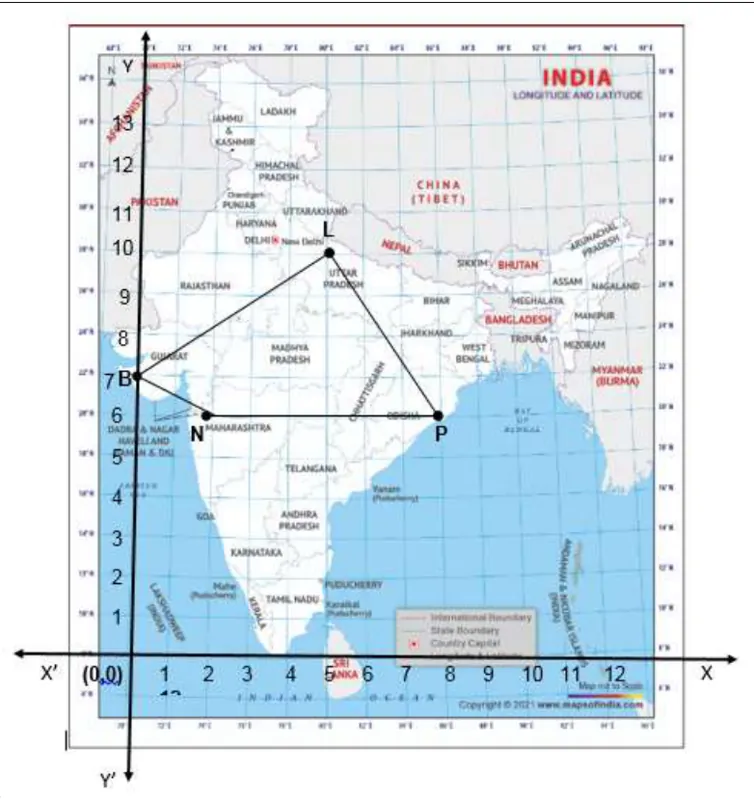
A family from Uttar Pradesh planned a round trip from Lucknow (L) to Puri (P) via Bhuj (B) and Nashik (N) as shown in the given figure below.
Original CBSE case illustration.
Describe the figure
The original map shows L(5,10), B(0,7), N(2,6) and P(8,6). Use the question’s simplified grid model with 150 km per grid interval; these are diagram coordinates rather than geographical latitude and longitude values.
Appeared in: 2022–23 · Basic · Official Sample
(I) Find the distance between Lucknow (L) to Bhuj (B). [1 mark]
Show answer and solution
150√34 km
L = (5, 10) and B = (0, 7).
LB = √[(0 − 5)² + (7 − 10)²] = √34 grid units.
Using the paper’s scale, distance = 150√34 km.
(II) If Kota (K), internally divide the line segment joining Lucknow (L) to Bhuj (B) into 3 : 2 then find the coordinate of Kota (K). [1 mark]
Show answer and solution
K(2, 41/5)
LK : KB = 3 : 2.
Using L(5,10) first and B(0,7) second,
K = (, ).
K = (2, 41/5).
Source note: the 2022–23 Basic official sample Q37(II) marking scheme, page 8, prints (3,41/5). Its x-coordinate uses the opposite weights. The point (2,41/5) satisfies LK : KB = 3 : 2.
(III) Name the type of triangle formed by the places Lucknow (L), Nashik (N) and Puri (P). [2 marks]
Show answer and solution
Isosceles triangle
LN = √[(2 − 5)² + (6 − 10)²] = 5 grid units.
LP = √[(8 − 5)² + (6 − 10)²] = 5 grid units.
NP = 8 − 2 = 6 grid units.
LN = LP, so △LNP is isosceles.
Source note: the 2022–23 Basic official sample Q37(III) marking scheme, page 8, prints NP = 4. The stated coordinates give NP = 8 − 2 = 6; the isosceles classification is unchanged.
OR
(III) Find a place (point) on the longitude (y-axis) which is equidistant from the points Lucknow (L) and Puri (P). [2 marks]
Show answer and solution
(0, 25/8)
Let the point be T(0, y).
TL² = TP².
5² + (10 − y)² = 8² + (6 − y)².
125 − 20y = 100 − 12y.
8y = 25, so y = 25/8.
T = (0, 25/8).
Standard4 marks
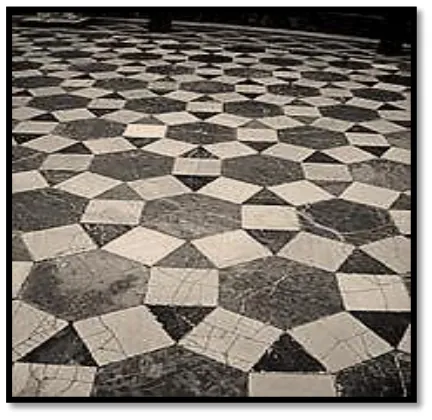
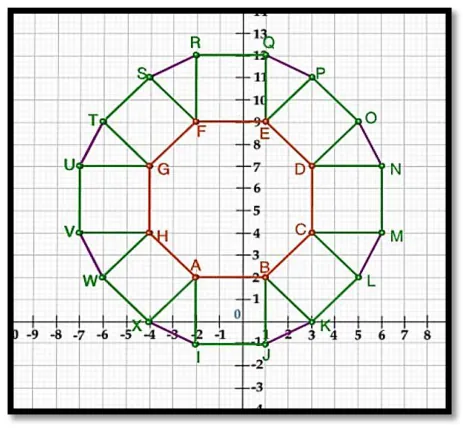
Case 22. A tessellated museum floor
A tiling or tessellation of a flat surface is the covering of a plane using one or more geometric shapes, called tiles, with no overlaps and no gaps. Historically, tessellations were used in ancient Rome and in Islamic art. You may find tessellation patterns on floors, walls, paintings etc. Shown below is a tiled floor in the archaeological Museum of Seville, made using squares, triangles and hexagons.
Original CBSE case illustration.Original CBSE case illustration.
Describe the figure
The museum-floor photograph and coordinate pattern are retained. Relevant coordinates are A(−2,2), B(1,2), F(−2,9), G(−4,7), H(−4,4), W(−6,2), X(−4,0), O(5,9) and P(3,11).
A craftsman thought of making a floor pattern after being inspired by the above design. To ensure accuracy in his work, he made the pattern on the Cartesian plane. He used regular octagons, squares and triangles for his floor tessellation pattern.
Appeared in: 2022–23 · Standard · Official Sample
(i) What is the length of the line segment joining points B and F? [1 mark]
Show answer and solution
√58 units
B = (1, 2) and F = (−2, 9).
BF = √[(−2 − 1)² + (9 − 2)²] = √58 units.
(ii) The centre Z of the figure will be the point of intersection of the diagonals of quadrilateral WXOP. Then what are the coordinates of Z? [1 mark]
Show answer and solution
Z(−1/2, 11/2)
WXOP is a rectangle, so its diagonals bisect each other.
Z is the midpoint of WO.
Z = (, ) = (−1/2, 11/2).
(iii) What are the coordinates of the point on y-axis equidistant from A and G? [2 marks]
Show answer and solution
(0, 57/10)
Let T = (0, y).
TA² = TG².
2² + (y − 2)² = 4² + (y − 7)².
8 − 4y = 65 − 14y.
10y = 57, so T = (0, 57/10).
OR
(iii) What is the area of Trapezium AFGH? [2 marks]
Show answer and solution
10 square units
AF = 9 − 2 = 7 units.
GH = 7 − 4 = 3 units.
AF and GH are parallel vertical sides, 2 units apart.
Area = (1/2)(AF + GH) × height.
Area = (1/2)(7 + 3) × 2 = 10 square units.
Basic4 marks
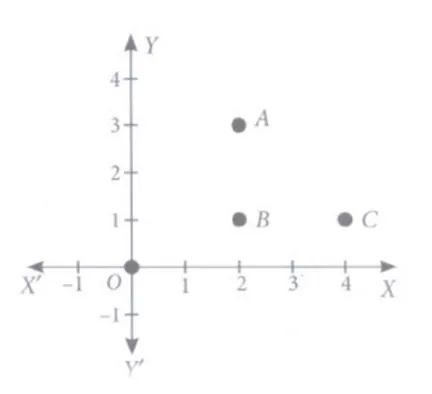
Case 23. Alia, Shagun and a library
Alia and Shagun are friends living on the same street in Patel Nagar. Shagun’s house is at the intersection of one street with another street on which there is a library. They both study in the same school and that is not far from Shagun’s house. Suppose the school is situated at the point O, i.e., the origin, Alia’s house is at A. Shagun’s house is at B and library is at C.
Original CBSE case illustration.
Describe the figure
The coordinate diagram shows school O(0,0), Alia’s house A(2,3), Shagun’s house B(2,1) and library C(4,1).
Appeared in: 2023–24 · Basic · Official Sample
(i) How far is Alia’s house from Shagun’s house? [1 mark]
Show answer and solution
2 units
A and B have the same x-coordinate.
AB = 3 − 1 = 2 units.
(ii) How far is the library from Shagun’s house? [1 mark]
Show answer and solution
2 units
B and C have the same y-coordinate.
BC = 4 − 2 = 2 units.
(iii) Show that for Shagun, school is farther compared to Alia’s house and library. [2 marks]
Show answer and solution
BO = √5 > BA = BC = 2 units
BO = √[(2 − 0)² + (1 − 0)²] = √5 units.
BA = BC = 2 units.
Since √5 > 2, the school is farther from Shagun’s house than either Alia’s house or the library.
OR
(iii) Show that Alia’s house, Shagun’s house and library form an isosceles right triangle. [2 marks]
Show answer and solution
△ABC is an isosceles right triangle at B.
AB = BC = 2 units.
AC² = (4 − 2)² + (1 − 3)² = 8.
AB² + BC² = 4 + 4 = 8 = AC².
By the converse of Pythagoras theorem, ∠ABC = 90°.
Since AB = BC, the triangle is also isosceles.
Standard4 marks
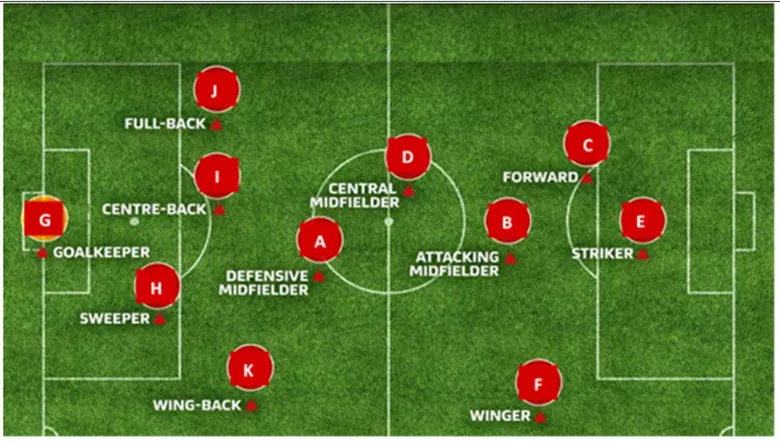
Case 24. Football players on a coordinate plane
Tharunya was thrilled to know that the football tournament is fixed with a monthly timeframe from 20th July to 20th August 2023 and for the first time in the FIFA Women’s World Cup’s history, two nations host in 10 venues. Her father felt that the game can be better understood if the position of players is represented as points on a coordinate plane.
Original CBSE case illustration.
Describe the figure
The original football-field illustration labels the players A to K and their roles. The numerical coordinates change between subparts; use each subpart’s own values rather than carrying a player’s earlier coordinates forward.
Appeared in: 2023–24 · Standard · Official Sample
(i) At an instance, the midfielders and forward formed a parallelogram. Find the position of the central midfielder D if the position of other players who formed the parallelogram are A(1,2), B(4,3) and C(6,6). [1 mark]
Show answer and solution
D(3, 5)
Let D = (x, y).
The diagonals AC and BD have the same midpoint.
1 + 6 = 4 + x, so x = 3.
2 + 6 = 3 + y, so y = 5.
D = (3, 5).
(ii) Check if the Goal keeper G(−3,5), Sweeper H(3,1) and Wing-back K(0,3) fall on a same straight line. [2 marks]
Show answer and solution
Yes; K is the midpoint of GH.
Midpoint of GH = (, ) = (0, 3).
This is K, so G, K and H lie on the same straight line.
OR
(ii) Check if the Full-back J(5,−3) and centre-back I(−4,6) are equidistant from forward C(0,1) and if C is the mid-point of IJ. [2 marks]
Show answer and solution
CI = CJ = √41 units; C is not the midpoint of IJ.
CJ = √[(5 − 0)² + (−3 − 1)²] = √41 units.
CI = √[(−4 − 0)² + (6 − 1)²] = √41 units.
Therefore, I and J are equidistant from C.
Midpoint of IJ = (, ) = (1/2, 3/2).
This differs from C(0,1), so C is not the midpoint.
(iii) If Defensive midfielder A(1,4), Attacking midfielder B(2,−3) and Striker E(a,b) lie on the same straight line and B is equidistant from A and E, find the position of E. [1 mark]
Show answer and solution
E(3, −10)
For these distinct collinear positions, B is the midpoint of AE.
= 2, so a = 3.
= −3, so b = −10.
E = (3, −10).
Basic4 marks
Case 25. Three friends share a car
Carpooling is the sharing of car journeys so that more than one person travels in a car, and prevents the need for others to have to drive to a location themselves. By having more people using one vehicle, carpooling reduces each person’s travel costs such as: fuel costs, tolls, and the stress of driving. Carpooling is also a more environmentally friendly and sustainable way to travel as sharing journeys reduces air pollution, carbon emissions, traffic congestion on the roads, and the need for parking spaces.
Original CBSE case illustration.Original CBSE case illustration.
Describe the figure
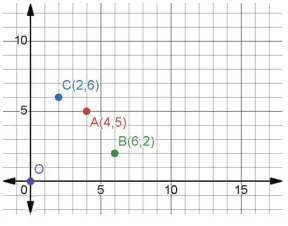
The original carpool illustration and coordinate grid are retained. The office is O(0,0); the three societies are A(4,5), B(6,2) and C(2,6).
Three friends Amar, Bhavin and Chetanya live in societies represented by the points A(4,5), B(6,2) and C(2,6) respectively. They all work in offices located in a same building represented by the point O(0,0). Since they all go to same building every day, they decided to do carpooling to save money on petrol.
Appeared in: 2025–26 · Basic · Official Sample
(i) What is the distance between B and C? [1 mark]
Show answer and solution
4√2 units
BC = √[(2 − 6)² + (6 − 2)²].
BC = √32 = 4√2 units.
(ii) If Bhavin and Chetanya planned to meet at a club situated at the mid-point of the line joining the points B and C, find the coordinates of this point. [1 mark]
Show answer and solution
(4, 4)
Midpoint of BC = (, ).
The club is at (4, 4).
(iii)(A) Which society is farthest from the office? Also find its distance from the office. [2 marks]
Show answer and solution
Society A; √41 units
OA² = 4² + 5² = 41.
OB² = 6² + 2² = 40.
OC² = 2² + 6² = 40.
OA is greatest, so society A is farthest, at √41 units.
OR
(iii)(B) Out of B and C which society is nearer to A? Also find their distances. [2 marks]
Show answer and solution
C is nearer; AB = √13 units and AC = √5 units.
AB = √[(6 − 4)² + (2 − 5)²] = √13 units.
AC = √[(2 − 4)² + (6 − 5)²] = √5 units.
Since √5 < √13, C is nearer to A.
Standard4 marks
Case 26. Three friends at a picnic
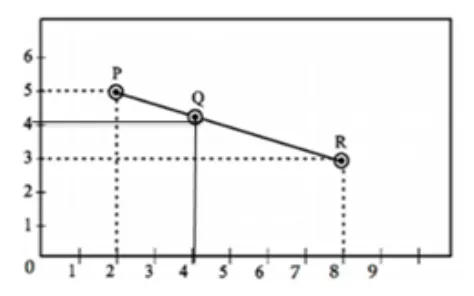
A group of class X students goes to picnic during winter holidays. The position of three friends Aman, Kirti and Chahat are shown by the points P, Q and R.
Original CBSE case illustration.
Describe the figure
The diagram places P at (2,5), Q at (4,4) and R at (8,3). These coordinates are also written explicitly in the accessible alternative in the same sample PDF; it is not counted as another paper appearance.
Appeared in: 2025–26 · Standard · Official Sample
(i) Find the distance between P and R. [1 mark]
Show answer and solution
2√10 units
PR = √[(8 − 2)² + (3 − 5)²].
PR = √40 = 2√10 units.
(ii) Is Q the midpoint of PR? Justify by finding midpoint of PR. [1 mark]
Show answer and solution
No; the midpoint is (5, 4).
Midpoint of PR = (, ) = (5, 4).
Q = (4, 4), so Q is not the midpoint of PR.
(iii)(A) Find the point on x-axis which is equidistant from P and Q. [2 marks]
Show answer and solution
(3/4, 0)
Let T = (x, 0).
TP² = TQ².
(x − 2)² + 5² = (x − 4)² + 4².
−4x + 29 = −8x + 32.
4x = 3, so x = 3/4.
T = (3/4, 0).
OR
(iii)(B) Let S be a point which divides the line joining PQ in ratio 2 : 3. Find the coordinates of S. [2 marks]
Show answer and solution
S(14/5, 23/5)
PS : SQ = 2 : 3.
S = (, ).
S = (14/5, 23/5).
Questions students ask
How do I avoid reversing the section ratio?
Write AP : PB = m : n and keep A as the first endpoint and B as the second. In the section formula, m multiplies B’s coordinates and n multiplies A’s. Check that a point closer to A has the smaller AP distance.
How do I find a point on an axis that is equidistant from two points?
Use T(x,0) on the x-axis or T(0,y) on the y-axis. Set the squared distances from T to the two given points equal, simplify and solve. Substitute the result back to check both distances.
Does being equidistant from two endpoints make a point their midpoint?
No. An equidistant point must also lie on the segment to be its midpoint. In the football case, C is equally far from I and J but differs from their midpoint.
Can a distance be negative?
A distance cannot be negative. A signed difference of two distances can be negative: the flower-plant question asks for BC − CD, not the magnitude of the difference.
Why is only one circle-equation solution accepted for the semicircular park?
The full circle gives y = 13 and y = −7. The original diagram shows the park below its diameter y = 3, so the marked point C is (12,−7). The other point is on the unpictured half of the circle.
How do I use a map’s scale?
Calculate the distance in coordinate-grid units first, then multiply by the stated scale. The GPS sample uses approximately 150 km per grid interval. The other cases retain units unless their source states a physical scale.
Can I use the area formula for a triangle from coordinates?
The coordinate-based triangle-area formula is not listed in CBSE’s 2026–27 Class 10 Coordinate Geometry syllabus, which specifies distance and internal-section formulas. These solutions use those methods and elementary geometry. The older tessellation case uses the ordinary trapezium-area formula.
Should I solve both OR alternatives in the examination?
Answer one alternative where an OR is printed, following the marks beside that part. Both alternatives are solved here for practice.
Both OR alternatives are listed. Answer one where an OR is given in the examination.
How to approach a case study
Read the passage and define the unknown with its units.
Read the axes, scale and point labels; record the given coordinates in order.
Choose distance, midpoint or section formula. State the endpoint order and ratio, substitute with brackets around negatives, then simplify one step per line.
Check the point’s location or the required geometry, then give a clear answer with the stated units.
About these questions and solutions
Selected CBSE case studies, with exact repeats merged and original passages, images, marks and OR choices retained.
Solutions prepared by Team TutorVertex, using NCERT-style working and CBSE marking-scheme checks; source discrepancies are explained beside the affected answers.
Official sources — View papers and marking schemesCase 1 sources