A Triangles case study asks you to match corresponding vertices, justify similarity and use the correct side ratio. These 6 selected cases cover similarity, proportional sides and shadows. Try each part before opening its solution.
6 distinct cases · 11 board-paper appearances + 1 official-sample appearance Solutions prepared by Team TutorVertex Verified by Siddharth Sir · 26 October 2026
Key results
Similar triangles have equal corresponding angles and proportional corresponding sides. Write their names in matching order.
AA: two pairs of corresponding angles are equal. SSS: all corresponding sides are proportional. SAS: two pairs of sides are proportional and their included angles are equal.
For △ABC ∼ △DEF: = = .
A line parallel to one side of a triangle divides the other two sides in the same ratio (BPT). Its converse establishes parallel lines.
If D lies on AB and E lies on AC, then AB = AD + DB and AC = AE + EC. Distinguish a whole side from one segment.
Congruent triangles are similar with scale factor 1. Similar triangles need not be congruent.
Similar triangles have the same ratio of perimeters as their corresponding sides.
Find a case study
Showing all 6 cases
No cases match these filters. Change a selection or use Reset to show all cases.
Basic4 marks
Case 1. Similar figures and congruent triangles
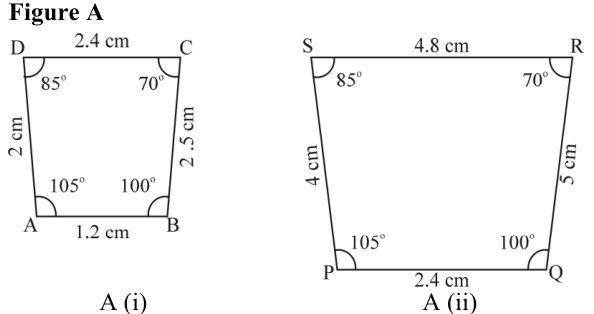
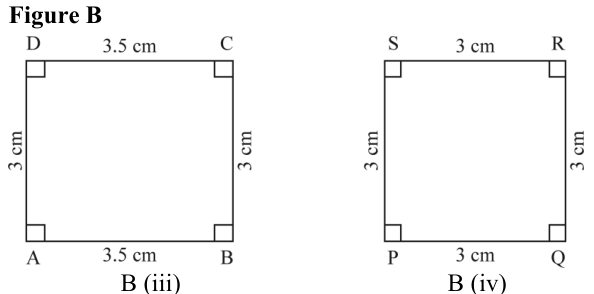
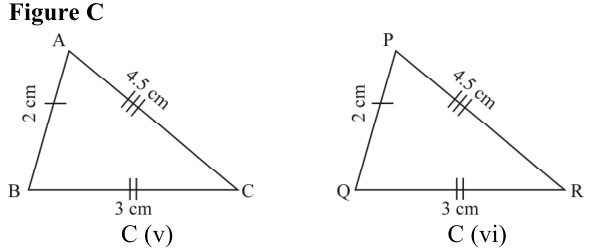
Observe the figures given below carefully and answer the questions:
Original CBSE case illustration.Original CBSE case illustration.Original CBSE case illustration.
Describe the figure
Figure A has two quadrilaterals: AB = 1.2 cm, BC = 2.5 cm, CD = 2.4 cm and DA = 2 cm; PQ = 2.4 cm, QR = 5 cm, RS = 4.8 cm and SP = 4 cm. Their corresponding angles are 105°, 100°, 70° and 85°. Figure B has a 3.5 cm by 3 cm rectangle and a 3 cm square. Figure C has two triangles with corresponding side lengths 2 cm, 3 cm and 4.5 cm.
Appeared in: 2023 · Basic · Main
(i) Name the figure(s) wherein two figures are similar. [1 mark]
Show answer and solution
Figures A and C
In Figure A, all corresponding angles are equal.
The corresponding side ratios are 1.2/2.4 = 2.5/5 = 2.4/4.8 = 2/4 = 1/2.
Hence, the quadrilaterals in Figure A are similar.
The corresponding sides of the triangles in Figure C are equal, so the triangles are congruent and therefore similar.
(ii) Name the figure(s) wherein the figures are congruent. [1 mark]
Show answer and solution
Figure C
In Figure C, the corresponding sides of the two triangles are 2 cm, 3 cm and 4.5 cm.
The triangles are congruent by SSS congruence.
(iii)(a) Prove that congruent triangles are also similar but not the converse. [2 marks]
Show answer and solution
Congruent triangles are similar; similar triangles need not be congruent.
Congruent triangles have equal corresponding angles.
Therefore, they are similar by the AA similarity criterion.
Consider two equilateral triangles of sides 2 cm and 4 cm.
Their corresponding angles are all 60°, so they are similar.
Their corresponding sides are unequal, so they are not congruent.
OR
(iii)(b) What more is least needed for two similar triangles to be congruent? [2 marks]
Show answer and solution
One pair of corresponding sides must be equal.
Similar triangles have all corresponding sides in the same ratio.
If one pair of corresponding sides is equal, this common ratio is 1.
Therefore, all corresponding sides are equal.
The triangles are congruent by SSS congruence.
Basic4 marks
Case 2. A folding table
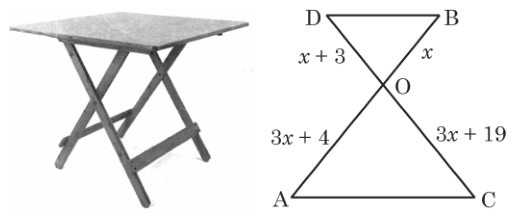
In the figure given below, a folding table is shown:
Original CBSE case illustration.
Describe the figure
The photograph shows a folding table. In the line diagram, AC is parallel to BD. Legs AB and CD cross at O. In the printed orientation, D and B are above O; A and C are below O.
The legs of the table are represented by line segments AB and CD intersecting at O. Join AC and BD.
Considering table top is parallel to the ground, and OB = x, OD = x + 3, OC = 3x + 19 and OA = 3x + 4, answer the following questions:
Appeared in: 2024 · Basic · Main
(i) Prove that △OAC is similar to △OBD. [1 mark]
Show answer and solution
△OAC ∼ △OBD
AC ∥ BD.
∠OAC = ∠OBD, since they are alternate interior angles.
∠AOC = ∠BOD, since they are vertically opposite angles.
Therefore, △OAC ∼ △OBD by AA similarity.
(ii) Prove that = . [1 mark]
Show answer and solution
OA/AC = OB/BD
Since △OAC ∼ △OBD, corresponding sides are proportional.
= .
OA × BD = OB × AC.
Therefore, = .
(iii)(a) Observe the figure and find the value of x. Hence, find the length of OC. [2 marks]
Show answer and solution
x = 2; OC = 25
By similarity, = .
= .
(3x + 4)(x + 3) = x(3x + 19).
3x² + 13x + 12 = 3x² + 19x.
6x = 12.
x = 2.
OC = 3(2) + 19 = 25.
OR
(iii)(b) Observe the figure and find . [2 marks]
Show answer and solution
BD/AC = 1/5
By similarity, = .
= .
(3x + 4)(x + 3) = x(3x + 19).
6x = 12, so x = 2.
OA = 3(2) + 4 = 10 and OB = 2.
= = = .
Basic4 marks · Accessible paper
Case 3. A tower and two house shadows
Raghu is trying to find the height of a tower near his house, using the properties of similar triangles. The height of Raghu’s house is 12 m. When Raghu’s house casts a shadow 6 m long on the ground, the tower casts a shadow 40 m long on the ground. At the same time, the house of his friend Ramesh casts 12 m long shadow on the ground.
Based on the above information, answer the following:
Appeared in: 2025 · Basic · Main
(i) What is the height of the tower? [1 mark]
Show answer and solution
80 m
The vertical objects and their shadows form right triangles.
At the same time, the Sun’s rays make equal angles with level ground, so the triangles are similar by AA.
Let the height of the tower be h metres.
= .
h = 40 × 2 = 80 m.
(ii) What is the height of Ramesh’s house? [1 mark]
Show answer and solution
24 m
Let the height of Ramesh’s house be h metres.
The height-to-shadow ratio is the same for these similar triangles.
= .
h = 24 m.
(iii)(a) When the tower casts a shadow of 60 m long, what will be the length of shadow of Ramesh’s house? [2 marks]
Show answer and solution
18 m
The tower is 80 m high and Ramesh’s house is 24 m high.
Let the required shadow length be s metres.
= .
s = = 18 m.
OR
(iii)(b) When the tower casts a shadow of 48 m long, what will be the length of shadow of Raghu’s house? [2 marks]
Show answer and solution
7.2 m
The tower is 80 m high and Raghu’s house is 12 m high.
Let the required shadow length be s metres.
= .
s = = 7.2 m.
Standard4 marks · Accessible paper
Case 4. A triangular school road sign
On a road leading to a school, there is a triangle (ABC) shaped board on the road. It is divided into two parts by a line DE, which is parallel to BC. On the upper part, it is written ‘DRIVE SLOW’ and on the lower part it is written, ‘SCHOOL AHEAD’.
Based on the above information, answer the following questions:
Appeared in: 2025 · Standard · Supplementary
(i) If AD = 3 cm, BD = 5 cm and AE = 4 cm, then find the length of AC. [1 mark]
Show answer and solution
AC = 32/3 cm
AB = AD + DB = 3 + 5 = 8 cm.
Since DE ∥ BC, △ADE ∼ △ABC by AA similarity.
= .
= .
AC = cm.
(ii) If ∠ADE = 50° and ∠DAE = 45°, then find ∠ACB. [1 mark]
Show answer and solution
85°
In △ADE, ∠AED = 180° − 50° − 45° = 85°.
Since DE ∥ BC, ∠ACB = ∠AED by corresponding angles.
Therefore, ∠ACB = 85°.
(iii)(a) If AD = 4 cm and BD = 6 cm, then find . [2 marks]
Show answer and solution
DE/BC = 2/5
AB = AD + DB = 4 + 6 = 10 cm.
Since △ADE ∼ △ABC, = .
= = .
OR
(iii)(b) If AD = 3 cm, BD = 6 cm and AE = 5 cm, then find . [2 marks]
Show answer and solution
AB/AC = 3/5
By the Basic Proportionality Theorem, = .
= .
EC = 10 cm.
AB = 3 + 6 = 9 cm.
AC = 5 + 10 = 15 cm.
= = .
Standard4 marks
Case 5. A disc on a carom board
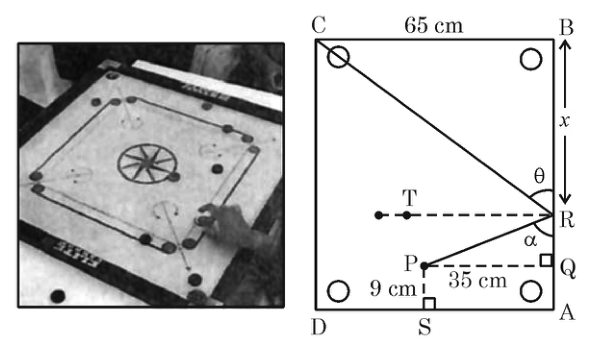
Carom board is a very popular game. The board is a square of side length 65 cm. It has circular pockets in each corner. Ansh strikes a disc, kept at position P with a striker. The disc, hits the boundary of the board at R and goes straight to pocket at corner C. It is given that PS = 9 cm, PQ = 35 cm, BR = x, ∠PRQ = α and ∠CRB = θ.
Original CBSE case illustration.
Describe the figure
ABCD is a square of side 65 cm, with C at the top left, B at the top right, A at the bottom right and D at the bottom left. R and Q lie on AB, with R above Q. PQ = 35 cm is horizontal and PS = 9 cm reaches the bottom edge. BR = x. The disc travels from P to R to C. RT is perpendicular to AB; α = ∠PRQ and θ = ∠CRB.
Based on the above information, answer the following questions:
Appeared in: 2026 · Standard · Main
(i) Using law of reflection i.e. ∠PRT = ∠CRT, prove that θ = α. [1 mark]
Show answer and solution
θ = α
RT is perpendicular to AB.
α + ∠PRT = 90°.
θ + ∠CRT = 90°.
Given ∠PRT = ∠CRT, their complementary angles are equal.
Therefore, θ = α.
(ii) Prove that △PQR ∼ △CBR given that PQ is perpendicular to AB. [1 mark]
Show answer and solution
△PQR ∼ △CBR
∠PQR = ∠CBR = 90°.
From part (i), ∠PRQ = ∠CRB.
Therefore, △PQR ∼ △CBR by AA similarity.
(iii)(a) Find the value of x using similarity of triangles. [2 marks]
Show answer and solution
x = 36.4 cm
AQ = PS = 9 cm.
QR = AB − BR − AQ = 65 − x − 9 = 56 − x cm.
Since △PQR ∼ △CBR, = .
= .
35x = 65(56 − x).
100x = 3640.
x = 36.4 cm.
OR
(iii)(b) If = , then find the value of x. [2 marks]
Show answer and solution
x = 36.4 cm
QR = 65 − x − 9 = 56 − x cm.
Area △PQR = (1/2) × 35 × (56 − x).
Area △CBR = (1/2) × 65 × x.
Using the area relation given in the question, = .
= .
65(56 − x) = 35x.
100x = 3640.
x = 36.4 cm.
Standard4 marks
Case 6. A triangular cabinet and its shelf
Original CBSE case illustration.Original CBSE case illustration.
Describe the figure
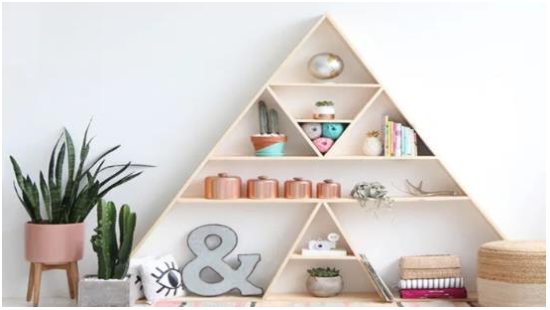
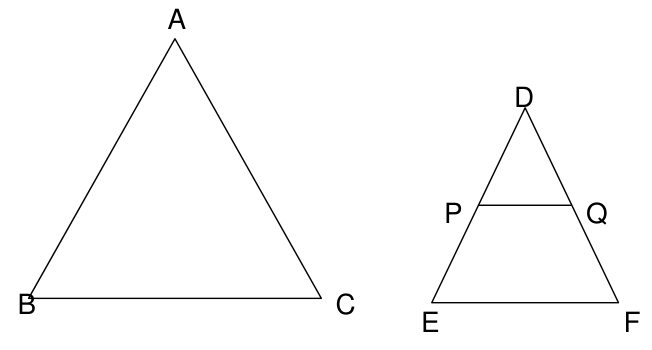
The photograph shows triangular shelving. The accompanying diagram has a large triangle ABC and a smaller triangle DEF. P lies on DE, Q lies on DF, and PQ is parallel to EF. The original diagram does not show medians AM and DN.
Triangle is a very popular shape used in interior designing. The picture given above shows a cabinet designed by a famous interior designer.
Here the largest triangle is represented by △ABC and smallest one with shelf is represented by △DEF. PQ is parallel to EF.
On the basis of the above information answer the following questions.
Appeared in: 2024–25 · Standard · Official Sample
(i) Show that △DPQ ∼ △DEF. [1 mark]
Show answer and solution
△DPQ ∼ △DEF
PQ ∥ EF.
∠DPQ = ∠DEF, by corresponding angles.
∠PDQ = ∠EDF, the common angle at D.
Therefore, △DPQ ∼ △DEF by AA similarity.
(ii) If DP = 50 cm and PE = 70 cm then find . [1 mark]
Show answer and solution
PQ/EF = 5/12
DE = DP + PE = 50 + 70 = 120 cm.
Since △DPQ ∼ △DEF, = .
= = .
(iii)(A) If 2AB = 5DE and △ABC ∼ △DEF then show that is constant. [2 marks]
Show answer and solution
Perimeter ratio = 5/2
2AB = 5DE gives = .
Since △ABC ∼ △DEF, = = = .
AB = (5/2)DE, BC = (5/2)EF and AC = (5/2)DF.
= .
Therefore, the ratio of the perimeters is the constant 5/2.
OR
(iii)(B) If AM and DN are medians of triangles ABC and DEF respectively then prove that △ABM ∼ △DEN. [2 marks]
Show answer and solution
△ABM ∼ △DEN, using the parent-triangle similarity intended by the official scheme.
The printed OR does not repeat the condition △ABC ∼ △DEF. The official marking scheme uses this similarity; medians alone would not prove the claim.
Using △ABC ∼ △DEF, = and ∠ABC = ∠DEF.
Since AM and DN are medians, BM = BC/2 and EN = EF/2.
= = .
As M lies on BC and N lies on EF, ∠ABM = ∠DEN.
Therefore, △ABM ∼ △DEN by SAS similarity.
Solution construction: AM and DN are medians; not to scale.
Questions students ask
How do I choose the correct corresponding sides?
Read the order of the similar triangles. In △PQR ∼ △CBR, P matches C, Q matches B and R matches R; therefore PQ/CB = QR/BR = PR/CR. Keep this order in every ratio.
Can two similar triangles be made congruent with one extra condition?
Yes. One pair of corresponding sides must be equal. Their common scale factor then becomes 1, so all corresponding sides are equal and SSS congruence applies.
When should I use BPT rather than a whole-side similarity ratio?
BPT compares the segments into which a parallel line divides two sides, such as AD/DB = AE/EC. Similarity compares matching sides of two triangles, such as AD/AB = AE/AC. Both work when used with the correct segments.
Why must the shadows be measured at the same time?
At the same time, parallel Sun rays make the same angle with level ground. Vertical objects and their shadows then form similar right triangles, so height/shadow has the same value for each object at that time.
Do the lengths in one subpart carry over to the next?
Use each subpart’s stated measurements. The road-sign parts give different values of AD, BD and AE; do not combine measurements from separate parts.
Do medians alone make two triangles similar?
No. In the cabinet OR, the official marking scheme uses similarity of the parent triangles ABC and DEF, although that condition is not repeated in the OR sentence. With that assumption, proportional half-bases and the included equal angle give SAS similarity.
Should I solve both OR alternatives in the examination?
Answer one alternative where an OR is printed, following its marks. Both alternatives are solved here for practice.