Arithmetic Progressions: Case Study PYQs with Answers
An Arithmetic Progressions case study asks you to identify the first term and common difference, then decide whether the question needs a term or a total. Practise 35 selected CBSE cases on savings, instalments, production, seating and patterns. Try each part before opening its solution.
35 distinct cases · 64 board-paper appearances + 7 official-sample appearances Solutions prepared by Team TutorVertex Verified by Siddharth Sir · 26 October 2026
Key results
An AP has a constant difference: d = a₂ − a₁ = a₃ − a₂.
nth term: aₙ = a + (n − 1)d.
Sum of the first n terms: Sₙ = [2a + (n − 1)d] = (a + l).
a is the first term; d the common difference; n the number or position of a term; aₙ the nth term; Sₙ the sum of the first n terms; l the last term.
Use aₙ for one instalment, row or year. Use Sₙ for a total up to that point.
The kth term from the end is l − (k − 1)d.
Count increases carefully: term n follows n − 1 increases. Convert all quantities to the same units.
Find a case study
Showing all 35 cases
No cases match these filters. Change a selection or use Reset to show all cases.
Basic4 marks
Case 1. Stitches in a reused-clothes rug
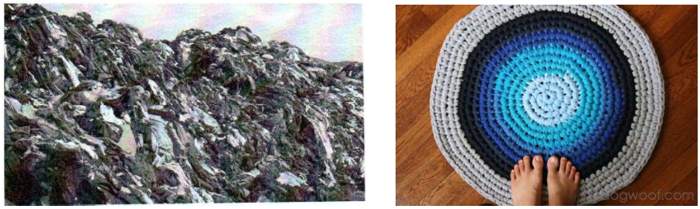
Do you know old clothes which are thrown as waste not only fill the landfill site but also produce very harmful greenhouse gas. So, it is very important that we reuse old clothes in whatever way we can.
Original CBSE case illustration.
Describe the figure
Discarded clothes and a circular rug made from reused T-shirt yarn.
The picture given below on the right, shows a footmat (rug) made out of old t-shirts yarn. Observing the picture, you will notice that a number of stitches in circular rows are making a pattern: 6, 12, 18, 24, …
Appeared in: 2022 · Basic · Main
(a) Check whether the given pattern forms an AP. If yes, find the common difference and the next term of the AP. [2 marks]
Show answer and solution
Yes; d = 6; next term = 30.
12 − 6 = 18 − 12 = 24 − 18 = 6.
Equal consecutive differences show that the pattern forms an AP.
d = 6.
Next term = 24 + 6 = 30.
(b) Write the nth term of the AP. Hence, find the number of stitches in the 10th circular row. [2 marks]
Show answer and solution
aₙ = 6n; 60 stitches in the 10th row.
Here, a = 6 and d = 6.
aₙ = a + (n − 1)d.
aₙ = 6 + (n − 1)6 = 6n.
a₁₀ = 6 × 10 = 60 stitches.
Standard4 marks
Case 2. Matchstick triangles
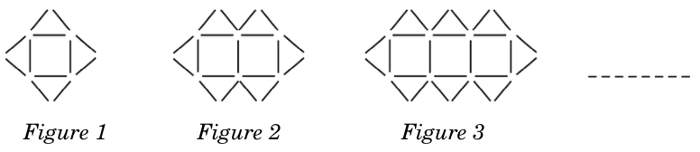
In Mathematics, relations can be expressed in various ways. The matchstick patterns are based on linear relations. Different strategies can be used to calculate the number of matchsticks used in different figures. One such pattern is shown below. Observe the pattern and answer the following questions using Arithmetic Progression:
Original CBSE case illustration.
Describe the figure
Figure 1 has 4 triangles and 12 matchsticks; Figure 2 has 6 triangles and 19 matchsticks; Figure 3 has 8 triangles and 26 matchsticks. Shared sides are counted once.
Appeared in: 2022 · Standard · Main
(a) Write the AP for the number of triangles used in the figures. Also, write the nth term of this AP. [2 marks]
Show answer and solution
4, 6, 8, …; aₙ = 2n + 2.
The figures contain 4, 6 and 8 triangles.
a = 4 and d = 2.
aₙ = a + (n − 1)d.
aₙ = 4 + 2(n − 1) = 2n + 2.
(b) Which figure has 61 matchsticks? [2 marks]
Show answer and solution
Figure 8.
Matchstick counts are 12, 19, 26, …
a = 12 and d = 7.
61 = 12 + 7(n − 1).
7(n − 1) = 49.
n = 8.
Standard4 marks · Accessible paper
Case 3. Aman’s car-loan instalments
While buying an expensive item like a house or a car, it becomes easier for a middle-class person to take a loan from a bank and then repay the loan along with interest in easy instalments. Aman buys a car by taking a loan of ₹2,36,000 from the bank and starts repaying the loan in monthly instalments. He pays ₹2,000 as the first instalment and then increases the instalment by ₹500 every month.
Appeared in: 2022 · Standard · Main
(a) Find the amount he pays in the 25th instalment. [2 marks]
Show answer and solution
₹14,000.
Here, a = 2000, d = 500 and n = 25.
aₙ = a + (n − 1)d.
aₙ = 2000 + (25 − 1) × (500).
= 14000 rupees.
(b) Find the total amount paid by him in first 25 instalments. [2 marks]
Show answer and solution
₹2,00,000.
Here, a = 2000, d = 500 and n = 25.
Sₙ = [2a + (n − 1)d].
Sₙ = [2 × 2000 + (25 − 1) × (500)].
= 200000 rupees.
Basic4 marks · Accessible paper
Case 4. Car production in the fourth and seventh years
A factory is manufacturing cars and is increasing its production by a fixed number every year. The factory produced 80,000 cars in the fourth year and 1,10,000 cars in the seventh year.
Appeared in: 2023 · Basic · Main
(a) Taking ‘a’ as the number of cars produced in the first year and ‘d’ the fixed number by which the production is increasing every year, write a relation between ‘a’ and ‘d’ for the fourth year. [1 mark]
Show answer and solution
a + 3d = 80,000.
aₙ = a + (n − 1)d.
a₄ = a + 3d = 80,000.
(b) Write the relation between ‘a’ and ‘d’ for the seventh year. [1 mark]
Show answer and solution
a + 6d = 1,10,000.
a₇ = a + (7 − 1)d.
a + 6d = 1,10,000.
(c) Solving the above two equations, find ‘a’. [2 marks]
Show answer and solution
50,000 cars.
Let a be first-year production and d the annual increase.
a + 3d = 80000.
a + 6d = 110000.
Subtracting, 3d = 30000.
d = 10000.
a = 80000 − 3 × 10000 = 50000.
OR
(c) Solving the above two equations, find ‘d’. [2 marks]
Show answer and solution
10,000 cars per year.
a + 3d = 80,000.
a + 6d = 1,10,000.
Subtracting, 3d = 30,000.
d = 10,000.
Standard4 marks · Accessible paper
Case 5. Ravindra’s car loan
Ravindra took a loan of ₹3,45,000 from a bank to buy a car, and decided to pay back by ₹2,000 at the end of the first month and then increased the instalment amount by ₹200 each month.
Appeared in: 2023 · Standard · Main
(a) Find the amount paid by him in 10th instalment. [1 mark]
Show answer and solution
₹3,800.
Here, a = 2000, d = 200 and n = 10.
aₙ = a + (n − 1)d.
aₙ = 2000 + (10 − 1) × (200).
= 3800 rupees.
(b) Find the total amount paid by him in first 10 instalments. [1 mark]
Show answer and solution
₹29,000.
Here, a = 2000, d = 200 and n = 10.
Sₙ = [2a + (n − 1)d].
Sₙ = [2 × 2000 + (10 − 1) × (200)].
= 29000 rupees.
(c) In how many instalments would he clear his total loan? [2 marks]
Show answer and solution
50 instalments.
Here, a = 2,000, d = 200 and Sₙ = 3,45,000.
Sₙ = [2a + (n − 1)d].
3,45,000 = [4,000 + 200(n − 1)].
n² + 19n − 3,450 = 0.
(n − 50)(n + 69) = 0.
n = 50; reject −69 because a count must be positive.
OR
(c) What amount will he be able to clear in his first 45 instalments? [2 marks]
Show answer and solution
₹2,88,000.
Here, a = 2000, d = 200 and n = 45.
Sₙ = [2a + (n − 1)d].
Sₙ = [2 × 2000 + (45 − 1) × (200)].
= 288000 rupees.
Basic4 marks
Case 6. Squares and triangles in a fabric pattern
A fashion designer is designing a fabric pattern. In each row, there are some shaded squares and unshaded triangles.
Original CBSE case illustration.
Describe the figure
Fabric pattern with shaded squares and unshaded triangles arranged in successive rows.
Appeared in: 2023 · Basic · Supplementary
(i) Identify A.P. for the number of squares in each row. [1 mark]
Show answer and solution
1, 3, 5, 7, …
Count shaded squares row-wise: 1, 3, 5, 7, …
a = 1 and d = 2.
(ii) Identify A.P. for the number of triangles in each row. [1 mark]
(iii)(a) If each shaded square is of side 2 cm, then find the shaded area when 15 rows have been designed. [2 marks]
Show answer and solution
900 cm².
For squares, a = 1 and d = 2.
S₁₅ = [2 × 1 + 14 × 2] = 225 squares.
Area of one square = 2² = 4 cm².
Shaded area = 225 × 4 = 900 cm².
OR
(iii)(b) Write a formula for finding total number of triangles in ‘n’ number of rows. Hence, find S₁₀. [2 marks]
Show answer and solution
Sₙ = 2n²; S₁₀ = 200 triangles.
For triangles, a = 2 and d = 4.
Sₙ = [2a + (n − 1)d].
Sₙ = [4 + 4(n − 1)] = 2n².
S₁₀ = 2 × 10² = 200 triangles.
Basic4 marks · Accessible paper
Case 7. Nikhil’s monthly savings
Nikhil started saving money for his new project. He started saving ₹240 in the first month, ₹300 in the second month, ₹360 in the third month and so on. He continues to save in this manner for quite some time.
Appeared in: 2023 · Basic · Supplementary
(i) Are the numbers representing his savings in AP? If so, write the first term (a) and the common difference (d). [1 mark]
Show answer and solution
Yes; a = ₹240 and d = ₹60.
300 − 240 = 360 − 300 = 60.
Equal consecutive differences show an AP.
a = ₹240 and d = ₹60.
(ii) In which month will he save ₹660? [1 mark]
Show answer and solution
The 8th month.
660 = 240 + 60(n − 1).
n − 1 = 7.
n = 8.
(iii)(a) What amount will he save in the 15th month? [2 marks]
Show answer and solution
₹1,080.
Here, a = 240, d = 60 and n = 15.
aₙ = a + (n − 1)d.
aₙ = 240 + (15 − 1) × (60).
= 1080 rupees.
OR
(iii)(b) How much money he will accumulate after 10 months? [2 marks]
Show answer and solution
₹5,100.
Here, a = 240, d = 60 and n = 10.
Sₙ = [2a + (n − 1)d].
Sₙ = [2 × 240 + (10 − 1) × (60)].
= 5100 rupees.
Basic4 marks
Case 8. Akbar’s matchstick squares
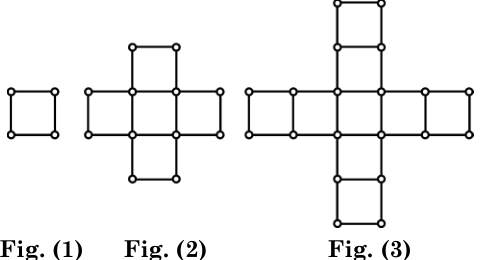
While preparing for a competitive examination, Akbar came across a match-stick pattern based question. The pattern is given below:
Original CBSE case illustration.
Describe the figure
Matchstick figures 1, 2 and 3, with 1, 5 and 9 squares respectively.
Appeared in: 2024 · Basic · Main
(i) Write first term and common difference of the A.P. formed by number of squares in each figure. [1 mark]
Show answer and solution
a = 1 and d = 4.
Square counts are 1, 5, 9, …
a = 1 and d = 5 − 1 = 4.
(ii) Write first term and common difference of the A.P. formed by number of sticks used in each figure. [1 mark]
Show answer and solution
a = 4 and d = 12.
Stick counts are 4, 16, 28, …
a = 4 and d = 16 − 4 = 12.
(iii)(a) How many squares are there in Fig. (10)? Also, write the number of sticks used in Fig. (10). [2 marks]
Show answer and solution
37 squares and 112 matchsticks.
aₙ = a + (n − 1)d.
Squares = 1 + 9 × 4 = 37.
Sticks = 4 + 9 × 12 = 112.
OR
(iii)(b) If 88 sticks are used to make mth figure (Fig. (m)), find the value of m. How many squares are formed in this figure? [2 marks]
Show answer and solution
m = 8; 29 squares.
88 = 4 + (m − 1)12.
m = 8.
Squares = 1 + 7 × 4 = 29.
Standard4 marks
Case 9. Treasure-hunt clues
Treasure Hunt is an exciting and adventurous game where participants follow a series of clues/numbers/maps to discover hidden treasures. Players engage in a thrilling quest, solving puzzles and riddles to unveil the location of the coveted prize. While playing a treasure hunt game, some clues (numbers) are hidden in various spots collectively forming an A.P. If the number on the nth spot is 20 + 4n, then answer the following questions to help the players in spotting the clues :
Original CBSE case illustration.
Describe the figure
Colourful Treasure Hunt illustration printed with the case.
Appeared in: 2024 · Standard · Main
(i) Which number is on first spot? [1 mark]
Show answer and solution
24.
Given aₙ = 20 + 4n.
a₁ = 20 + 4 × 1 = 24.
(ii)(a) Which spot is numbered as 112? [2 marks]
Show answer and solution
The 23rd spot.
112 = 20 + 4n.
4n = 92.
n = 23.
OR
(ii)(b) What is the sum of all the numbers on the first 10 spots? [2 marks]
Show answer and solution
420.
a = 24 and d = 4.
S₁₀ = [2 × 24 + 9 × 4].
= 5 × 84 = 420.
(iii) Which number is on the (n − 2)th spot? [1 mark]
Show answer and solution
4n + 12 (n ≥ 3).
Replace the term index by n − 2.
aₙ₋₂ = 20 + 4(n − 2).
aₙ₋₂ = 4n + 12.
A spot index is positive, so n ≥ 3.
Standard4 marks · Accessible paper
Case 10. Road-roller production: 800 and 1,130
A road roller is a compactor-type engineering vehicle, used to compact soil, gravel, concrete, etc, in the construction of roads and foundations. They are also used at landfills or in agriculture. A company started making road rollers 10 years ago and increased its production uniformly by a fixed number every year. The company produces 800 rollers in the 6th year and 1130 rollers in the 9th year.
Appeared in: 2024 · Standard · Main
(i) What is the company’s production in the first year? [1 mark]
Show answer and solution
250 road rollers.
Let a be first-year production and d the annual increase.
a + 5d = 800.
a + 8d = 1130.
Subtracting, 3d = 330.
d = 110.
a = 800 − 5 × 110 = 250.
(ii) What was the increase in the company’s production every year? [1 mark]
Show answer and solution
110 road rollers per year.
a + 5d = 800.
a + 8d = 1,130.
3d = 330.
d = 110.
(iii)(a) What was the company’s production in the 8th year? [2 marks]
Show answer and solution
1,020 road rollers.
Here, a = 250, d = 110 and n = 8.
aₙ = a + (n − 1)d.
aₙ = 250 + (8 − 1) × (110).
= 1020 road rollers.
OR
(iii)(b) What was the company’s total production in the first 6 years? [2 marks]
Show answer and solution
3,150 road rollers.
Here, a = 250, d = 110 and n = 6.
Sₙ = [2a + (n − 1)d].
Sₙ = [2 × 250 + (6 − 1) × (110)].
= 3150 road rollers.
Basic4 marks
Case 11. Neha’s marathon practice
The marathon is a long-distance foot race with a distance of 42.195 km, usually run as a road race, but the distance can be covered on trail routes. The marathon can be completed by running or with a run/walk strategy. The marathon was one of the original modern Olympic events in 1896.
Original CBSE case illustration.
Describe the figure
Illustration of runners accompanying the marathon passage.
Neha, a student of class X, wishes to participate in a marathon. She decided to begin her practice by gradually increasing her running distance. In the first week, she decided to run 3 km each day and increase the distance by 2 km each week, i.e., in the second week she would run 5 km each day, in the third week she would run 7 km each day and so on.
Appeared in: 2024 · Basic · Supplementary
(i) What distance will Neha cover each day of the 8th week of her practice? [1 mark]
Show answer and solution
17 km each day.
Here, a = 3, d = 2 and n = 8.
aₙ = a + (n − 1)d.
aₙ = 3 + (8 − 1) × (2).
= 17 km.
(ii) In which week would she be able to run for 45 km each day? [1 mark]
Show answer and solution
The 22nd week.
45 = 3 + 2(n − 1).
n − 1 = 21.
n = 22.
(iii)(a) What is the total distance covered by Neha after 11 weeks, if she practised for 5 days in each week? [2 marks]
Show answer and solution
715 km.
The daily distances across weeks have a = 3 and d = 2.
S₁₁ = [2 × 3 + 10 × 2] = 143 km.
This counts one practice day from each week.
Total for five days each week = 5 × 143 = 715 km.
OR
(iii)(b) Had she increased the distance by 3 km each week instead of 2 km each week, in how many weeks would she have trained herself to run for 42 km per day? [2 marks]
Show answer and solution
14 weeks.
Now a = 3 and d = 3.
42 = 3 + (n − 1)3.
n − 1 = 13.
n = 14.
Standard4 marks · Accessible paper
Case 12. Hari’s 200 m race
Hari wants to participate in a 200 m race. He can currently run that distance in 51 seconds, and with each day of practice, he hopes to take 2 seconds less than the previous day. He wants to do it in 31 seconds.
Appeared in: 2024 · Standard · Supplementary
(i) Write the A.P. which represents the above situation. [1 mark]
Show answer and solution
51, 49, 47, …, 31 seconds.
The starting time is 51 seconds.
Subtract 2 seconds for each successive day.
The AP is 51, 49, 47, …, 31.
(ii) Find the minimum number of days he needs to practice to achieve the goal. [1 mark]
Show answer and solution
Day 11 under the official scheme’s indexing.
a = 51 and d = −2.
31 = 51 + (n − 1)(−2).
n − 1 = 10.
n = 11.
The scheme counts 51 seconds as Day 1: Day 11 follows 10 daily improvements.
(iii)(a) Find the expression for the nth term of the A.P. [2 marks]
Show answer and solution
aₙ = 53 − 2n.
aₙ = a + (n − 1)d.
aₙ = 51 − 2(n − 1).
aₙ = 53 − 2n.
OR
(iii)(b) If he wants to do it in 21 seconds, how many minimum days will he take? [2 marks]
Show answer and solution
Day 16 under the same indexing.
21 = 51 − 2(n − 1).
2(n − 1) = 30.
n = 16.
The 16th listed day follows 15 daily improvements.
Basic4 marks
Case 13. A loan repaid in increasing instalments
A woman borrowed ₹10,00,000 from her friend and promised to return the borrowed money in monthly instalments beginning from the next month. After one month, she returned ₹10,000, the next month she returned ₹15,000, the third month she returned ₹20,000 and so on, thereby increasing the monthly instalment uniformly.
Original CBSE case illustration.
Describe the figure
The three original illustrations: a woman borrowing money, a hand holding currency and a calendar.
Appeared in: 2025 · Basic · Main
(i) Find the amount of instalment paid in the tenth month. [1 mark]
Show answer and solution
₹55,000.
Here, a = 10000, d = 5000 and n = 10.
aₙ = a + (n − 1)d.
aₙ = 10000 + (10 − 1) × (5000).
= 55000 rupees.
(ii) In which instalment did she pay ₹40,000? [1 mark]
Show answer and solution
The 7th instalment.
40,000 = 10,000 + (n − 1)5,000.
n − 1 = 6.
n = 7.
(iii)(a) If she returned ₹11,50,000 in all, how many instalments did she pay? [2 marks]
Show answer and solution
20 instalments.
11,50,000 = [20,000 + (n − 1)5,000].
n² + 3n − 460 = 0.
(n − 20)(n + 23) = 0.
n = 20; reject −23.
OR
(iii)(b) By which instalment has she returned a total amount of ₹3,25,000? [2 marks]
Show answer and solution
The 10th instalment.
3,25,000 = [20,000 + (n − 1)5,000].
n² + 3n − 130 = 0.
(n − 10)(n + 13) = 0.
n = 10; reject −13.
Basic4 marks
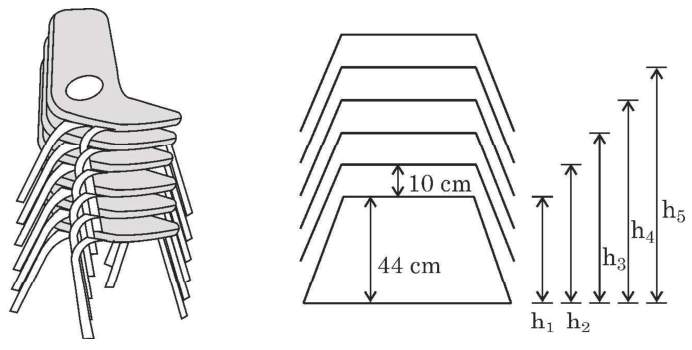
Case 14. Stacking rented chairs
A tent house owner provides furniture on rent. He stacks chairs in his shop to save space.
Original CBSE case illustration.
Describe the figure
Photograph of stacked chairs and the source diagram marking the first seat at 44 cm and the 10 cm gaps.
In the diagram, the height of seat of chair from ground is represented by h₁, h₂, h₃, … . The height of first seat is 44 cm from ground level and gap between every two seats is 10 cm.
Appeared in: 2025 · Basic · Main
(i) Write the values of h₁, h₂, h₃, h₄ and h₅ in this order only. [1 mark]
Show answer and solution
44 cm, 54 cm, 64 cm, 74 cm, 84 cm.
h₁ = 44 cm.
Add 10 cm for each subsequent seat.
h₂ = 54 cm, h₃ = 64 cm, h₄ = 74 cm, h₅ = 84 cm.
(ii) Show that the above values form an A.P. Write its first term and common difference. [1 mark]
Show answer and solution
Yes; a = 44 cm and d = 10 cm.
54 − 44 = 64 − 54 = 74 − 64 = 84 − 74 = 10.
Equal consecutive differences show an AP.
a = 44 cm and d = 10 cm.
(iii)(a) If chairs can be stacked up to the maximum height of 160 cm, then find the maximum number of chairs in a stack. [2 marks]
Show answer and solution
12 chairs in the question’s seat-height model.
hₙ = 44 + (n − 1)10.
44 + (n − 1)10 ≤ 160.
n ≤ 12.6.
The greatest whole-number count is 12.
h₁₂ = 154 cm ≤ 160 cm; h₁₃ = 164 cm > 160 cm.
The marking scheme models stack height using the labelled seat heights.
OR
(iii)(b) Is it possible to stack 15 chairs if maximum height of the stack can not be more than 180 cm? Justify your answer. [2 marks]
Show answer and solution
No; h₁₅ = 184 cm > 180 cm.
h₁₅ = 44 + (15 − 1)10.
h₁₅ = 184 cm.
184 cm exceeds the limit of 180 cm.
Standard4 marks
Case 15. Distances in a charity run
A school is organizing a charity run to raise funds for a local hospital. The run is planned as a series of rounds around a track, with each round being 300 metres. To make the event more challenging and engaging, the organizers decide to increase the distance of each subsequent round by 50 metres. For example, the second round will be 350 metres, the third round will be 400 metres and so on. The total number of rounds planned is 10.
Original CBSE case illustration.
Describe the figure
Colour illustration of runners in a charity event.
Appeared in: 2025 · Standard · Main
(i) Write the fourth, fifth and sixth term of the Arithmetic Progression so formed. [1 mark]
Show answer and solution
450 m, 500 m and 550 m.
Use the stated sequence 300, 350, 400, … metres.
a = 300 and d = 50.
a₄ = 300 + 3 × 50 = 450 m.
a₅ = 300 + 4 × 50 = 500 m.
a₆ = 300 + 5 × 50 = 550 m.
(ii) Determine the distance of the 8th round. [1 mark]
Show answer and solution
650 m.
Here, a = 300, d = 50 and n = 8.
aₙ = a + (n − 1)d.
aₙ = 300 + (8 − 1) × (50).
= 650 m.
(iii)(a) Find the total distance run after completing all 10 rounds. [2 marks]
Show answer and solution
5,250 m.
Here, a = 300, d = 50 and n = 10.
Sₙ = [2a + (n − 1)d].
Sₙ = [2 × 300 + (10 − 1) × (50)].
= 5250 m.
OR
(iii)(b) If a runner completes only the first 6 rounds, what is the total distance run by the runner? [2 marks]
Show answer and solution
2,550 m (corrected arithmetic; scheme prints 2,250 m).
Here, a = 300, d = 50 and n = 6.
Sₙ = [2a + (n − 1)d].
Sₙ = [2 × 300 + (6 − 1) × (50)].
= 2550 m.
Source correction: CBSE 2025 Standard papers 30/1/1 (Q36), 30/1/2 (Q38) and 30/1/3 (Q37) have schemes that print 2,250 m after the same expression; the calculation gives 2,550 m.
The representative scheme file is X_MS_041_Mathematics Standard_30-1-1_2024-25.pdf. All three filenames are recorded under Case 15 sources.
Standard4 marks
Case 16. Poles along a cable-car route
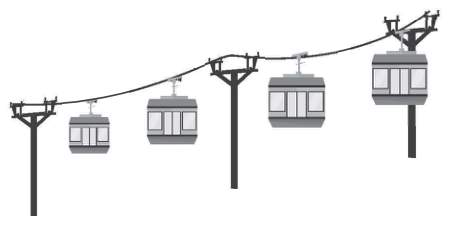
Cable cars at hill stations are one of the major tourist attractions. On a hill station, the length of cable car ride from base point to top most point on the hill is 5000 m. Poles are installed at equal intervals on the way to provide support to the cables on which car moves. The distance of first pole from base point is 200 m and subsequent poles are installed at equal interval of 150 m. Further, the distance of last pole from the top is 300 m.
Original CBSE case illustration.
Describe the figure
Cable car illustration accompanying the hill-station passage.
Appeared in: 2025 · Standard · Main
(i) Find the distance of 10th pole from the base. [1 mark]
Show answer and solution
1,550 m.
Here, a = 200, d = 150 and n = 10.
aₙ = a + (n − 1)d.
aₙ = 200 + (10 − 1) × (150).
= 1550 m.
(ii) Find the distance between 15th pole and 25th pole. [1 mark]
Show answer and solution
1,500 m.
a₂₅ − a₁₅ = (a + 24d) − (a + 14d).
= 10d.
= 10 × 150 = 1,500 m.
(iii)(a) Find the time taken by cable car to reach 15th pole from the top if it is moving at the speed of 5 m/sec and coming from top. [2 marks]
Show answer and solution
480 seconds (8 minutes).
For this part, count poles from the top, as the question states.
The nearest pole is 300 m from the top; consecutive gaps are 150 m.
Distance to 15th pole = 300 + 14 × 150 = 2,400 m.
Time = distance ÷ speed.
Time = = 480 seconds = 8 minutes.
OR
(iii)(b) Find the total number of poles installed along the entire journey. [2 marks]
Show answer and solution
31 poles.
Last pole is 5,000 − 300 = 4,700 m from the base.
4,700 = 200 + (n − 1)150.
n − 1 = 30.
n = 31.
Standard4 marks
Case 17. Unit triangles in ten rows
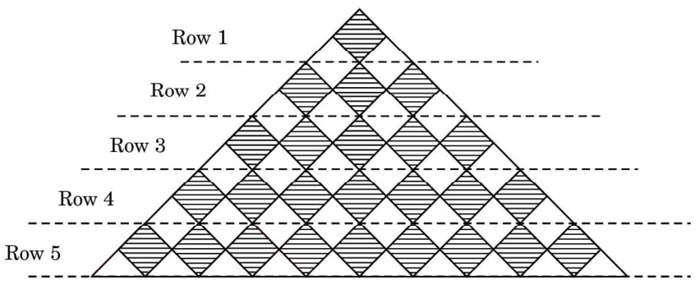
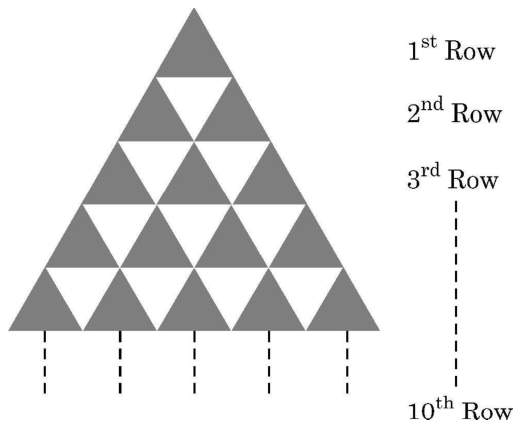
In an equilateral triangle of side 10 cm, equilateral triangles of side 1 cm are formed as shown in the figure below, such that there is one triangle in the first row, three triangles in the second row, five triangles in the third row and so on.
Original CBSE case illustration.
Describe the figure
An equilateral triangle divided into ten rows of unit equilateral triangles, labelled first, second, third and tenth row.
Appeared in: 2025 · Standard · Main
(i) How many triangles will be there in bottom most row? [1 mark]
Show answer and solution
19 triangles.
There are 10 rows from the top.
a = 1 and d = 2.
a₁₀ = 1 + 9 × 2 = 19 triangles.
(ii) How many triangles will be there in fourth row from the bottom? [1 mark]
Show answer and solution
13 triangles.
Fourth row from bottom = row 10 − 4 + 1 = 7 from top.
a₇ = 1 + 6 × 2 = 13 triangles.
(iii)(a) Find the total number of triangles of side 1 cm each till 8th row. [2 marks]
Show answer and solution
64 triangles.
Here, a = 1, d = 2 and n = 8.
Sₙ = [2a + (n − 1)d].
Sₙ = [2 × 1 + (8 − 1) × (2)].
= 64 triangles.
OR
(iii)(b) How many more number of triangles are there from 5th row to 10th row than in first 4 rows? Show working. [2 marks]
Show answer and solution
68 more triangles.
For 1, 3, 5, …, Sₙ = n².
S₁₀ = 100 and S₄ = 16.
Rows 5 to 10 contain 100 − 16 = 84 triangles.
Required difference = 84 − 16 = 68 triangles.
Standard4 marks
Case 18. Eight lanes of a running track
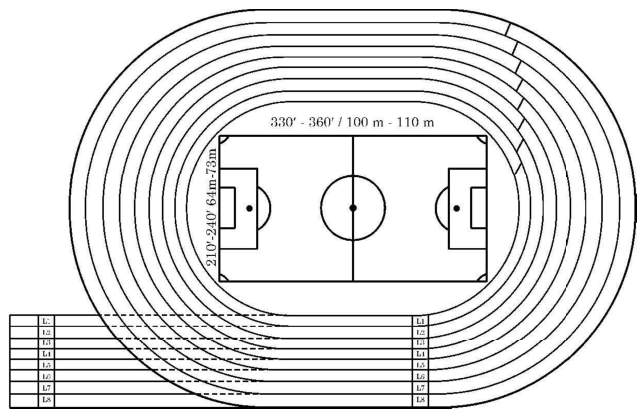
In order to organise Annual Sports Day, a school prepared an eight lane running track with an integrated football field inside the track area as shown below:
Original CBSE case illustration.
Describe the figure
The original eight-lane running-track diagram with an integrated football field and its printed dimensions.
The length of innermost lane of the track is 400 m and each subsequent lane is 7.6 m longer than the preceding lane.
Appeared in: 2025 · Standard · Main
(i) What is the length of the 6th lane? [1 mark]
Show answer and solution
438 m.
Here, a = 400, d = 7.6 and n = 6.
aₙ = a + (n − 1)d.
aₙ = 400 + (6 − 1) × (7.6).
= 438 m.
(ii) How long is the 8th lane than that of 4th lane? [1 mark]
Show answer and solution
30.4 m longer.
a₈ − a₄ = (a + 7d) − (a + 3d).
= 4d.
= 4 × 7.6 = 30.4 m.
(iii)(a) While practicing for a race, a student took one round each in first six lanes. Find the total distance covered by the student. [2 marks]
Show answer and solution
2,514 m.
Here, a = 400, d = 7.6 and n = 6.
Sₙ = [2a + (n − 1)d].
Sₙ = [2 × 400 + (6 − 1) × (7.6)].
= 2514 m.
OR
(iii)(b) A student took one round each in lane 4 to lane 8. Find the total distance covered by the student. [2 marks]
Show answer and solution
2,190 m.
a₄ = 400 + 3 × 7.6 = 422.8 m.
a₈ = 400 + 7 × 7.6 = 453.2 m.
Number of included lanes = 8 − 4 + 1 = 5.
Sum = (422.8 + 453.2) = 2,190 m.
Basic4 marks
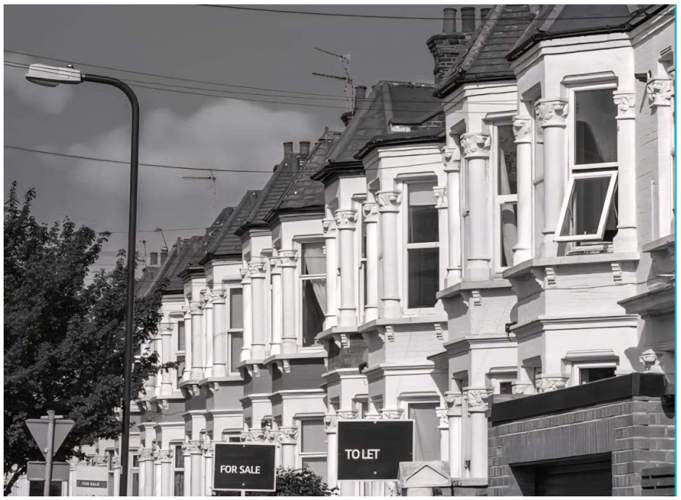
Case 19. Solar panels on Maplewood Avenue
In a charming village, there is a street called ‘Maplewood Avenue’, where the houses are numbered from 1 to 49. A community group has decided to undertake a green renovation project, aiming to install solar panels on the houses. They have a few questions before they begin the project.
Original CBSE case illustration.
Describe the figure
Photograph of houses on a village street.
Appeared in: 2025 · Basic · Supplementary
(i) How many houses are there on ‘Maplewood Avenue’? [1 mark]
Show answer and solution
49 houses.
Count = 49 − 1 + 1 = 49 houses.
(ii) The house numbers follow an Arithmetic Progression. What is the first term of the A.P. and the common difference? [1 mark]
Show answer and solution
a = 1 and d = 1.
The AP is 1, 2, 3, …, 49.
a = 1 and d = 2 − 1 = 1.
(iii)(a) If the group wanted to calculate the sum of all house numbers from 1 to 49, how much would that be? [2 marks]
Show answer and solution
1,225.
Here, a = 1, l = 49 and n = 49.
Sₙ = (a + l).
S₄₉ = (1 + 49) = 1,225.
OR
(iii)(b) What is the sum of the house numbers between 15 and 30? [2 marks]
Show answer and solution
315.
The scheme interprets “between” strictly: 16, 17, …, 29.
Number of terms = 29 − 16 + 1 = 14.
Sum = (16 + 29) = 315.
Basic4 marks · Accessible paper
Case 20. Passengers in successive train coaches
A long passenger train has 72 passengers in the first coach, 68 passengers in the second coach, 64 passengers in the third coach and so on.
Appeared in: 2025 · Basic · Supplementary
(i) If the number of passengers in the successive coaches form an AP, then find the first term and the common difference of the AP. [1 mark]
Show answer and solution
a = 72 and d = −4.
a = 72.
d = 68 − 72 = −4.
(ii) In which coach is the number of passengers 56? [1 mark]
Show answer and solution
The 5th coach.
56 = 72 + (n − 1)(−4).
n − 1 = 4.
n = 5.
(iii)(a) How many passengers are there in total, in the first 10 coaches? [2 marks]
Show answer and solution
540 passengers.
Here, a = 72, d = -4 and n = 10.
Sₙ = [2a + (n − 1)d].
Sₙ = [2 × 72 + (10 − 1) × (-4)].
= 540 passengers.
OR
(iii)(b) How many passengers are there in the 10th coach? [2 marks]
Show answer and solution
36 passengers.
Here, a = 72, d = -4 and n = 10.
aₙ = a + (n − 1)d.
aₙ = 72 + (10 − 1) × (-4).
= 36 passengers.
Standard4 marks
Case 21. Three-digit multiples in pharmacy sales
In the month of September, villagers of Ankurhut were falling ill with high temperature. Paracetamol was one of the highest sold medicines during that phase. A survey was conducted to estimate the overall sale of Paracetamol of each pharmacy during the last 7 days. It was observed that the number of Paracetamol sold in different shops were all 3-digit numbers, divisible by 13, taken in order.
Original CBSE case illustration.
Describe the figure
Original photograph of a pharmacy accompanying the paracetamol-sales case.
Appeared in: 2025 · Standard · Supplementary
(i) How many Paracetamols were sold by the 7th pharmacy? [1 mark]
Show answer and solution
182.
Smallest three-digit multiple of 13 = 104.
The AP is 104, 117, 130, …
a₇ = 104 + 6 × 13 = 182.
(ii) What was the difference between the number of Paracetamols sold by the 14th and the 9th pharmacy? [1 mark]
Show answer and solution
65.
a₁₄ − a₉ = (a + 13d) − (a + 8d).
= 5 × 13 = 65.
(iii)(a) How many Paracetamols were sold by the 9th pharmacy from the last? [2 marks]
Show answer and solution
884.
Largest three-digit multiple of 13 = 988.
Counting backwards, d = −13.
9th value from end = 988 − 8 × 13 = 884.
OR
(iii)(b) What was the total number of Paracetamols sold in that week? [2 marks]
Show answer and solution
37,674.
a = 104, d = 13 and l = 988.
988 = 104 + (n − 1)13.
n = 69.
S₆₉ = (104 + 988) = 37,674.
Standard4 marks
Case 22. An elder brother’s car loan
Your elder brother wants to buy a car and plans to take a loan from a bank for his car. He repays his total loan of ₹1,18,000 by paying every month, starting with the first instalment of ₹1,000 and he increases the instalment by ₹100 every month.
Appeared in: 2026 · Standard · Main
(i) Find the amount paid by him in the 30th instalment. [1 mark]
Show answer and solution
₹3,900.
Here, a = 1000, d = 100 and n = 30.
aₙ = a + (n − 1)d.
aₙ = 1000 + (30 − 1) × (100).
= 3900 rupees.
(ii) If the total number of instalments is 40, what is the amount paid in the last instalment? [1 mark]
Show answer and solution
₹4,900.
Here, a = 1000, d = 100 and n = 40.
aₙ = a + (n − 1)d.
aₙ = 1000 + (40 − 1) × (100).
= 4900 rupees.
(iii)(a) What amount does he still have to pay after the 30th instalment? [2 marks]
Show answer and solution
₹44,500.
S₃₀ = [2 × 1,000 + 29 × 100].
S₃₀ = ₹73,500.
Remaining = 1,18,000 − 73,500 = ₹44,500.
OR
(iii)(b) Find the ratio of the tenth instalment to the last instalment. [2 marks]
Show answer and solution
19 : 49.
a₁₀ = 1,000 + 9 × 100 = ₹1,900.
a₄₀ = 1,000 + 39 × 100 = ₹4,900.
Ratio = 1,900 : 4,900 = 19 : 49.
Standard4 marks · Accessible paper
Case 23. An electric-car loan
A friend of you wants to buy an electric car for which he plans to take a loan from a bank and plans to pay the total loan and the interest = ₹5,90,000, by paying every month starting with the first instalment of ₹5,000. He increases the instalment by ₹500 every month.
Appeared in: 2026 · Standard · Main
(a) What are the first three instalments paid by him? [1 mark]
Show answer and solution
₹5,000, ₹5,500 and ₹6,000.
Start with ₹5,000.
Add ₹500 for each next instalment.
The first three are ₹5,000, ₹5,500 and ₹6,000.
(b) Find the amount to be paid by him in 11th instalment. [1 mark]
Show answer and solution
₹10,000.
Here, a = 5000, d = 500 and n = 11.
aₙ = a + (n − 1)d.
aₙ = 5000 + (11 − 1) × (500).
= 10000 rupees.
(c) Find the number of instalments in which he would clear his total loan. [2 marks]
Show answer and solution
40 instalments.
5,90,000 = [10,000 + (n − 1)500].
n² + 19n − 2,360 = 0.
(n − 40)(n + 59) = 0.
n = 40; reject −59.
OR
(c) After paying the 31st instalment, find how much money he still has to pay. [2 marks]
Show answer and solution
₹2,02,500.
S₃₁ = [10,000 + 30 × 500].
S₃₁ = ₹3,87,500.
Remaining = 5,90,000 − 3,87,500 = ₹2,02,500.
Basic4 marks · Accessible paper
Case 24. A 300 m athlete’s practice schedule
The best athlete of your school wants to participate in a 300 m. race in a state championship. Presently he can run that distance in 60 seconds but is confident that with each day of practice it will take him 3 seconds less than the previous day. So, first day he will take 60 seconds, 2nd day 57 seconds, third day 54 seconds and so on, to complete the race. He wants to do it in 30 seconds.
Appeared in: 2026 · Basic · Main
(i) Write the first five terms of time and show that it forms an A.P. [1 mark]
Show answer and solution
60, 57, 54, 51, 48 seconds; d = −3.
The first five times are 60, 57, 54, 51 and 48 seconds.
57 − 60 = 54 − 57 = 51 − 54 = 48 − 51 = −3.
Equal consecutive differences show an AP.
(ii) How much time he will take on 6th day to complete the race? [1 mark]
Show answer and solution
45 seconds.
Here, a = 60, d = -3 and n = 6.
aₙ = a + (n − 1)d.
aₙ = 60 + (6 − 1) × (-3).
= 45 seconds.
(iii)(a) On which day he will be able to achieve his target of 30 seconds? [2 marks]
Show answer and solution
Day 11.
Day 1 is explicitly given as 60 seconds.
30 = 60 + (n − 1)(−3).
n − 1 = 10.
n = 11.
OR
(iii)(b) If he devotes more time in practice and that may take him 3.2 seconds less than the previous day in completing the race, then on which day he will be able to complete the race in 28 seconds? [2 marks]
Show answer and solution
Day 11.
Now a = 60 and d = −3.2.
28 = 60 + (n − 1)(−3.2).
n − 1 = = 10.
n = 11.
Standard4 marks
Case 25. Dots in a Kolam pattern
‘Kolam’ is a decorative art which is made with rice flour in South Indian States. It is drawn on grid pattern of dots. One such art work is shown below. Observe the given figure carefully. There are 4 dots in first square, 8 dots in second square, 12 dots in third square and so on.
Original CBSE case illustration.
Describe the figure
Kolam design with dots on successive squares: 4 dots on the first, 8 on the second and 12 on the third.
Appeared in: 2026 · Standard · Main
(i) Show that number of dots given above form an A.P. Write the first term and common difference. [1 mark]
Show answer and solution
Yes; a = 4 and d = 4.
8 − 4 = 12 − 8 = 4.
Equal consecutive differences show an AP.
a = 4 and d = 4.
(ii) Write nth term of the A.P. formed. [1 mark]
Show answer and solution
aₙ = 4n.
aₙ = a + (n − 1)d.
aₙ = 4 + (n − 1)4 = 4n.
(iii)(a) The pattern is expanded on a large ground. If total 220 dots are used, then find the number of squares formed. [2 marks]
Show answer and solution
10 squares.
220 = [2 × 4 + (n − 1)4].
n(n + 1) = 110.
(n − 10)(n + 11) = 0.
n = 10; reject −11.
OR
(iii)(b) Is it possible to complete n number of squares using 100 dots? If yes, then find the value of n. [2 marks]
Show answer and solution
No.
Sₙ = 2n(n + 1).
100 = 2n(n + 1).
n² + n − 50 = 0.
n = .
Neither root is a positive integer, so exactly 100 dots cannot complete this pattern.
Basic4 marks
Case 26. A foldable ten-step ladder
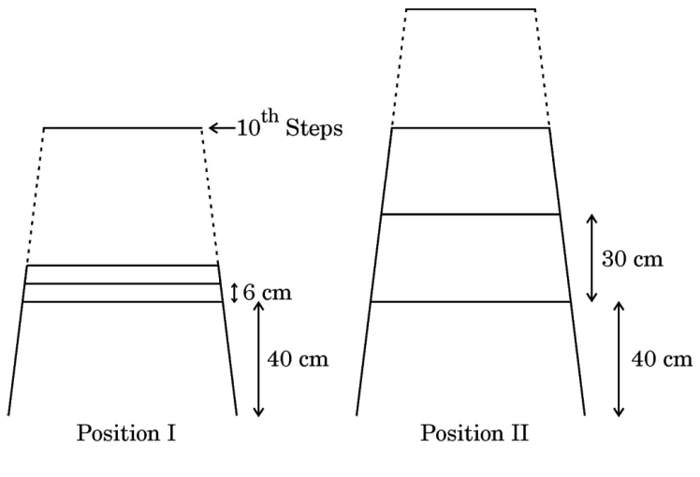
A foldable ladder has ten steps. In folded position (Position I), the distance between every two consecutive steps is 6 cm, whereas in extended position (Position II) this distance becomes 30 cm. The height of the first step from the ground is 40 cm. When measured, the heights of different steps from the ground, taken in order, form an AP.
Original CBSE case illustration.
Describe the figure
Foldable ladder in Position I and Position II, showing step spacing of 6 cm and 30 cm, with the first step 40 cm above ground.
Appeared in: 2026 · Basic · Second Board Examination
(i) Write the AP when the ladder is standing in Position I. [1 mark]
Show answer and solution
40, 46, 52, 58, … cm.
The first step is at 40 cm.
The folded spacing is 6 cm.
The AP is 40, 46, 52, 58, … cm.
(ii) Write the AP when the ladder is standing in Position II. [1 mark]
Show answer and solution
40, 70, 100, 130, … cm.
The first step remains at 40 cm.
The extended spacing is 30 cm.
The AP is 40, 70, 100, 130, … cm.
(iii)(a) Write the total height of the ladder in both the situations. [2 marks]
Show answer and solution
Position I: 94 cm; Position II: 310 cm.
Ten steps give nine gaps above the first step.
Position I = 40 + 9 × 6 = 94 cm.
Position II = 40 + 9 × 30 = 310 cm.
OR
(iii)(b) What would be the height of the ladder when the ladder is opened till the seventh step only? [2 marks]
Show answer and solution
238 cm.
Six gaps are extended to 30 cm.
Height to 7th step = 40 + 6 × 30 = 220 cm.
The remaining three gaps stay folded at 6 cm.
Total height = 220 + 3 × 6 = 238 cm.
Basic4 marks · Accessible paper
Case 27. Yogesh’s project savings
Yogesh started saving money for his new project. He started saving ₹200 in the first month, ₹250 in the second month, ₹300 in the third month and so on. He continues to save in this manner for quite some time.
Appeared in: 2026 · Basic · Second Board Examination
(i) Show that the pattern of savings followed by him forms an AP. [1 mark]
Show answer and solution
Yes; a = ₹200 and d = ₹50.
250 − 200 = 300 − 250 = 50.
Equal consecutive differences show an AP.
a = ₹200 and d = ₹50.
(ii) In which month would he save ₹1,000? [1 mark]
Show answer and solution
The 17th month.
1,000 = 200 + (n − 1)50.
n − 1 = 16.
n = 17.
(iii)(a) Determine the total amount saved in the first 20 months. [2 marks]
Show answer and solution
₹13,500.
Here, a = 200, d = 50 and n = 20.
Sₙ = [2a + (n − 1)d].
Sₙ = [2 × 200 + (20 − 1) × (50)].
= 13500 rupees.
OR
(iii)(b) How many months will he take to save a total amount of ₹21,450? [2 marks]
Show answer and solution
26 months.
21,450 = [400 + (n − 1)50].
n² + 7n − 858 = 0.
(n − 26)(n + 33) = 0.
n = 26; reject −33.
Standard4 marks
Case 28. Road-roller production: 270 and 510
A road roller, often called a roller compactor or just a roller, is an engineering vehicle used to compact soil, gravel, concrete, or asphalt in the construction of roads and foundations. Similar machines are also used in landfills or agriculture. Past records of a road roller manufacturing company show that the number of products produced each year forms an Arithmetic Progression (AP). The company produced 270 road rollers in the 4th year and 510 in the 10th year.
Appeared in: 2026 · Standard · Second Board Examination
(i) What was the company’s production in the 1st year? [1 mark]
Show answer and solution
150 road rollers.
Let a be first-year production and d the annual increase.
a + 3d = 270.
a + 9d = 510.
Subtracting, 6d = 240.
d = 40.
a = 270 − 3 × 40 = 150.
(ii) What was the company’s production in the 8th year? [1 mark]
Show answer and solution
430 road rollers.
Here, a = 150, d = 40 and n = 8.
aₙ = a + (n − 1)d.
aₙ = 150 + (8 − 1) × (40).
= 430 road rollers.
(iii)(a) What was the company’s total production of the first 6 years? [2 marks]
Show answer and solution
1,500 road rollers.
Here, a = 150, d = 40 and n = 6.
Sₙ = [2a + (n − 1)d].
Sₙ = [2 × 150 + (6 − 1) × (40)].
= 1500 road rollers.
OR
(iii)(b) Find the ratio of 2nd year’s production to 8th year’s production. [2 marks]
Show answer and solution
19 : 43.
a₂ = 150 + 40 = 190.
a₈ = 150 + 7 × 40 = 430.
Ratio = 190 : 430 = 19 : 43.
Basic4 marks
Case 29. Passenger-car production: official sample
In the month of April to June 2022, the exports of passenger cars from India increased by 26% in the corresponding quarter of 2021–22, as per a report.
A car manufacturing company planned to produce 1800 cars in 4th year and 2600 cars in 8th year. Assuming that the production increases uniformly by a fixed number every year.
Original CBSE case illustration.
Describe the figure
Photograph of passenger cars printed with the official sample case.
Appeared in: 2022–23 · Basic · Official Sample
I Find the production in the 1st year. [1 mark]
Show answer and solution
1,200 cars.
Let a be first-year production and d the annual increase.
a + 3d = 1800.
a + 7d = 2600.
Subtracting, 4d = 800.
d = 200.
a = 1800 − 3 × 200 = 1200.
II Find the production in the 12th year. [1 mark]
Show answer and solution
3,400 cars.
Here, a = 1200, d = 200 and n = 12.
aₙ = a + (n − 1)d.
aₙ = 1200 + (12 − 1) × (200).
= 3400 cars.
III Find the total production in first 10 years. [2 marks]
Show answer and solution
21,000 cars.
Here, a = 1200, d = 200 and n = 10.
Sₙ = [2a + (n − 1)d].
Sₙ = [2 × 1200 + (10 − 1) × (200)].
= 21000 cars.
OR
III In how many years will the total production reach 31200 cars? [2 marks]
Show answer and solution
13 years.
31,200 = [2 × 1,200 + (n − 1)200].
n² + 11n − 312 = 0.
(n − 13)(n + 24) = 0.
n = 13; reject −24.
Standard4 marks
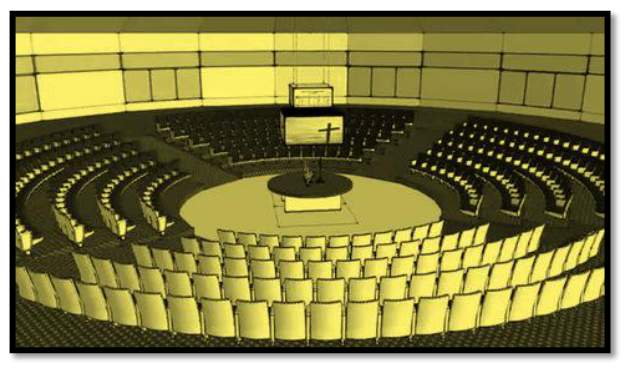
Case 30. Concentric rows in a school auditorium
The school auditorium was to be constructed to accommodate at least 1500 people. The chairs are to be placed in concentric circular arrangement in such a way that each succeeding circular row has 10 seats more than the previous one.
Original CBSE case illustration.
Describe the figure
Photograph of an auditorium with concentric rows of chairs.
Appeared in: 2022–23 · Standard · Official Sample
(i) If the first circular row has 30 seats, how many seats will be there in the 10th row? [1 mark]
Show answer and solution
120 seats.
Here, a = 30, d = 10 and n = 10.
aₙ = a + (n − 1)d.
aₙ = 30 + (10 − 1) × (10).
= 120 seats.
(ii) For 1500 seats in the auditorium, how many rows need to be there? [2 marks]
Show answer and solution
15 rows.
a = 30 and d = 10.
1,500 = [60 + (n − 1)10].
n² + 5n − 300 = 0.
(n − 15)(n + 20) = 0.
n = 15; reject −20.
OR
(ii) If 1500 seats are to be arranged in the auditorium, how many seats are still left to be put after 10th row? [2 marks]
Show answer and solution
750 seats.
S₁₀ = [2 × 30 + 9 × 10] = 750 seats.
Seats left = 1,500 − 750 = 750.
(iii) If there were 17 rows in the auditorium, how many seats will be there in the middle row? [1 mark]
Show answer and solution
110 seats.
Middle row = = 9th row.
a₉ = 30 + 8 × 10 = 110 seats.
Basic4 marks
Case 31. Television manufacturing
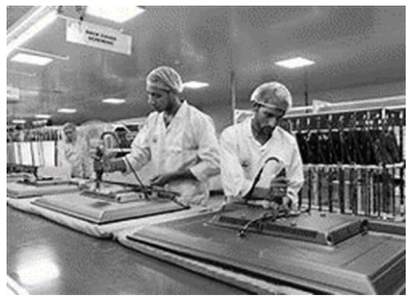
India is competitive manufacturing location due to the low cost of manpower and strong technical and engineering capabilities contributing to higher quality production runs.
The production of TV sets in a factory increases uniformly by a fixed number every year. It produced 16000 sets in 6th year and 22600 in 9th year.
Original CBSE case illustration.
Describe the figure
Photograph of a television manufacturing line.
Appeared in: 2023–24 · Basic · Official Sample
1) In which year, the production is 29,200 sets? [1 mark]
Show answer and solution
The 12th year.
Let a be first-year production and d the annual increase.
a + 5d = 16000.
a + 8d = 22600.
Subtracting, 3d = 6600.
d = 2200.
a = 16000 − 5 × 2200 = 5000.
29,200 = 5,000 + (n − 1)2,200.
n = 12.
2) Find the production in the 8th year. [2 marks]
Show answer and solution
20,400 TV sets.
Here, a = 5000, d = 2200 and n = 8.
aₙ = a + (n − 1)d.
aₙ = 5000 + (8 − 1) × (2200).
= 20400 TV sets.
OR
2) Find the production in first 3 years. [2 marks]
Show answer and solution
21,600 TV sets.
Here, a = 5000, d = 2200 and n = 3.
Sₙ = [2a + (n − 1)d].
Sₙ = [2 × 5000 + (3 − 1) × (2200)].
= 21600 TV sets.
3) Find the difference of the production in 7th year and 4th year. [1 mark]
Show answer and solution
6,600 TV sets.
a₇ − a₄ = (a + 6d) − (a + 3d).
= 3d = 3 × 2,200 = 6,600 TV sets.
Standard4 marks
Case 32. Sanjitha’s shot-put practice
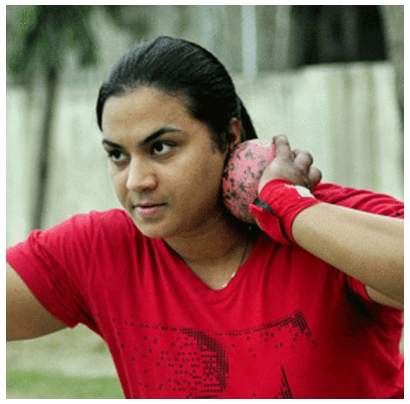
Manpreet Kaur is the national record holder for women in the shot-put discipline. Her throw of 18.86 m at the Asian Grand Prix in 2017 is the maximum distance for an Indian female athlete.
Keeping her as a role model, Sanjitha is determined to earn gold in Olympics one day. Initially her throw reached 7.56 m only. Being an athlete in school, she regularly practiced both in the mornings and in the evenings and was able to improve the distance by 9 cm every week.
During the special camp for 15 days, she started with 40 throws and every day kept increasing the number of throws by 12 to achieve this remarkable progress.
Original CBSE case illustration.
Describe the figure
Photograph of a female shot-put athlete accompanying the official sample passage.
Appeared in: 2023–24 · Standard · Official Sample
(i) How many throws Sanjitha practiced on 11th day of the camp? [1 mark]
Show answer and solution
160 throws.
Here, a = 40, d = 12 and n = 11.
aₙ = a + (n − 1)d.
aₙ = 40 + (11 − 1) × (12).
= 160 throws.
(ii) What would be Sanjitha’s throw distance at the end of 6 weeks? [2 marks]
Show answer and solution
8.10 m.
Initial distance = 7.56 m.
Weekly increase = 9 cm = 0.09 m.
Six completed weeks give six increases.
Distance = 7.56 + 6 × 0.09 = 8.10 m.
OR
(ii) When will she be able to achieve a throw of 11.16 m? [2 marks]
Show answer and solution
After 40 weekly improvements; labelled the 41st week in the official scheme.
Let k count completed weekly improvements.
11.16 = 7.56 + 0.09k.
k = = 40.
If the initial throw is term 1, this is term 41.
The scheme reports 41 weeks by term numbering; 40 weeks have elapsed since the initial throw.
(iii) How many throws did she do during the entire camp of 15 days? [1 mark]
Show answer and solution
1,860 throws.
Here, a = 40, d = 12 and n = 15.
Sₙ = [2a + (n − 1)d].
Sₙ = [2 × 40 + (15 − 1) × (12)].
= 1860 throws.
Standard4 marks
Case 33. Layers of glass jars
Ms. Sheela visited a store near her house and found that the glass jars are arranged one above the other in a specific pattern.
On the top layer there are 3 jars. In the next layer there are 6 jars. In the 3rd layer from the top there are 9 jars and so on till the 8th layer.
Appeared in: 2024–25 · Standard · Official Sample
(i) Write an A.P whose terms represent the number of jars in different layers starting from top. Also, find the common difference. [1 mark]
Show answer and solution
3, 6, 9, …, 24; d = 3.
Eight layer counts: 3, 6, 9, 12, 15, 18, 21, 24.
d = 6 − 3 = 3.
(ii) Is it possible to arrange 34 jars in a layer if this pattern is continued? Justify your answer. [1 mark]
Show answer and solution
No.
34 = 3 + (n − 1)3.
n = , which is not a positive integer.
No complete layer has exactly 34 jars.
(iii)(A) If there are ‘n’ number of rows in a layer then find the expression for finding the total number of jars in terms of n. Hence find S₈. [2 marks]
Show answer and solution
Sₙ = ; S₈ = 108 jars.
Following the marking scheme, n counts the successive layers.
a = 3 and d = 3.
Sₙ = [6 + (n − 1)3].
Sₙ = .
S₈ = = 108 jars.
OR
(iii)(B) The shopkeeper added 3 jars in each layer. How many jars are there in the 5th layer from the top? [2 marks]
Show answer and solution
18 jars.
The new AP is 6, 9, 12, …
a = 6 and d = 3.
a₅ = 6 + (5 − 1)3 = 18 jars.
Standard4 marks
Case 34. Aryan and Roshan’s two progressions
In a class, the teacher asks every student to write an example of A.P. Two boys Aryan and Roshan writes the progression as −5, −2, 1, 4, … and 187, 184, 181, … respectively.
Now the teacher asks his various students the following questions on progression. Help the students to find answers for the following:
Appeared in: 2025–26 · Standard · Official Sample
i. Find the sum of the common difference of two progressions. [1 mark]
Show answer and solution
0.
Aryan: d₁ = −2 − (−5) = 3.
Roshan: d₂ = 184 − 187 = −3.
Sum = 3 + (−3) = 0.
ii. Find the 34th term of progression written by Roshan. [1 mark]
Show answer and solution
88.
Here, a = 187, d = -3 and n = 34.
aₙ = a + (n − 1)d.
aₙ = 187 + (34 − 1) × (-3).
= 88.
iii.(A) Find the sum of first 10 terms of the progression written by Aryan. [2 marks]
Show answer and solution
85.
Here, a = -5, d = 3 and n = 10.
Sₙ = [2a + (n − 1)d].
Sₙ = [2 × -5 + (10 − 1) × (3)].
= 85.
OR
iii.(B) Which term of the progressions will have the same value? [2 marks]
Show answer and solution
The 33rd term of each; common value = 91.
Equate terms at the same position n.
−5 + 3(n − 1) = 187 − 3(n − 1).
6(n − 1) = 192.
n = 33.
Common value = −5 + 32 × 3 = 91.
Basic4 marks
Case 35. Trees planted by Classes I to XII
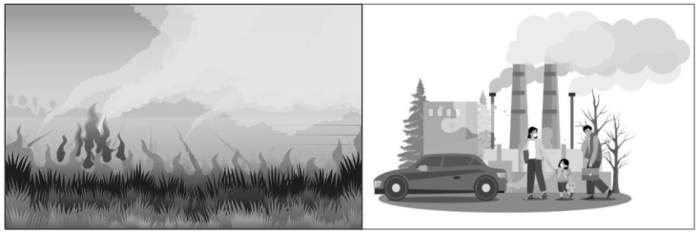
Delhi’s pollution is a severe, often seasonal issue caused by a combination of factors like high vehicular and industrial emissions, dust from construction, and crop burning in surrounding states. In a school, students of classes I to XII thought of planting trees in and around the school to reduce air pollution.
Original CBSE case illustration.
Describe the figure
Both original pollution photographs: a hazy urban landscape and industrial emissions.
It was decided that the number of trees that each section of each class will plant be three more than the double of the class in which they are studying, e.g., a section of class IV will plant 11 trees. If in the given school, there are two sections of each class, then answer the following questions:
Appeared in: 2026–27 · Basic · Official Sample
(i) If number of trees planted by students class-wise follow arithmetic progression, then find the common difference. [1 mark]
Show answer and solution
4 trees.
One section of Class n plants 2n + 3 trees.
Two sections plant 2(2n + 3) = 4n + 6 trees.
Class totals are 10, 14, 18, …
d = 14 − 10 = 4 trees.
(ii) What is the number of trees planted by students of class VI? [1 mark]
Show answer and solution
30 trees.
Each section plants 2 × 6 + 3 = 15 trees.
Two sections plant 2 × 15 = 30 trees.
(iii)(A) What is the total number of trees planted by the students of given school? [2 marks]
Show answer and solution
384 trees.
Use class totals: a = 10, d = 4 and n = 12.
S₁₂ = [2 × 10 + 11 × 4].
= 6 × 64 = 384 trees.
OR
(iii)(B) Identify the class that planted 34 trees. [2 marks]
Show answer and solution
Class VII.
34 = 10 + (n − 1)4.
n − 1 = 6.
n = 7, so the class is VII.
Questions students ask
How do I know whether to use aₙ or Sₙ?
Use aₙ when asked for one month’s saving, one row’s seats or one year’s production. Use Sₙ when asked for the combined saving, seats or production over several terms.
How do I count a row from the bottom?
If there are N rows, the kth row from the bottom is row N − k + 1 from the top. For ten rows, the fourth from the bottom is the seventh from the top.
Why are there n − 1 increases rather than n?
The first term is already a. Reaching the second term needs one increase, so reaching term n needs n − 1 increases. If the question instead gives an initial measurement before practice begins, count completed increases from that starting measurement.
Can the common difference be negative?
Yes. Times decreasing by 3 seconds follow an AP with d = −3; train-coach counts 72, 68, 64, … have d = −4. Keep the negative sign in both term and sum formulas.
What if an answer gives a fraction for the number of rows or chairs?
A count must be a positive integer. For a maximum-height question, choose the greatest whole number that satisfies the limit and check the next one. For an exact pattern such as 34 jars in a layer, a non-integer index means it is impossible.
Do the two sections change the tree-planting AP?
Yes. Each section of Class n plants 2n + 3 trees. With two sections per class, class totals are 4n + 6: 10, 14, 18, …, with common difference 4.
Why is the partly opened ladder 238 cm rather than 220 cm?
220 cm is the height to the seventh step. Three folded gaps remain above it, each 6 cm, so the total ladder height is 220 + 18 = 238 cm.
Should I solve both OR alternatives in the examination?
Answer one alternative where an OR is printed, following the marks beside that part. Both alternatives are solved here for practice.