A quadratic-equations case study asks you to form an equation, solve it and decide which roots fit the situation. Practise 13 selected CBSE cases on dimensions, seating, costs and travel speeds. Try each part before opening its solution.
13 distinct cases · 31 board-paper appearances Reviewed by Team TutorVertex · 26 October 2026
Key results
Standard form: ax² + bx + c = 0, a ≠ 0; a, b and c are its coefficients.
Quadratic formula: x = .
The discriminant is D = b² − 4ac: D > 0 gives two distinct real roots; D = 0 gives equal real roots; D < 0 gives no real roots.
A uniform border of width x on all four sides changes each full dimension by 2x.
Check each root against the passage. Two positive roots can both be valid.
For travel problems, time = distance ÷ speed; convert minutes to hours when speed is in km/h.
Standard4 marks
Case 1. Swimming pool and its sidewalk
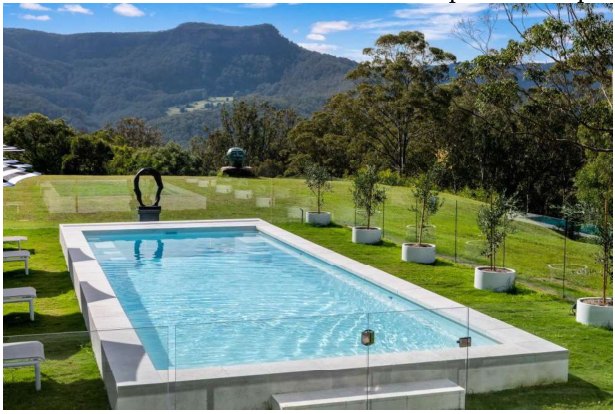
In the picture given below, one can see a rectangular in-ground swimming pool installed by a family in their backyard. There is a concrete sidewalk around the pool of width x m. The outside edges of the sidewalk measure 7 m and 12 m. The area of the pool is 36 sq. m.
Original CBSE case illustration.
Describe the figure
A rectangular swimming pool has a uniform sidewalk. The complete outer rectangle measures 7 m by 12 m; the pool area is 36 m². The photograph supplies the setting; the measurements are stated in the passage.
Appeared in: 2022 · Standard · Main
(a) Based on the information given above, form a quadratic equation in terms of x. [2 marks]
Show answer and solution
4x² − 38x + 48 = 0.
Let x m be the uniform width of the sidewalk.
The pool dimensions are (7 − 2x) m and (12 − 2x) m.
Area of pool = length × breadth.
(7 − 2x)(12 − 2x) = 36.
84 − 38x + 4x² = 36.
4x² − 38x + 48 = 0.
Answer checked against the corresponding official CBSE marking scheme.
(b) Find the width of the sidewalk around the pool. [2 marks]
Show answer and solution
Width = m = 1.5 m.
4x² − 38x + 48 = 0.
2x² − 19x + 24 = 0.
2x² − 16x − 3x + 24 = 0.
2x(x − 8) − 3(x − 8) = 0.
(2x − 3)(x − 8) = 0.
x = or x = 8.
For positive pool dimensions, 0 < x < .
Therefore, x = 8 is rejected.
The width is 1.5 m.
Answer checked against the corresponding official CBSE marking scheme.
Basic4 marks
Case 2. Pottery production and cost
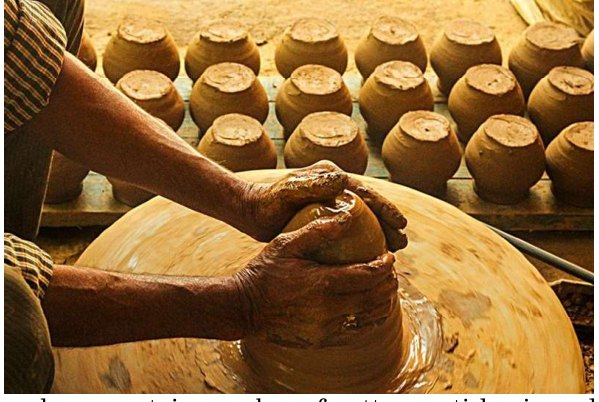
The tradition of pottery making in India is very old. In fact, it is older than Indus Valley Civilization. The shaping and baking of clay articles has continued through the ages. The picture of a potter is shown below :
Original CBSE case illustration.
Describe the figure
The photograph shows pottery being made. The quantities required for the equation are stated in the passage.
A potter makes a certain number of pottery articles in a day. It was observed on a particular day the cost of production of each article (in ₹) was one more than twice the number of articles produced on that day. The total cost of production on that day was ₹210.
Appeared in: 2022 · Basic · Main
(a) Taking number of articles produced on that day as x, form a quadratic equation in x. [2 marks]
Show answer and solution
2x² + x − 210 = 0.
Let the number of articles be x.
Cost of each article = ₹(2x + 1).
Total cost = number of articles × cost per article.
x(2x + 1) = 210.
2x² + x − 210 = 0.
Answer checked against the corresponding official CBSE marking scheme.
(b) Find the number of articles produced and the cost of each article. [2 marks]
Show answer and solution
10 articles; ₹21 per article.
2x² + x − 210 = 0.
2x² + 21x − 20x − 210 = 0.
x(2x + 21) − 10(2x + 21) = 0.
(x − 10)(2x + 21) = 0.
x = 10 or x = −.
Reject −, since the number of articles must be a positive integer.
Cost of each article = 2(10) + 1 = ₹21.
Check: 10 × ₹21 = ₹210.
Answer checked against the corresponding official CBSE marking scheme.
Standard4 marks · Accessible paper
Case 3. Auditorium seating: 2022 case
In an auditorium, the sloping floor allows the seats to be arranged to give a clear view of the stage. The seats are arranged in such a way that the number of rows are equal to the number of seats in each row. When the number of rows are doubled and the number of seats in each row is reduced by 16, then the total number of seats increases by 320.
Based on the above, answer the following questions :
Appeared in: 2022 · Standard · Supplementary
(a) If x is taken as the number of rows in the original arrangement, describe the above situation by a quadratic equation. [2 marks]
Show answer and solution
x² − 32x − 320 = 0.
Originally, the number of rows and seats per row are both x.
Original total = x².
New number of rows = 2x.
New number of seats per row = x − 16.
2x(x − 16) = x² + 320.
x² − 32x − 320 = 0.
Answer checked against the corresponding official CBSE marking scheme.
(b) Find the number of rows and hence the total number of seats in the original arrangement. [2 marks]
Show answer and solution
40 rows; 1,600 seats.
x² − 32x − 320 = 0.
x² − 40x + 8x − 320 = 0.
(x − 40)(x + 8) = 0.
x = 40 or x = −8.
Reject −8, since a row count must be positive.
Original total = 40² = 1,600 seats.
Check: 80 × 24 = 1,920 seats, an increase of 320.
Answer checked against the corresponding official CBSE marking scheme.
Standard4 marks
Case 4. Land donated for a school
Social work aims at fulfilment of human needs. Social workers aim to open the doors of access and opportunity for those who are in greatest need. Free education is a great social work. By doing so, we can remove illiteracy from our society.
Rohan, being a social worker, wants to donate his land to the Village Panchayat for opening of a school.
Original CBSE case illustration.
Describe the figure
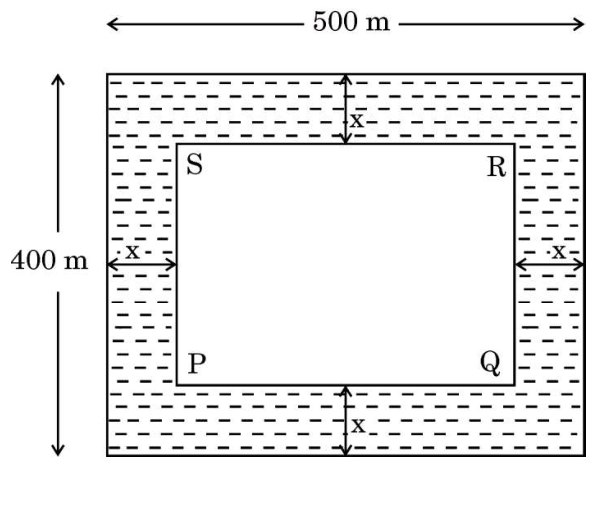
The outer rectangle is 500 m horizontally and 400 m vertically. A border of width x m on all four sides surrounds PQRS. PQ is horizontal and QR is vertical.
Rohan’s land is in the form of a rectangle of dimensions 500 m × 400 m. The Village Panchayat decides to leave the area on all the four sides of the land for grass and flowers. If width of x m land is kept for grass and flowers on all the four sides (as shown in Figure 4);
Appeared in: 2022 · Standard · Supplementary
(a) Find the lengths PQ and QR if area of grass and flowers region surrounding PQRS is 118400 m². [2 marks]
Show answer and solution
PQ = 340 m; QR = 240 m.
Let the border width be x m.
Area of the whole land = 500 × 400 = 200,000 m².
Area of PQRS = 200,000 − 118,400 = 81,600 m².
(500 − 2x)(400 − 2x) = 81,600.
200,000 − 1,800x + 4x² = 81,600.
x² − 450x + 29,600 = 0.
(x − 80)(x − 370) = 0.
x = 80 or x = 370.
Since 0 < x < 200, reject x = 370.
PQ = 500 − 2(80) = 340 m.
QR = 400 − 2(80) = 240 m.
Answer checked against the corresponding official CBSE marking scheme.
(b) Also, find the perimeter of the rectangle PQRS. [2 marks]
Show answer and solution
Perimeter = 1,160 m.
Perimeter of a rectangle = 2(length + breadth).
Perimeter of PQRS = 2(340 + 240).
Perimeter of PQRS = 1,160 m.
Answer checked against the corresponding official CBSE marking scheme.
Basic4 marks
Case 5. Fencing a field beside a river
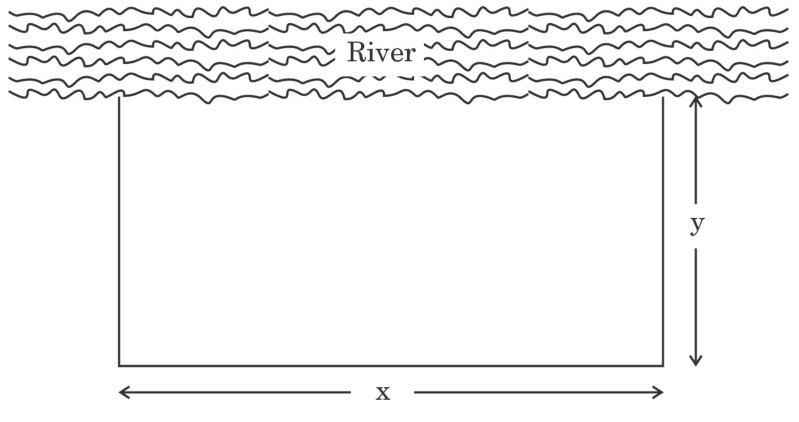
Ramesh, a farmer, wishes to fence off his rectangular field of given area 1500 m². The length of the field lies along a straight river. A wire of length 110 m is required for the fencing assuming that along the river, no fencing is needed for the field.
Original CBSE case illustration.
Describe the figure
The river runs along the top side of the rectangle. The opposite horizontal side is x m and each perpendicular side is y m. Wire is needed for x + 2y, not for all four sides.
Appeared in: 2022 · Basic · Supplementary
(a) Write the perimeter and the area of the rectangular field in terms of ‘x’ and ‘y’. [2 marks]
Show answer and solution
Fenced length = x + 2y; area = xy. Full perimeter = 2(x + y).
Let x m be the side parallel to the river and y m the perpendicular side.
Only three sides need fencing.
Required fenced length = x + 2y = 110 m.
Area = xy = 1,500 m².
The full geometric perimeter is 2(x + y).
The official scheme accepts the fencing interpretation and also allows the full-perimeter interpretation for this part.
Answer checked against the corresponding official CBSE marking scheme.
(b) What are the dimensions of the rectangular field? [2 marks]
Show answer and solution
(x, y) = (60, 25) m or (50, 30) m.
x + 2y = 110.
x = 110 − 2y.
xy = 1,500.
y(110 − 2y) = 1,500.
y² − 55y + 750 = 0.
(y − 25)(y − 30) = 0.
y = 25 or y = 30.
For y = 25, x = 110 − 50 = 60.
For y = 30, x = 110 − 60 = 50.
Both pairs give area 1,500 m² and fenced length 110 m.
Answer checked against the corresponding official CBSE marking scheme.
Standard4 marks
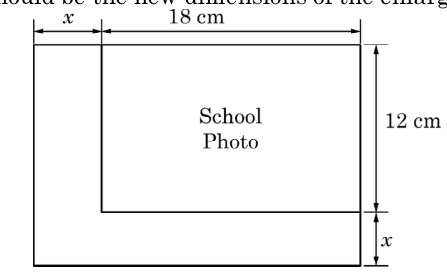
Case 6. Enlarging a school photograph
While designing the school year book, a teacher asked the student that the length and width of a particular photo is increased by x units each to double the area of the photo. The original photo is 18 cm long and 12 cm wide.
Original CBSE case illustration.
Describe the figure
The original photograph measures 18 cm horizontally and 12 cm vertically. The enlarged outer rectangle adds x cm to the total length and x cm to the total width. This is not a uniform border of width x on all four sides.
Based on the above information, answer the following questions :
Appeared in: 2023 · Standard · Main
(I) Write an algebraic equation depicting the above information. [1 mark]
Show answer and solution
(18 + x)(12 + x) = 432.
Let the increase in each dimension be x cm.
Original area = 18 × 12 = 216 cm².
New dimensions are (18 + x) cm and (12 + x) cm.
(18 + x)(12 + x) = 2(216).
(18 + x)(12 + x) = 432.
Answer checked against the corresponding official CBSE marking scheme.
(II) Write the corresponding quadratic equation in standard form. [1 mark]
Show answer and solution
x² + 30x − 216 = 0.
(18 + x)(12 + x) = 432.
216 + 30x + x² = 432.
x² + 30x − 216 = 0.
Answer checked against the corresponding official CBSE marking scheme.
(III) What should be the new dimensions of the enlarged photo? [2 marks]
Show answer and solution
24 cm × 18 cm.
x² + 30x − 216 = 0.
x² + 36x − 6x − 216 = 0.
(x + 36)(x − 6) = 0.
x = −36 or x = 6.
Reject −36 because the photograph is enlarged and its dimensions must be positive.
New length = 18 + 6 = 24 cm.
New width = 12 + 6 = 18 cm.
Answer checked against the corresponding official CBSE marking scheme.
OR
(III) Can any rational value of x make the new area equal to 220 cm²? [2 marks]
Show answer and solution
No; the required values of x are irrational.
For this alternative, use new area 220 cm².
(18 + x)(12 + x) = 220.
x² + 30x − 4 = 0.
Here a = 1, b = 30 and c = −4.
D = b² − 4ac.
D = 30² − 4(1)(−4) = 916.
916 is not a perfect square.
The roots −15 ± √229 are irrational, so no rational x satisfies the condition.
Answer checked against the corresponding official CBSE marking scheme.
Standard4 marks · Accessible paper
Case 7. Auditorium seating: 2023 case
In an auditorium, seats are arranged in rows and columns. The number of rows are equal to the number of seats in each row in the beginning. When the number of rows are doubled and the number of seats in each row is reduced by 10, the total number of seats increases by 300.
Based on the above, answer the following questions :
Appeared in: 2023 · Standard · Supplementary
(a) Taking x as the number of rows in the beginning, represent the above situation by a quadratic equation. [1 mark]
Show answer and solution
x² − 20x − 300 = 0.
Original rows = seats per row = x.
Original total = x².
New rows = 2x.
New seats per row = x − 10.
2x(x − 10) = x² + 300.
x² − 20x − 300 = 0.
Answer checked against the corresponding official CBSE marking scheme.
(b)(i) How many rows are there in the original arrangement? [2 marks]
Show answer and solution
30 rows.
x² − 20x − 300 = 0.
x² − 30x + 10x − 300 = 0.
(x − 30)(x + 10) = 0.
x = 30 or x = −10.
Reject −10 because a row count must be positive.
There are 30 rows.
Answer checked against the corresponding official CBSE marking scheme.
OR
(b)(ii) How many seats are there in the auditorium in the beginning? [2 marks]
Show answer and solution
900 seats.
x² − 20x − 300 = 0.
(x − 30)(x + 10) = 0.
The positive solution is x = 30.
Original total = x² = 30² = 900 seats.
Answer checked against the corresponding official CBSE marking scheme.
(c) How many seats are there in the auditorium after re-arrangement? [1 mark]
Show answer and solution
1,200 seats.
New total = original total + 300.
New total = 900 + 300 = 1,200 seats.
Check: 60 rows × 20 seats per row = 1,200.
Answer checked against the corresponding official CBSE marking scheme.
Basic4 marks · Accessible paper
Case 8. Motorboat upstream and downstream
The speed of a motor boat in still water is 25 km/h. For covering a distance of 40 km, the boat took 40 minutes more to go upstream than downstream.
Based on the above, answer the following questions :
Appeared in: 2024 · Basic · Main
(i) Let the speed of the stream be x km/h. Express, in terms of x, the speed of the motor boat going upstream. [1 mark]
Show answer and solution
Upstream speed = (25 − x) km/h.
Upstream speed = speed in still water − speed of stream.
Upstream speed = (25 − x) km/h.
Answer checked against the corresponding official CBSE marking scheme.
(ii) Express the above situation in terms of a quadratic equation in x. [1 mark]
Show answer and solution
x² + 120x − 625 = 0.
Let 0 < x < 25.
Downstream speed = (25 + x) km/h.
Time = distance ÷ speed.
40 minutes = hour.
− = .
= .
240x = 1,250 − 2x².
x² + 120x − 625 = 0.
Answer checked against the corresponding official CBSE marking scheme.
(iii)(a) Find the speed of the stream. [2 marks]
Show answer and solution
5 km/h.
x² + 120x − 625 = 0.
x² + 125x − 5x − 625 = 0.
(x + 125)(x − 5) = 0.
x = −125 or x = 5.
Reject −125 because stream speed must be positive.
The speed of the stream is 5 km/h.
Check: upstream time = = 2 hours.
Downstream time = = hours.
Difference = hour = 40 minutes.
Answer checked against the corresponding official CBSE marking scheme.
OR
(iii)(b) If the speed of the stream is 10 km/h, how much time will the boat take to cover 40 km upstream? [2 marks]
Show answer and solution
hours = 2 hours 40 minutes.
Use the alternative stream speed of 10 km/h.
Upstream speed = 25 − 10 = 15 km/h.
Time = = hours.
Time = 160 minutes = 2 hours 40 minutes.
Answer checked against the corresponding official CBSE marking scheme.
Basic4 marks
Case 9. Two circular sprinkler areas
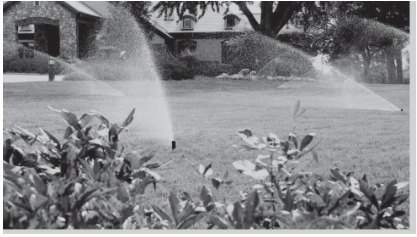
To keep the lawn green and cool, Sadhna uses water sprinklers which rotate in circular shape and cover a particular area.
The diagram below shows the circular areas covered by two sprinklers :
Original CBSE case illustration.Original CBSE case illustration.
Describe the figure
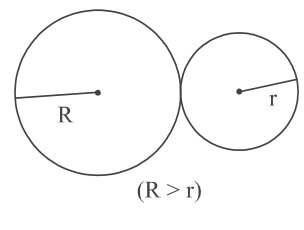
Two circles touch externally and their centre distance is 14 m. The larger radius is R and smaller radius is r, with R > r. Their total area is 130π m². The accompanying lawn photograph is retained.
Two circles touch externally. The sum of their areas is 130π sq m and the distance between their centres is 14 m.
Based on above information, answer the following questions :
Appeared in: 2024 · Basic · Main
(i) Obtain a quadratic equation involving R and r from above. [1 mark]
Show answer and solution
R² + r² = 130.
Let R and r be the larger and smaller radii in metres, with R > r.
Sum of areas = πR² + πr².
πR² + πr² = 130π.
R² + r² = 130.
Answer checked against the corresponding official CBSE marking scheme.
(ii) Write a quadratic equation involving only r. [1 mark]
Show answer and solution
r² − 14r + 33 = 0.
For externally touching circles, R + r = 14.
R = 14 − r.
(14 − r)² + r² = 130.
196 − 28r + 2r² = 130.
r² − 14r + 33 = 0.
Answer checked against the corresponding official CBSE marking scheme.
(iii)(a) Find the radius r and the corresponding area irrigated. [2 marks]
Show answer and solution
r = 3 m; area = 9π m².
r² − 14r + 33 = 0.
(r − 11)(r − 3) = 0.
r = 11 or r = 3.
If r = 11, then R = 3, contrary to R > r.
Therefore, r = 3 m.
Area irrigated = πr² = π(3)² = 9π m².
Answer checked against the corresponding official CBSE marking scheme.
OR
(iii)(b) Find the radius R and the corresponding area irrigated. [2 marks]
Show answer and solution
R = 11 m; area = 121π m².
R² − 14R + 33 = 0.
(R − 11)(R − 3) = 0.
Since R > r, R = 11 m and r = 3 m.
Area irrigated = πR² = π(11)² = 121π m².
Answer checked against the corresponding official CBSE marking scheme.
Standard4 marks
Case 10. Covering a floor with square tiles
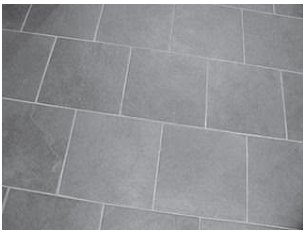
A rectangular floor area can be completely tiled with 200 square tiles. If the side length of each tile is increased by 1 unit, it would take only 128 tiles to cover the floor.
Original CBSE case illustration.
Describe the figure
The photograph shows a tiled floor. The equation uses the tile counts and side-length change stated in the passage; do not infer measurements from the photograph.
Appeared in: 2024 · Standard · Main
(i) Assuming the original length of each side of a tile be x units, make a quadratic equation from the above information. [1 mark]
Show answer and solution
200x² = 128(x + 1)².
Let the original tile side be x units.
Original area per tile = x² square units.
New area per tile = (x + 1)² square units.
Both sets of tiles cover the same floor area.
200x² = 128(x + 1)².
Answer checked against the corresponding official CBSE marking scheme.
(ii) Write the corresponding quadratic equation in standard form. [1 mark]
Show answer and solution
9x² − 32x − 16 = 0.
200x² = 128(x + 1)².
25x² = 16(x² + 2x + 1).
25x² = 16x² + 32x + 16.
9x² − 32x − 16 = 0.
Answer checked against the corresponding official CBSE marking scheme.
(iii)(a) Find the value of x, the length of side of a tile by factorisation. [2 marks]
Show answer and solution
x = 4 units.
9x² − 32x − 16 = 0.
9x² − 36x + 4x − 16 = 0.
9x(x − 4) + 4(x − 4) = 0.
(9x + 4)(x − 4) = 0.
x = − or x = 4.
Reject − because a tile side is positive.
The original tile side is 4 units.
Answer checked against the corresponding official CBSE marking scheme.
OR
(iii)(b) Solve the quadratic equation for x, using quadratic formula. [2 marks]
Show answer and solution
x = 4 units.
9x² − 32x − 16 = 0.
Here a = 9, b = −32 and c = −16.
x = .
x = .
x = .
x = 4 or x = −.
Reject the negative length.
Therefore, x = 4 units.
Answer checked against the corresponding official CBSE marking scheme.
Basic4 marks · Accessible paper
Case 11. Two families on a long drive
Ashok and Harish are very close friends. They decided to go on a long drive with their families in separate cars. Ashok’s car travels at a speed of x km/h, while Harish was driving the car at a speed of 5 km/h faster than Ashok’s car. Ashok took 4 hours more than Harish to complete the journey of 400 km.
Based on the above information, answer the following questions :
Appeared in: 2024 · Basic · Supplementary
(i) Find the distance covered by Harish’s car in two hours (in terms of x). [1 mark]
Show answer and solution
2(x + 5) km.
Harish’s speed = (x + 5) km/h.
Distance = speed × time.
Distance in two hours = 2(x + 5) km.
Answer checked against the corresponding official CBSE marking scheme.
(ii) Make a quadratic equation describing the speed of Ashok’s car. [1 mark]
Show answer and solution
x² + 5x − 500 = 0.
Ashok’s time = hours.
Harish’s time = hours.
− = 4.
2,000 = 4x(x + 5).
x² + 5x − 500 = 0.
Answer checked against the corresponding official CBSE marking scheme.
(iii)(a) Find the speed of Ashok’s car (in km/h). [2 marks]
Show answer and solution
20 km/h.
x² + 5x − 500 = 0.
(x + 25)(x − 20) = 0.
x = −25 or x = 20.
Reject −25 because speed must be positive.
Ashok’s speed = 20 km/h.
Answer checked against the corresponding official CBSE marking scheme.
OR
(iii)(b) Find the speed of Harish’s car (in km/h). [2 marks]
Show answer and solution
25 km/h.
(x + 25)(x − 20) = 0.
The positive value is x = 20.
Harish’s speed = x + 5 = 25 km/h.
Check: Ashok takes 20 hours and Harish takes 16 hours.
The difference is 4 hours.
Answer checked against the corresponding official CBSE marking scheme.
Standard4 marks
Case 12. Rectangular lawn with a uniform walkway
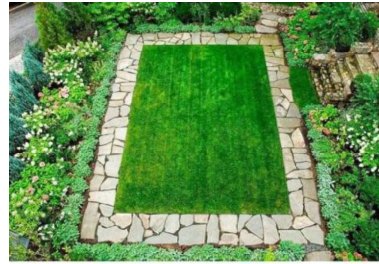
A garden designer is planning a rectangular lawn that is to be surrounded by a uniform walkway.
Original CBSE case illustration.Original CBSE case illustration.
Describe the figure
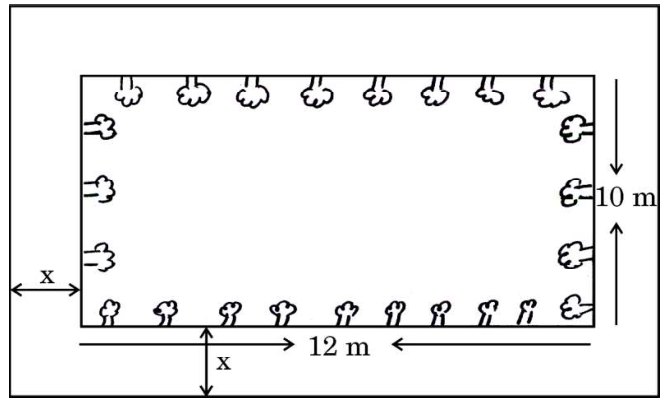
The lawn is the inner 12 m by 10 m rectangle. The walkway adds x on each side, so the outside dimensions are 12 + 2x and 10 + 2x. The source photograph and diagram are both retained.
The total area of the lawn and the walkway is 360 square metres. The width of the walkway is same on all sides. The dimensions of the lawn itself are 12 metres by 10 metres.
Based on the information given above, answer the following questions :
Appeared in: 2025 · Standard · Main
(i) Formulate the quadratic equation representing the total area of the lawn and the walkway, taking width of walkway = x m. [1 mark]
Show answer and solution
x² + 11x − 60 = 0.
Let the walkway width be x m.
Outer length = (12 + 2x) m.
Outer breadth = (10 + 2x) m.
(12 + 2x)(10 + 2x) = 360.
4x² + 44x + 120 = 360.
x² + 11x − 60 = 0.
Answer checked against the corresponding official CBSE marking scheme.
(ii)(a) Solve the quadratic equation to find the width of the walkway ‘x’. [2 marks]
Show answer and solution
Walkway width = 4 m.
x² + 11x − 60 = 0.
(x + 15)(x − 4) = 0.
x = −15 or x = 4.
Reject −15 because walkway width is positive.
The width is 4 m.
Check: (12 + 8)(10 + 8) = 20 × 18 = 360 m².
Answer checked against the corresponding official CBSE marking scheme.
OR
(ii)(b) If the cost of paving the walkway at the rate of ₹50 per square metre is ₹12,000, calculate the area of the walkway. [2 marks]
Show answer and solution
Walkway area = 240 m².
Area = total paving cost ÷ cost per square metre.
Area = = 240 m².
Answer checked against the corresponding official CBSE marking scheme.
(iii) Find the perimeter of the lawn. [1 mark]
Show answer and solution
Lawn perimeter = 44 m.
Perimeter of lawn = 2(length + breadth).
Perimeter = 2(12 + 10) = 44 m.
Answer checked against the corresponding official CBSE marking scheme.
Basic4 marks
Case 13. Six rectangular animal enclosures
Original CBSE case illustration.Original CBSE case illustration.
Describe the figure
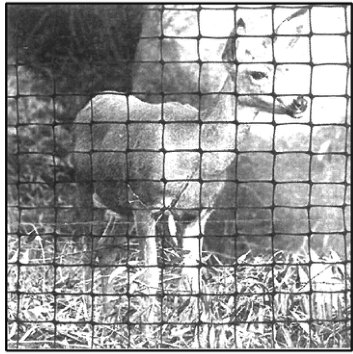
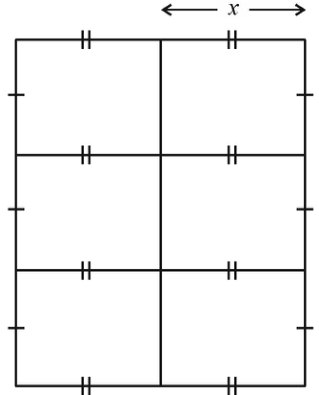
Six identical rectangles form two columns and three rows. Each small rectangle is x feet wide and y feet high. Count four horizontal runs of 2x and three vertical runs of 3y. The accompanying animal photograph is retained.
Observe the figure given above. It shows six identical rectangular enclosures made by using fencing wire mesh. These enclosures are used to protect baby animals in a zoo. Dimensions of each enclosure is x feet × y feet. The total length of fencing required is 152 feet and area of each enclosure is 80 square feet.
Based on the above, answer the following questions :
Appeared in: 2026 · Basic · Main
(i) Write an expression for length of fencing required in terms of x and y. [1 mark]
Show answer and solution
Fencing length = 8x + 9y; hence 8x + 9y = 152.
Each enclosure has horizontal side x feet and vertical side y feet.
Four horizontal runs each have length 2x.
Total horizontal fencing = 4(2x) = 8x.
Three vertical runs each have length 3y.
Total vertical fencing = 3(3y) = 9y.
Total fencing = 8x + 9y = 152 feet.
Answer checked against the corresponding official CBSE marking scheme.
(ii) Write the area of each enclosure in terms of x. [1 mark]
Show answer and solution
= 80 square feet.
8x + 9y = 152.
y = .
Area of one enclosure = xy.
Area = = 80 square feet.
Answer checked against the corresponding official CBSE marking scheme.
(iii)(a) Write the above equation in quadratic equation form and thus find the dimensions of each enclosure using factorisation method. [2 marks]
Show answer and solution
(x, y) = (10, 8) feet or (9, ) feet.
= 80.
152x − 8x² = 720.
x² − 19x + 90 = 0.
(x − 10)(x − 9) = 0.
x = 10 or x = 9.
Since xy = 80, y = .
For x = 10, y = 8.
For x = 9, y = .
Both positive dimension pairs satisfy the stated fencing and area conditions.
Answer checked against the corresponding official CBSE marking scheme.
OR
(iii)(b) Using above equation in quadratic form, solve the equation and find the dimensions of each enclosure using quadratic formula. [2 marks]
Show answer and solution
(x, y) = (10, 8) feet or (9, ) feet.
x² − 19x + 90 = 0.
Here a = 1, b = −19 and c = 90.
x = .
x = .
x = .
x = 10 or x = 9.
For x = 10, y = = 8.
For x = 9, y = .
Both pairs are retained in the official marking scheme.
Answer checked against the corresponding official CBSE marking scheme.
Questions students ask
How do I form a quadratic equation from a case study?
Define the unknown with units, express the related quantities using it, and translate the passage into an equation. Expand and rearrange into ax² + bx + c = 0 before solving.
Why does a border of width x change a dimension by 2x?
A uniform border lies on two opposite sides of the rectangle. It adds x + x = 2x to an outer dimension, or subtracts 2x when the outside dimensions are given. In Case 6, the photograph instead increases each whole dimension by x only.
When should I reject a root?
Reject a root when it violates the passage, such as a negative tile side, a non-integer article count or a border wider than the available space. A positive root can also fail: the pool case rejects 8 m because the remaining pool dimensions would be negative.
Can both roots give valid dimensions?
Yes. The river-field case has two valid dimension pairs, and the enclosure case also has two. Check the area and fencing conditions for each pair rather than discarding a root automatically.
Does the river-field case ask for perimeter or fenced length?
The full perimeter is 2(x + y), but only three sides need wire, so fenced length is x + 2y. The official marking scheme acknowledges this wording ambiguity and allows the full-perimeter interpretation in part (a). Use the three-sided fencing condition to find the dimensions.
Should I use factorisation or the quadratic formula?
Follow the method requested. Cases 10 and 13 give factorisation and the quadratic formula as separate OR alternatives; each is worked using the specified method.
How are marks split, and should I answer both OR alternatives?
Follow the marks beside each subpart. The 2022 cases here use 2 + 2; later cases include 1 + 1 + 2 and 1 + 2 + 1. Answer one alternative where an OR is printed. Both are solved here for practice.