Define the two unknown quantities, form equations from the given conditions, then solve and check both equations. These 8 selected CBSE cases practise purchases, fares, tickets, rentals, exercise rates and sales in different months.
8 distinct cases · 19 board-paper appearances · 1 official sample-paper appearance Reviewed by Team TutorVertex · 26 October 2026
Key results
Define each variable with its meaning and units before forming equations.
For a fixed charge and a rate: total cost = fixed charge + quantity × rate.
Use substitution or elimination as requested, then substitute the answer into both original equations.
Intersecting lines have one solution; distinct parallel lines have none; coincident lines have infinitely many.
Basic4 marks
Case 1. Taxi fares in Mumbai
Lokesh, a production manager in Mumbai, hires a taxi everyday to go to his office. The taxi charges in Mumbai consists of a fixed charges together with the charges for the distance covered. His office is at a distance of 10 km from his home. For a distance of 10 km to his office, Lokesh paid ₹105. While coming back home, he took another route. He covered a distance of 15 km and the charges paid by him were ₹155.
Original CBSE case illustration.Describe the figure
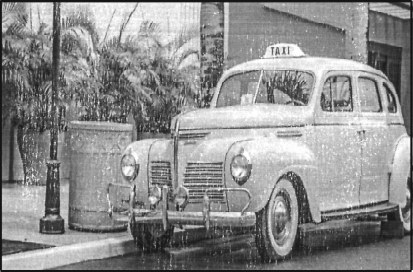
Original CBSE photograph of a Mumbai taxi. The quantities used in the equations are stated in the passage.
Based on the above information, answer the following questions:
Appeared in: 2023 · Basic · Main
(i) What are the fixed charges? [1 mark]
Show answer and solution
₹5 per journey
Let the fixed charge be ₹x per journey and the distance charge be ₹y per km.
x + 10y = 105 … (1)
x + 15y = 155 … (2)
Subtracting (1) from (2): 5y = 50.
Therefore, y = 10.
Substituting in (1): x + 100 = 105.
Therefore, the fixed charge is ₹5.
Checked against the corresponding official CBSE marking scheme.
(ii) What are the charges per km? [1 mark]
Show answer and solution
₹10 per km
Let x be the fixed charge and y the charge per km, in rupees.
x + 10y = 105 and x + 15y = 155
Subtracting gives 5y = 50.
Therefore, y = 10, or ₹10 per km.
Checked against the corresponding official CBSE marking scheme.
(iii) If fixed charges are ₹20 and charges per km are ₹10, then how much does Lokesh have to pay for travelling a distance of 10 km? [2 marks]
Show answer and solution
₹120
Fare = fixed charge + distance × charge per km
Using the new fixed charge stated in this alternative:
Fare = 20 + 10 × 10 = ₹120.
Checked against the corresponding official CBSE marking scheme.
OR
(iii) Find the total amount paid by Lokesh for travelling 10 km from home to office and 25 km from office to home. [Fixed charges and charges per km are as in (i) and (ii).] [2 marks]
Show answer and solution
₹360
From (i) and (ii), fixed charge = ₹5 per journey and distance charge = ₹10 per km.
Outward fare = 5 + 10 × 10 = ₹105
Return fare = 5 + 25 × 10 = ₹255
Total fare = 105 + 255 = ₹360.
The fixed charge applies to each of the two journeys.
Checked against the corresponding official CBSE marking scheme.
Basic4 marks
Case 2. Notebooks and pens from the school bookshop
Deepankar bought 3 notebooks and 2 pens for ₹80 and his friend Suryansh bought 4 notebooks and 3 pens for ₹110 from the school bookshop.
Original CBSE case illustration.Describe the figure
Original CBSE photograph of books, an open notebook and stationery. The quantities used in the equations are stated in the passage.
Based on the above information, answer the following questions:
Appeared in: 2024 · Basic · Main
(i) If the price of one notebook is ₹x and the price of one pen is ₹y, write the given situation algebraically. [1 mark]
Show answer and solution
3x + 2y = 80; 4x + 3y = 110
Cost = number of items × price of one item.
Deepankar: 3x + 2y = 80
Suryansh: 4x + 3y = 110
Checked against the corresponding official CBSE marking scheme.
(ii)(a) What is the price of one notebook? [2 marks]
Show answer and solution
₹20
Let x and y be the prices, in rupees, of a notebook and a pen respectively.
3x + 2y = 80 … (1)
4x + 3y = 110 … (2)
Multiplying (1) by 3: 9x + 6y = 240
Multiplying (2) by 2: 8x + 6y = 220
Subtracting gives x = 20.
Therefore, one notebook costs ₹20.
Checked against the corresponding official CBSE marking scheme.
OR
(ii)(b) What is the price of one pen? [2 marks]
Show answer and solution
₹10
Let x and y be the prices of a notebook and a pen, in rupees.
3x + 2y = 80 … (1)
4x + 3y = 110 … (2)
Multiplying (1) by 4: 12x + 8y = 320
Multiplying (2) by 3: 12x + 9y = 330
Subtracting gives y = 10.
Therefore, one pen costs ₹10.
Checked against the corresponding official CBSE marking scheme.
(iii) What is the total amount to be paid by Suryansh if he purchases 6 notebooks and 3 pens? [1 mark]
Show answer and solution
₹150
Notebook price = ₹20; pen price = ₹10.
Total cost = 6 × 20 + 3 × 10
Total cost = 120 + 30 = ₹150.
Checked against the corresponding official CBSE marking scheme.
Standard4 marks
Case 3. Tickets at an amusement park
Essel World is one of India’s largest amusement parks that offers a diverse range of thrilling rides, water attractions and entertainment options for visitors of all ages. The park is known for its iconic “Water Kingdom” section, making it a popular destination for family outings and fun-filled adventure. The ticket charges for the park are ₹150 per child and ₹250 per adult.
On a day, the cashier of the park found that 300 tickets were sold and an amount of ₹55,000 was collected.
Original CBSE case illustration.Describe the figure
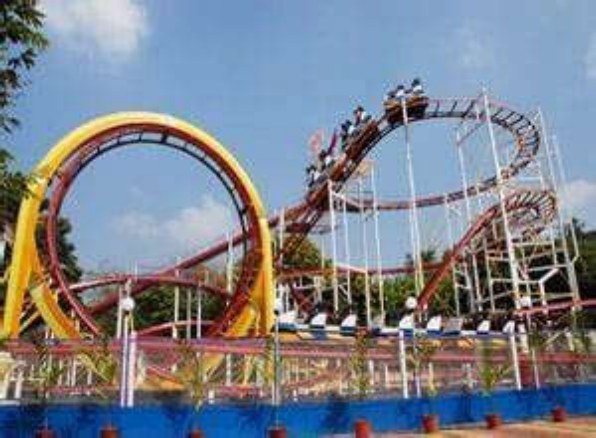
Original CBSE photograph of amusement-park rides. The quantities used in the equations are stated in the passage.
Based on the above, answer the following questions:
Appeared in: 2024 · Standard · Main
(i) If the number of children who visited is x and the number of adults who visited is y, write the given situation algebraically. [1 mark]
Show answer and solution
x + y = 300; 150x + 250y = 55000
Total tickets: x + y = 300
Total collection: 150x + 250y = 55000
Checked against the corresponding official CBSE marking scheme.
(ii)(a) How many children visited the amusement park that day? [2 marks]
Show answer and solution
200 children
Let x and y be the numbers of children and adults respectively.
x + y = 300 … (1)
Dividing the collection equation by 50 gives 3x + 5y = 1100 … (2).
Multiplying (1) by 5: 5x + 5y = 1500
Subtracting (2): 2x = 400
Therefore, x = 200 children.
Checked against the corresponding official CBSE marking scheme.
OR
(ii)(b) How many adults visited the amusement park that day? [2 marks]
Show answer and solution
100 adults
Let x and y be the numbers of children and adults respectively.
x + y = 300 … (1)
3x + 5y = 1100 … (2)
Multiplying (1) by 3: 3x + 3y = 900
Subtracting gives 2y = 200.
Therefore, y = 100 adults.
Checked against the corresponding official CBSE marking scheme.
(iii) How much amount will be collected if 250 children and 100 adults visit the amusement park? [1 mark]
Show answer and solution
₹62,500
Collection = 250 × 150 + 100 × 250
Collection = 37500 + 25000 = ₹62,500.
Checked against the corresponding official CBSE marking scheme.
Basic4 marks
Case 4. Comparing two telephone plans
A telecommunication company came up with two plans—plan A and plan B—for its customers. The plans are represented by linear equations where t represents the time (in minutes) bought and C represents the cost.
Plan A: 3C = 20t. Plan B: 3C = 10t + 300.
Original CBSE case illustration.Describe the figure
Original CBSE illustration of a telephone and communication tower. The quantities used in the equations are stated in the passage.
Based on the above information, answer the following questions:
Appeared in: 2025 · Basic · Main
(i) If you purchase plan B, how much initial amount do you have to pay? [1 mark]
Show answer and solution
₹100
For the initial amount, t = 0.
3C = 10 × 0 + 300
C = 300 ÷ 3 = ₹100.
Checked against the corresponding official CBSE marking scheme.
(ii) Charu purchased plan A. How many minutes did she buy for ₹250? [1 mark]
Show answer and solution
37.5 minutes
For plan A, 3C = 20t.
Substitute C = 250: 3 × 250 = 20t.
t = 750 ÷ 20 = 37.5 minutes.
Checked against the corresponding official CBSE marking scheme.
(iii)(a) At how many minutes do both plans charge the same amount? What is that amount? [2 marks]
Show answer and solution
30 minutes; ₹200
At the same time t and cost C: 3C = 20t and 3C = 10t + 300.
Therefore, 20t = 10t + 300.
10t = 300, so t = 30 minutes.
3C = 20 × 30 = 600
C = ₹200.
Checked against the corresponding official CBSE marking scheme.
OR
(iii)(b) Which plan is better if you want to buy 60 minutes? Give a reason for your answer. [2 marks]
Show answer and solution
Plan B; saves ₹100
At t = 60, plan A: C = (20 × 60) ÷ 3 = ₹400.
At t = 60, plan B: C = (10 × 60 + 300) ÷ 3 = ₹300.
Plan B costs ₹100 less, so it is better for 60 minutes.
Checked against the corresponding official CBSE marking scheme.
Standard4 marks
Case 5. Renting chairs and tables for a school event
A school is organizing a grand cultural event to show the talent of its students. To accommodate the guests, the school plans to rent chairs and tables from a local supplier. It finds that rent for each chair is ₹50 and for each table is ₹200. The school spends ₹30,000 for renting the chairs and tables. Also, the total number of items (chairs and tables) rented are 300.
Original CBSE case illustration.Describe the figure
Original CBSE photograph of chairs and tables arranged for an event. The quantities used in the equations are stated in the passage.
If the school rents x chairs and y tables, answer the following questions:
Appeared in: 2025 · Standard · Main
(i) Write down the pair of linear equations representing the given information. [1 mark]
Show answer and solution
x + y = 300; 50x + 200y = 30000
Here, x is the number of chairs and y is the number of tables.
Total items: x + y = 300
Total rent: 50x + 200y = 30000
Checked against the corresponding official CBSE marking scheme.
(ii)(a) Find the number of chairs and number of tables rented by the school. [2 marks]
Show answer and solution
200 chairs and 100 tables
Let x and y be the numbers of chairs and tables.
x + y = 300 … (1)
Dividing the rent equation by 50: x + 4y = 600 … (2).
Subtracting (1) from (2): 3y = 300.
y = 100
x = 300 − 100 = 200
Therefore, 200 chairs and 100 tables were rented.
Checked against the corresponding official CBSE marking scheme.
OR
(ii)(b) If the school wants to spend a maximum of ₹27,000 on 300 items (tables and chairs), find the number of chairs and tables it can rent. [2 marks]
Show answer and solution
At the full budget: 220 chairs and 80 tables
The official marking scheme uses the full ₹27,000 budget.
Let x and y be the numbers of chairs and tables.
x + y = 300 and 50x + 200y = 27000
Dividing the second equation by 50 gives x + 4y = 540.
Subtracting x + y = 300 gives 3y = 240.
y = 80
x = 300 − 80 = 220
Thus, 220 chairs and 80 tables use the full budget.
Because the question says “a maximum”, this is not the only affordable combination: fewer tables and more chairs also fit. In general, y is an integer from 0 to 80 and x = 300 − y.
Checked against the corresponding official CBSE marking scheme.
(iii) What is the maximum number of tables that can be rented in ₹30,000 if no chairs are rented? [1 mark]
Show answer and solution
150 tables
Maximum tables = total budget ÷ rent per table
Maximum tables = 30000 ÷ 200 = 150.
Checked against the corresponding official CBSE marking scheme.
Basic4 marks
Case 6. Calories burned on two exercise machines
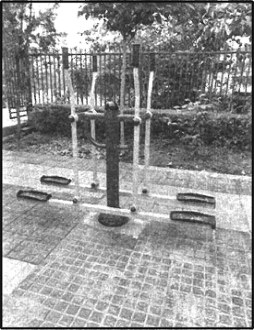
Seema daily goes to a park to exercise on machines available there. When Seema spent 15 minutes on exercise bicycle and 30 minutes on double cross walker, she received a message of burning 435 calories on her fitness watch. When she spent 30 minutes on exercise bicycle and 40 minutes on double cross walker, she received a message of burning 690 calories.
Original CBSE case illustration.Describe the figure
Original CBSE photograph of outdoor exercise equipment in a park. The quantities used in the equations are stated in the passage.
To find the number of calories burned per minute on each machine, answer the following:
Appeared in: 2026 · Basic · Main
(i) Represent the above situation in terms of a pair of linear equations in two variables. [1 mark]
Show answer and solution
15x + 30y = 435; 30x + 40y = 690
Let x and y be calories burned per minute on the bicycle and walker respectively.
First session: 15x + 30y = 435
Second session: 30x + 40y = 690
Checked against the corresponding official CBSE marking scheme.
(ii) Show that the equations have a unique solution. [1 mark]
Show answer and solution
A unique solution
The equations are 15x + 30y = 435 and 30x + 40y = 690.
The ratios of the x-coefficients and y-coefficients are = and = .
Since ≠ , the two lines intersect at one point.
Therefore, the equations have a unique solution.
Checked against the corresponding official CBSE marking scheme.
(iii)(a) Solve both equations to find the values of the variables using the elimination method. [2 marks]
Show answer and solution
Bicycle: 11 calories/min; walker: 9 calories/min
Let x and y be calories burned per minute on the bicycle and walker.
15x + 30y = 435 … (1)
30x + 40y = 690 … (2)
Multiplying (1) by 2: 30x + 60y = 870.
Subtracting (2): 20y = 180.
Therefore, y = 9.
In (1): 15x + 270 = 435.
15x = 165
Therefore, x = 11.
The rates are 11 calories/min on the bicycle and 9 calories/min on the walker.
Checked against the corresponding official CBSE marking scheme.
OR
(iii)(b) Solve both equations to find the values of the variables using the substitution method. [2 marks]
Show answer and solution
Bicycle: 11 calories/min; walker: 9 calories/min
Let x and y be calories burned per minute on the bicycle and walker.
Dividing 15x + 30y = 435 by 15 gives x + 2y = 29.
Therefore, x = 29 − 2y.
Substitute into 30x + 40y = 690:
30(29 − 2y) + 40y = 690
870 − 20y = 690
y = 9
x = 29 − 18 = 11
The rates are 11 calories/min on the bicycle and 9 calories/min on the walker.
Checked against the corresponding official CBSE marking scheme.
Standard4 marks · Accessible paper
Case 7. Giant-wheel rides and hoopla at a fair
Ankita went to a fair organised in an open ground near her school. After taking a round she decided to enjoy rides on the giant wheel and also play hoopla (a game in which you throw a ring on the items kept in a stall and if the ring covers any object completely, you get it).
The number of times she rides the giant wheel is 2 less than twice the number of times she played hoopla. Each ride costs ₹5 and a game of hoopla costs ₹6 and she spent ₹54 in the fair.
Based on the information given above, answer the following questions:
Appeared in: 2026 · Standard · Second Board Examination
(i) Taking x as the number of times she played hoopla and y as the number of rides on the wheel, represent the above statements algebraically. [2 marks]
Show answer and solution
y = 2x − 2; 6x + 5y = 54
The number of wheel rides is 2 less than twice the number of hoopla games.
Therefore, y = 2x − 2.
Total cost = ₹6 per hoopla game + ₹5 per wheel ride.
Therefore, 6x + 5y = 54.
Checked against the corresponding official CBSE marking scheme.
(ii) Solve the above equations for x and y. [2 marks]
Show answer and solution
x = 4 hoopla games; y = 6 wheel rides
Here, x counts hoopla games and y counts wheel rides.
Substitute y = 2x − 2 into 6x + 5y = 54.
6x + 5(2x − 2) = 54
16x − 10 = 54
x = 4
y = 2 × 4 − 2 = 6
Check: 6 × 4 + 5 × 6 = 24 + 30 = ₹54.
Checked against the corresponding official CBSE marking scheme.
Standard4 marks · Official sample
Case 8. Sanitizer sales in June and July
A student entrepreneur started a company that manufactures sanitizers in two sizes – small and large. The cost of a small bottle of sanitizer is ₹10 and that of a large bottle is ₹15. In June, the company sold 1000 bottles and recorded a total sale of ₹12,750. Seeing the increased demand, the company decided to increase the price of both sanitizer bottles by ₹2 each. In the next month, the company sold 2500 bottles and recorded a total sale of ₹34,250.
Based on the above information, answer the following questions:
Appeared in: 2026–27 · Standard · Official Sample
(i) Form a linear equation in two variables representing the sale for June. [1 mark]
Show answer and solution
10x + 15y = 12750
Let x and y be the numbers of small and large bottles sold in June.
June revenue = 10x + 15y.
Therefore, 10x + 15y = 12750.
Checked against the corresponding official CBSE marking scheme.
(ii) Form a linear equation in two variables representing the sale for July. [1 mark]
Show answer and solution
12u + 17v = 34250
Let u and v be the numbers of small and large bottles sold in July.
July prices: ₹12 per small bottle and ₹17 per large bottle.
Therefore, 12u + 17v = 34250.
The July counts are separate from the June counts; the two months are not one simultaneous system.
Checked against the corresponding official CBSE marking scheme.
(iii)(A) How many sanitizer bottles of each type were actually sold in June? [2 marks]
Show answer and solution
450 small and 550 large bottles
Let x and y count small and large bottles sold in June.
x + y = 1000 … (1)
10x + 15y = 12750 … (2)
Multiplying (1) by 10: 10x + 10y = 10000.
Subtracting from (2): 5y = 2750.
y = 550
x = 1000 − 550 = 450
Checked against the corresponding official CBSE marking scheme.
OR
(iii)(B) How many sanitizer bottles of each type were sold in July? [2 marks]
Show answer and solution
1650 small and 850 large bottles
Let u and v count small and large bottles sold in July.
u + v = 2500 … (1)
12u + 17v = 34250 … (2)
Multiplying (1) by 12: 12u + 12v = 30000.
Subtracting from (2): 5v = 4250.
v = 850
u = 2500 − 850 = 1650
Checked against the corresponding official CBSE marking scheme.
Questions students ask
How do I choose the two variables?
Choose the two unknown quantities asked about or needed to solve the case. State their meanings and units—for example, the price in rupees of one notebook and one pen.
Why should the June and July counts be separate?
The company sold different totals in the two months. June’s small and large bottle counts are one pair of unknowns; July’s counts are another. Combine each month’s revenue equation with that month’s total-bottle equation.
Why are fixed taxi charges added twice for a return trip?
There are two separate journeys. In Case 1’s last alternative, each journey carries a ₹5 fixed charge, so the total includes ₹10 in fixed charges.
Does a maximum budget give one unique furniture combination?
Not by itself. Case 5’s marking scheme uses the full ₹27,000 budget, giving 220 chairs and 80 tables. Combinations with fewer tables and more chairs can also stay within the maximum budget.
How do I check a calculated solution?
Substitute the values into both original equations. Then check whether the units and values make sense—for example, ticket counts must be non-negative whole numbers.
Can I use any solving method?
Follow the method specified in the question. Case 6 asks for elimination in one alternative and substitution in the other; both methods are shown separately.
How are the four marks split?
Use the marks printed beside the parts. These cases include 1 + 1 + 2, 1 + 2 + 1 and a 2 + 2 case. Where an OR appears, answer one alternative; both are solved here for practice.