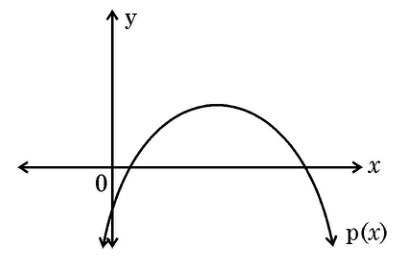
A zero of a polynomial is a value of x for which p(x) = 0; on its graph, it is an x-axis intersection. These 8 selected Polynomials case studies practise graph reading, relationships between zeroes and coefficients, and height models. Try each part before opening its solution.
A zero of p(x) is a value of x for which p(x) = 0. On the graph, read its x-axis intersections.
For p(x) = ax² + bx + c, a ≠ 0, with zeroes α and β: α + β = −b/a and αβ = c/a.
A quadratic with zeroes α and β has the form k(x − α)(x − β), where k ≠ 0.
The y-intercept is (0, p(0)). A reflected graph q(x) = −p(x) keeps its x-axis intersections.
Basic4 marks
Case 1. A rainbow and its graph
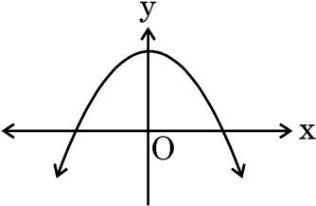
Rainbow is an arch of colours that is visible in the sky after rain or when water droplets are present in the atmosphere. The colours of the rainbow are generally red, orange, yellow, green, blue, indigo and violet. Each colour of the rainbow makes a parabola. We know that any quadratic polynomial p(x) = ax² + bx + c (a ≠ 0) represents a parabola on the graph paper.
Original CBSE case illustrations, including the accompanying photograph where supplied.
Describe the figure
The original page shows a rainbow photograph and a downward-opening parabola labelled y = f(x), crossing the x-axis on both sides of the y-axis.
Based on the above, answer the following questions:
Appeared in: 2023 · Basic · Main
(i) The graph of a rainbow y = f(x) is shown in the figure. Write the number of zeroes of the curve. [1 mark]
Show answer and solution
2 zeroes
The number of zeroes equals the number of points where the graph meets the x-axis.
The given curve meets the x-axis at two points.
Therefore, it has 2 zeroes.
Checked against the corresponding official CBSE marking scheme.
(ii) If the graph of a rainbow does not intersect the x-axis but intersects the y-axis at one point, then how many zeroes will it have? [1 mark]
Show answer and solution
0 zeroes
Zeroes are read from the x-axis, not the y-axis.
The graph does not meet the x-axis.
Therefore, it has no zeroes.
Checked against the corresponding official CBSE marking scheme.
(iii)(a) If the zeroes of a polynomial x² + (a + 1)x + b are 2 and −3, determine the values of a and b. [2 marks]
Show answer and solution
a = 0; b = −6
Sum of zeroes = −(coefficient of x) ÷ coefficient of x²
2 + (−3) = −(a + 1)
−1 = −a − 1
Therefore, a = 0.
Product of zeroes = constant term ÷ coefficient of x²
2 × (−3) = b
Therefore, b = −6.
Checked against the corresponding official CBSE marking scheme.
OR
(iii)(b) The polynomial x² − 2x − (7p + 3) represents a rainbow. If −4 is a zero of it, find the value of p. [2 marks]
Show answer and solution
p = 3
Since −4 is a zero, substitute x = −4.
(−4)² − 2(−4) − (7p + 3) = 0
16 + 8 − 7p − 3 = 0
21 − 7p = 0
Therefore, p = 3.
Checked against the corresponding official CBSE marking scheme.
Standard4 marks
Case 2. A honeycomb and polynomial zeroes
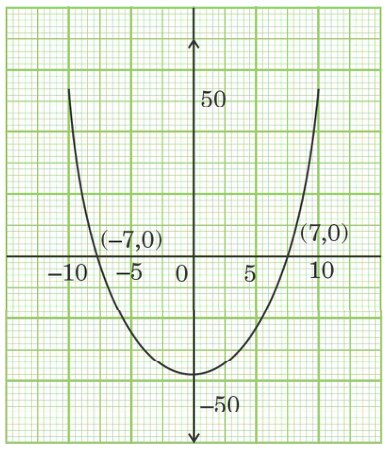
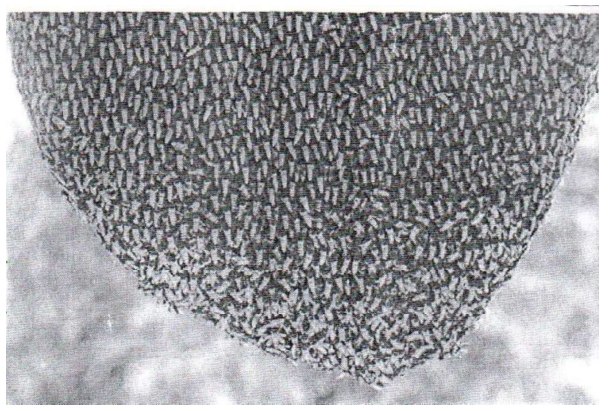
While playing in a garden, Samaira saw a honeycomb and asked her mother what is that. Her mother replied that it is a honeycomb made by honey bees to store honey. Also, she told her that the shape of the honeycomb formed is a mathematical structure. The mathematical representation of the honeycomb is shown in the graph.
Original CBSE case illustrations, including the accompanying photograph where supplied.
Describe the figure
A photograph of a honeycomb accompanies an upward-opening curve. The graph labels its x-axis intersections (−7, 0) and (7, 0).
Based on the above information, answer the following questions:
Appeared in: 2023 · Standard · Supplementary
(i) How many zeroes are there for the polynomial represented by the graph given? [1 mark]
Show answer and solution
2 zeroes
The graph meets the x-axis at two points.
Therefore, the polynomial has 2 zeroes.
Checked against the corresponding official CBSE marking scheme.
(ii) Write the zeroes of the polynomial. [1 mark]
Show answer and solution
−7 and 7
At a zero, the ordinate is 0.
The marked intersections are (−7, 0) and (7, 0).
Therefore, the zeroes are −7 and 7.
Checked against the corresponding official CBSE marking scheme.
(iii)(a) If the zeroes of a polynomial x² + (a + 1)x + b are 2 and −3, determine the values of a and b. [2 marks]
Show answer and solution
a = 0; b = −6
Sum of zeroes = −(coefficient of x) ÷ coefficient of x²
2 + (−3) = −(a + 1)
−1 = −a − 1
Therefore, a = 0.
Product of zeroes = constant term ÷ coefficient of x²
2 × (−3) = b
Therefore, b = −6.
Checked against the corresponding official CBSE marking scheme.
OR
(iii)(b) If the square of difference of the zeroes of the polynomial x² + px + 45 is 144, find the value of p. [2 marks]
Show answer and solution
p = ±18
Let α and β be the zeroes.
α + β = −p and αβ = 45
(α − β)² = (α + β)² − 4αβ
144 = (−p)² − 4 × 45
p² = 144 + 180 = 324
Therefore, p = ±18.
Checked against the corresponding official CBSE marking scheme.
Standard4 marks
Case 3. A dolphin jumps above the water
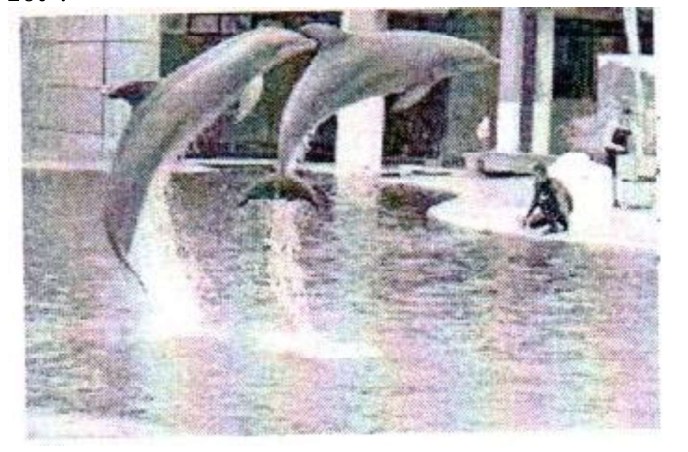
In a pool at an aquarium, a dolphin jumps out of the water travelling at 20 cm per second. Its height above water level after t seconds is given by h = 20t − 16t².
Original CBSE case illustration, including the accompanying photograph where supplied.
Describe the figure
The original photograph shows a dolphin jumping above a pool. Part (ii) supplies four labelled graph choices, reproduced with the question.
Based on the above, answer the following questions:
Checked against the corresponding official CBSE marking scheme.
(ii) Which of the following types of graph represents p(t)? [1 mark]
Show answer and solution
Graph (a)
The coefficient of t² is negative, so the parabola opens downward.
Its zeroes are 0 and .
Graph (a) passes through both these points on the time axis.
Checked against the corresponding official CBSE marking scheme.
(iii)(a) What would be the value of h at t = ? Interpret the result. [2 marks]
Show answer and solution
h = −6 cm; 6 cm below water level
h = 20t − 16t²
At t = , h = 20 × − 16 ×
h = 30 − 36 = −6 cm
The negative sign means the dolphin is 6 cm below water level.
Checked against the corresponding official CBSE marking scheme.
OR
(iii)(b) How much distance has the dolphin covered before hitting the water level again? [2 marks]
Show answer and solution
25 cm, using the speed model intended in the marking scheme
The non-zero time at which h = 0 is s.
Using the stated speed of 20 cm per second as intended in the CBSE marking scheme:
Distance = speed × time
Distance = 20 × = 25 cm.
This uses the paper’s stated-speed model; the height polynomial alone does not specify the full path length.
Checked against the corresponding official CBSE marking scheme.
Standard4 marks
Case 4. A ball thrown into the air
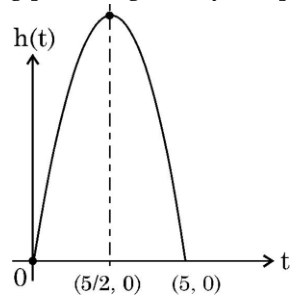
A ball is thrown in the air so that t seconds after it is thrown, its height h metre above its starting point is given by the polynomial h = 25t − 5t².
Original CBSE case illustration, including the accompanying photograph where supplied.
Describe the figure
The original height–time graph opens downward. Its time-axis intersections are labelled 0 and 5; a dashed vertical line through the highest point meets the time axis at 5/2.
Observe the graph of the polynomial and answer the following questions:
Appeared in: 2024 · Standard · Main
(i) Write zeroes of the given polynomial. [1 mark]
Show answer and solution
0 and 5
h = 5t(5 − t)
For a zero, 5t(5 − t) = 0.
Therefore, t = 0 or t = 5.
Checked against the corresponding official CBSE marking scheme.
(ii) Find the maximum height achieved by the ball. [1 mark]
Show answer and solution
31.25 m
The graph marks the highest point at t = s.
h = 25 × 2.5 − 5 × (2.5)²
h = 62.5 − 31.25 = 31.25 m.
Checked against the corresponding official CBSE marking scheme.
(iii)(a) After throwing upward, how much time did the ball take to reach the height of 30 m? [2 marks]
Show answer and solution
2 s and 3 s; first reaches 30 m at 2 s
25t − 5t² = 30
5t² − 25t + 30 = 0
t² − 5t + 6 = 0
(t − 2)(t − 3) = 0
Therefore, t = 2 s or 3 s.
The ball reaches 30 m on its way up at 2 s and again on its way down at 3 s.
Checked against the corresponding official CBSE marking scheme.
OR
(iii)(b) Find the two different values of t when the height of the ball was 20 m. [2 marks]
Show answer and solution
1 s and 4 s
25t − 5t² = 20
t² − 5t + 4 = 0
(t − 1)(t − 4) = 0
Therefore, t = 1 s or 4 s.
Checked against the corresponding official CBSE marking scheme.
Basic4 marks · Official sample
Case 5. Fountains in a pool
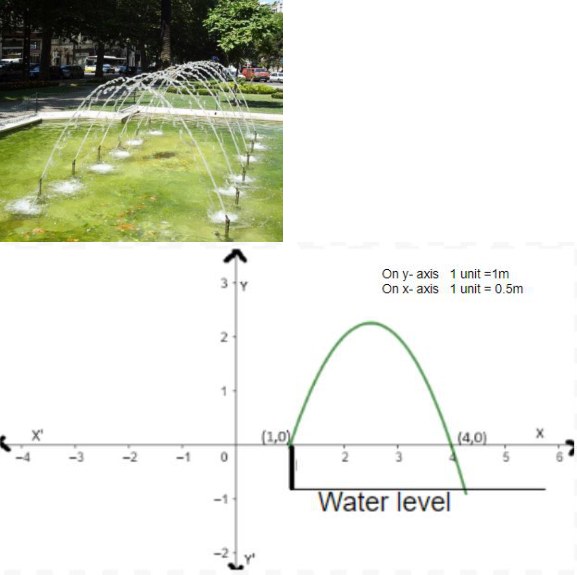
Radha, an aspiring landscape designer, is tasked with creating a visually captivating pool design that incorporates a unique arrangement of fountains. The challenge entails arranging the fountains in such a way that when water is thrown upwards, it forms the shape of a parabola. The graph of one such parabola is given below.
The height of each fountain rod above water level is 10 cm. The equation of the downward-facing parabola representing the water fountain is given by p(x) = −x² + 5x − 4.
Original CBSE case illustration, including the accompanying photograph where supplied.
Describe the figure
The original fountain photograph and graph are retained. The graph labels x-axis intersections (1, 0) and (4, 0), water level below the x-axis, and scales of 1 m per y-axis unit and 0.5 m per x-axis unit. Answers use the graph coordinates requested in the official scheme.
Based on the above information, answer the following questions:
Appeared in: 2024–25 · Basic · Official Sample
(i) Find the zeroes of the polynomial p(x) from the graph. [1 mark]
Show answer and solution
1 and 4
The graph meets the x-axis at (1, 0) and (4, 0).
Therefore, the zeroes are 1 and 4.
Checked against the corresponding official CBSE marking scheme.
(ii) Find the value of x at which water attains maximum height. [1 mark]
Show answer and solution
x =
The highest point lies midway between the two zeroes.
x = (1 + 4) ÷ 2
Therefore, x = .
Checked against the corresponding official CBSE marking scheme.
(iii)(A) If h is the maximum height attained by the water stream from the water level of the pool, find the value of h. [2 marks]
Show answer and solution
2.35 m
At x = , p(x) = −(2.5)² + 5(2.5) − 4
p(2.5) = −6.25 + 12.5 − 4 = 2.25 m
Height of fountain rod above water = 10 cm = 0.10 m
h = 2.25 + 0.10 = 2.35 m
Checked against the corresponding official CBSE marking scheme.
OR
(iii)(B) At what point(s) on the x-axis is the height of water above the x-axis 2 m? [2 marks]
Show answer and solution
(2, 0) and (3, 0), in the graph’s coordinates
−x² + 5x − 4 = 2
x² − 5x + 6 = 0
(x − 2)(x − 3) = 0
Therefore, x = 2 or 3.
The corresponding points on the x-axis are (2, 0) and (3, 0).
Checked against the corresponding official CBSE marking scheme.
Standard4 marks
Case 6. Building arches on a theatre backdrop
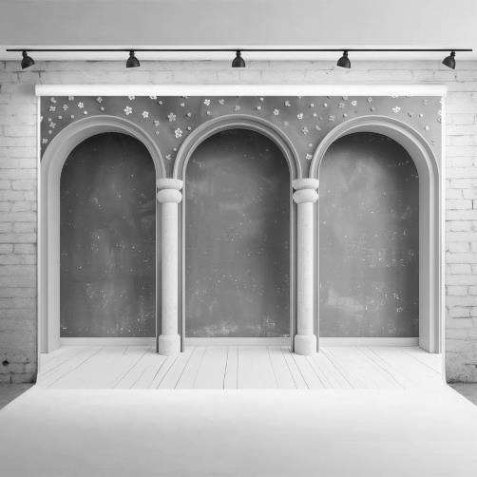
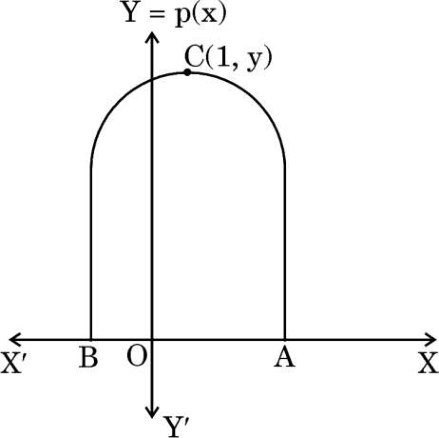
During a theatre drama, a backdrop of building arches was used. The shape of the curve shown below can be represented by the polynomial p(x) = −x² + 2x + 8, where x is the length (in feet) on stage level.
Original CBSE case illustrations, including the accompanying photograph where supplied.
Describe the figure
The original arch photograph accompanies a downward-opening parabola. Its highest point is C(1, y); it meets the stage-level x-axis at B to the left and A to the right of O.
Based on the figure given above, answer the following questions:
Appeared in: 2026 · Standard · Main
(i) Determine the height of the arch. [1 mark]
Show answer and solution
9 feet
The figure gives x = 1 at the highest point C.
p(1) = −1² + 2 × 1 + 8
Height of arch = 9 feet.
Checked against the corresponding official CBSE marking scheme.
(ii)(a) Find zeroes of the polynomial p(x). Which points on the graph represent the zeroes? [2 marks]
Show answer and solution
−2 and 4; points B and A
p(x) = −x² + 2x + 8
p(x) = −(x − 4)(x + 2)
For p(x) = 0, x = 4 or −2.
B(−2, 0) and A(4, 0) represent the zeroes.
Checked against the corresponding official CBSE marking scheme.
OR
(ii)(b) Find the span of the arch on the stage floor. [2 marks]
Show answer and solution
6 feet
p(x) = −(x − 4)(x + 2)
The x-axis intersections are B(−2, 0) and A(4, 0).
Span AB = 4 − (−2)
Therefore, the span is 6 feet.
Checked against the corresponding official CBSE marking scheme.
(iii) Write the coordinates of the point of intersection of the above curve with the y-axis. [1 mark]
Show answer and solution
(0, 8)
On the y-axis, x = 0.
p(0) = −0² + 2 × 0 + 8 = 8
Therefore, the intersection is (0, 8).
Checked against the corresponding official CBSE marking scheme.
Standard4 marks · Accessible paper
Case 7. A barrier chain between two posts
While playing badminton Ravi has set the barrier chain hung between two posts at the edge of the walkway of a street. It is hung in the shape of a parabola.
Based on the above information answer the following questions:
Appeared in: 2026 · Standard · Main
(a) Which type of polynomial (linear, quadratic, cubic etc.) is graphically represented by a parabola? [1 mark]
Show answer and solution
Quadratic polynomial
A polynomial of degree 2 has a parabolic graph.
Therefore, it is a quadratic polynomial.
Checked against the corresponding official CBSE marking scheme.
(b) If the polynomial represented by a parabola intersects the x-axis at −2 and 3 and the y-axis at −3, write the zeroes of the parabola. [1 mark]
Show answer and solution
−2 and 3
The x-coordinates of the x-axis intersections are the zeroes.
Therefore, the zeroes are −2 and 3.
Checked against the corresponding official CBSE marking scheme.
(c) Find the expression for the above polynomial. [2 marks]
Show answer and solution
p(x) = x² − x − 3
With zeroes −2 and 3, p(x) = k(x + 2)(x − 3), k ≠ 0.
The y-intercept is −3, so p(0) = −3.
−6k = −3, giving k = .
Therefore, p(x) = (x + 2)(x − 3).
p(x) = x² − x − 3.
The CBSE scheme gives k(x + 2)(x − 3); the stated y-intercept fixes k as .
Official factored form checked; TutorVertex completes the y-intercept condition.
OR
(c) If the zeroes of the polynomial are −5 and 3, find its expression. [2 marks]
Show answer and solution
One such polynomial: x² + 2x − 15
A polynomial with zeroes −5 and 3 is k(x + 5)(x − 3), k ≠ 0.
Taking k = 1 gives g(x) = (x + 5)(x − 3).
Therefore, one such polynomial is x² + 2x − 15.
Checked against the corresponding official CBSE marking scheme.
Basic4 marks
Case 8. A parabolic fountain in a park
A parabolic fountain in a park is designed such that its shape follows the polynomial p(x) = −x² + 6x − 5, where p(x) is the height (in metres) above ground level at a horizontal distance x metre from the origin.
Original CBSE case illustration, including the accompanying photograph where supplied.
Describe the figure
The original downward-opening curve is labelled p(x), with coordinate axes and the origin marked.
Based on the above, answer the following questions:
Appeared in: 2026 · Basic · Second Board Examination
(i) What are the zeroes of p(x)? [1 mark]
Show answer and solution
1 and 5
p(x) = −x² + 6x − 5
p(x) = −(x − 1)(x − 5)
For p(x) = 0, x = 1 or 5.
Checked against the corresponding official CBSE marking scheme.
(ii) What is the height of the fountain at a horizontal distance of 2 metres from the origin? [1 mark]
Show answer and solution
3 m
p(2) = −2² + 6 × 2 − 5
p(2) = −4 + 12 − 5
Therefore, the height is 3 m.
Checked against the corresponding official CBSE marking scheme.
(iii)(a) If q(x) is a reflection of p(x), that is q(x) = −p(x), write its value as a polynomial and draw its figure. [2 marks]
Show answer and solution
q(x) = x² − 6x + 5
q(x) = −p(x)
q(x) = −(−x² + 6x − 5)
q(x) = x² − 6x + 5
The reflected curve opens upward, has zeroes 1 and 5, and its lowest point is (3, −4).
TutorVertex solution sketch: reflection in the x-axis.
Checked against the corresponding official CBSE marking scheme.
OR
(iii)(b) At what horizontal distance from the origin does water hit the ground? [2 marks]
Show answer and solution
1 m or 5 m from the origin
At ground level, p(x) = 0.
−(x − 1)(x − 5) = 0
Therefore, x = 1 or 5.
The ground-level points are 1 m and 5 m from the origin.
Checked against the corresponding official CBSE marking scheme.
Questions students ask
How do I find zeroes from a polynomial graph?
Read the x-coordinates where the curve meets the x-axis, including where it only touches the axis. A y-axis crossing does not determine the number of zeroes.
Do two zeroes determine a unique quadratic polynomial?
No. Every non-zero multiple k(x − α)(x − β) has the same zeroes. A further condition, such as a y-intercept or leading coefficient, can fix k.
Why does the chain case use the y-intercept?
Its zeroes give p(x) = k(x + 2)(x − 3). The stated y-intercept gives p(0) = −3, so −6k = −3 and k = 1/2.
Why can a height question give two times?
A rising and then falling object can reach the same height twice. Keep both non-negative solutions, and distinguish the upward and downward journeys where the question requires it.
How are marks divided in these case studies?
Follow the printed marks. Most cases here use 1 + 1 + 2; the theatre case uses 1 + 2 + 1. The two-mark OR stays in its original position.
Should I answer both OR alternatives?
Answer one alternative where an OR is given, following the paper’s instructions. Both are solved here for practice; each case still carries four marks.
Does a negative height mean the calculation is wrong?
Not necessarily. It means the object is below the chosen reference level. In the dolphin case, −6 cm means 6 cm below water level.