Each case below carries 4 marks and tests prime factorisation, HCF or LCM through a real-world setting. Practise 3 distinct cases selected from CBSE supplementary papers in 2023 and 2025, representing 7 paper appearances. Read the whole passage, inspect the figure and try each part before opening its solution.
In a factor tree, each parent equals the product of its two branches. Continue until every leaf is prime.
HCF: take the common prime factors with their least exponents.
LCM: take every prime factor present with its greatest exponent.
For fixed totals split into equal groups, the largest valid group size gives the fewest groups.
Number of groups = total items ÷ items in each group.
Basic4 marks
Case 1. The factor-tree exhibition
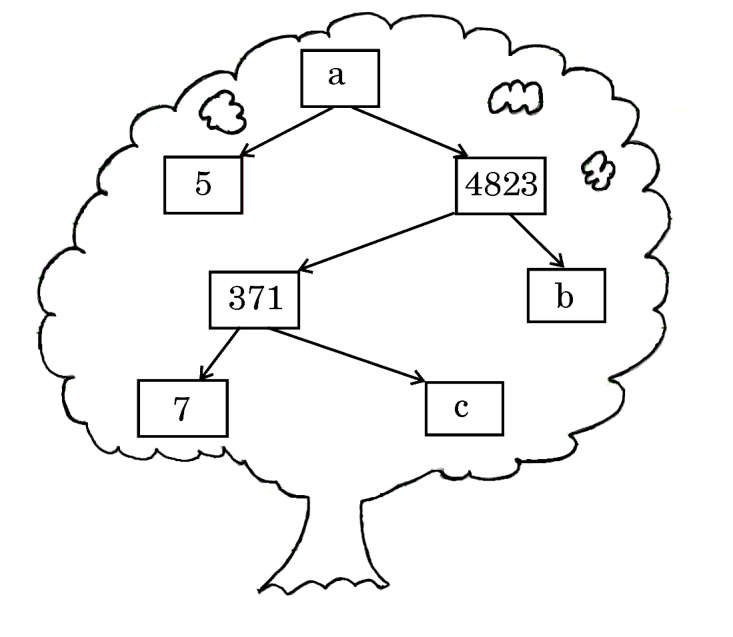
A Mathematics exhibition is being conducted in your school and one of your friends is making a model of a ‘factor tree’. He has some difficulty and asks for your help in completing a quiz for the audience.
Observe the following ‘factor tree’ and answer the following questions:
Original CBSE illustration, including the decorative tree outline.Describe the figure
The factor tree is drawn inside a decorative tree outline. The top box a splits into 5 and 4823. The box 4823 splits into 371 and b. The box 371 splits into 7 and c.
In a factor tree, a parent number is the product of its two branches.
a = 5 × 4823
a = 24115.
Answer matched to the official CBSE marking scheme.
(ii)(a) What is the value of b? [2 marks]
Show answer and solution
b = 13
4823 = 371 × b
b = 4823 ÷ 371
b = 13.
Answer matched to the official CBSE marking scheme.
OR
(ii)(b) What is the value of c? [2 marks]
Show answer and solution
c = 53
371 = 7 × c
c = 371 ÷ 7
c = 53.
Answer matched to the official CBSE marking scheme.
(iii) Write the prime factorisation of 24115. [1 mark]
Show answer and solution
24115 = 5 × 7 × 13 × 53
24115 = 5 × 4823
24115 = 5 × 371 × 13
24115 = 5 × 7 × 53 × 13
Therefore, 24115 = 5 × 7 × 13 × 53, where every factor is prime.
Answer matched to the official CBSE marking scheme.
Standard4 marks
Case 2. Books for a public library
February 14 is celebrated as International Book Giving Day and many countries in the world celebrate this day. Some people in India also started celebrating this day and donated the following number of books of various subjects to a public library:
History = 96, Science = 240, Mathematics = 336.
These books have to be arranged in minimum number of stacks such that each stack contains books of only one subject and the number of books on each stack is the same.
Based on the above information, answer the following questions:
Appeared in: 2023 supplementary · Standard · 30/C/1 · Q38 ; 2023 supplementary · Standard · 30/C/2 · Q36 ; 2023 supplementary · Standard · 30/C/3 · Q36
(i) How many books are arranged in each stack? [1 mark]
Show answer and solution
48 books
For the minimum number of equal-sized stacks, the number of books in each stack must be the greatest common divisor of 96, 240 and 336.
96 = 2⁵ × 3
240 = 2⁴ × 3 × 5
336 = 2⁴ × 3 × 7
HCF (96, 240, 336) = 2⁴ × 3 = 48.
Therefore, each stack contains 48 books.
Answer matched to the official CBSE marking scheme.
(ii) How many stacks are used to arrange all the Mathematics books? [1 mark]
Show answer and solution
7 stacks
Number of stacks = number of books ÷ books per stack
Number of Mathematics stacks = 336 ÷ 48
Therefore, 7 stacks are required.
Answer matched to the official CBSE marking scheme.
(iii)(a) Determine the total number of stacks that will be used for arranging all the books. [2 marks]
Show answer and solution
14 stacks
Number of History stacks = 96 ÷ 48 = 2
Number of Science stacks = 240 ÷ 48 = 5
Number of Mathematics stacks = 336 ÷ 48 = 7
Total number of stacks = 2 + 5 + 7 = 14.
Answer matched to the official CBSE marking scheme.
OR
(iii)(b) If the thickness of each book of History, Science and Mathematics is 1.8 cm, 2.2 cm and 2.5 cm respectively, then find the height of each stack of History, Science and Mathematics books. [2 marks]
Show answer and solution
History: 86.4 cm; Science: 105.6 cm; Mathematics: 120 cm
Height of a stack = number of books in the stack × thickness of one book
Height of each History stack = 48 × 1.8 = 86.4 cm
Height of each Science stack = 48 × 2.2 = 105.6 cm
Height of each Mathematics stack = 48 × 2.5 = 120 cm
Answer matched to the official CBSE marking scheme.
Standard4 marks · Accessible paper
Case 3. Seating at a science seminar
The science department of a college is conducting an international seminar in which the number of participants in Physics, Chemistry and Biology are 65, 91 and 117 respectively. The coordinator has made the arrangement such that in each room, the same number of participants are to be seated with all of them being in the same subject.
Based on the information given above, answer the following questions:
Appeared in: 2025 supplementary · Standard · 30(B)/S · Q36
(i) Find the HCF of 65, 91 and 117. [1 mark]
Show answer and solution
13
65 = 5 × 13
91 = 7 × 13
117 = 3² × 13
HCF (65, 91, 117) = 13.
Answer matched to the official CBSE marking scheme.
(ii) Find the LCM of 65, 91 and 117. [1 mark]
Show answer and solution
4095
65 = 5 × 13, 91 = 7 × 13 and 117 = 3² × 13.
The LCM contains each prime factor with its greatest exponent.
LCM (65, 91, 117) = 3² × 5 × 7 × 13
LCM = 4095.
Answer matched to the official CBSE marking scheme.
(iii)(a) Find the minimum number of rooms required based on the above conditions. [2 marks]
Show answer and solution
21 rooms
To minimise the number of rooms, seat the maximum possible equal number of participants in each room.
Participants per room = HCF (65, 91, 117) = 13
Rooms for Physics = 65 ÷ 13 = 5
Rooms for Chemistry = 91 ÷ 13 = 7
Rooms for Biology = 117 ÷ 13 = 9
Minimum number of rooms = 5 + 7 + 9 = 21.
Answer matched to the official CBSE marking scheme.
OR
(iii)(b) Find the minimum number of participants to be accommodated in each of the rooms. [2 marks]
Show answer and solution
1 participant per room
The equal number of participants per room must divide 65, 91 and 117.
Their common positive divisors are 1 and 13.
The least of these is 1.
Therefore, the minimum is 1 participant per room.
This alternative asks for the minimum participants per room; it does not require the minimum number of rooms.
Answer matched to the official CBSE marking scheme.
Questions students ask
How are marks divided in a case-study question?
Follow the marks printed beside each part. These cases carry 4 marks each: Case 1 uses 1 + 2 + 1; Cases 2 and 3 use 1 + 1 + 2. Answer one alternative where an OR is given.
How do I decide whether a case study needs HCF or LCM?
Translate the condition first. Equal groups that use every item need a common divisor; the largest possible group uses HCF. A smallest positive quantity divisible by all given numbers uses LCM. Explain why the condition applies before calculating.
Why does the minimum number of stacks use HCF?
The total number of books is fixed. Larger equal stacks mean fewer stacks. The largest stack size that divides every subject’s book count is their HCF.
Are minimum rooms and minimum participants per room the same condition?
No. Minimum rooms uses the greatest possible equal group size, 13 in Case 3. The alternative asks for the smallest possible positive group size, which is 1.
Do I need to answer both OR alternatives in the examination?
An OR gives an internal choice: answer one of those alternatives, following the paper’s instructions. Both alternatives are solved here for practice; each case still carries 4 marks.
How can I check a completed factor tree?
Check that each parent equals the product of its two branches. Then multiply the prime leaves: here, 5 × 7 × 13 × 53 = 24115.
Can I use HCF × LCM = product for three numbers?
The familiar identity applies to two positive integers. Do not assume it holds for three numbers. Use prime factorisation for the three-number HCF and LCM in Case 3.