Chapter 14 · Class 10 CBSE
Probability 2-Mark Questions Class 10: CBSE PYQs with Answers
Define the event, count the equally likely outcomes, then substitute into the probability formula. Practise official two-mark questions with given values, clear counting and NCERT-style working, including both alternatives of original OR pairs.
41 question groups · 48 worked alternatives · 7 OR pairs · 69 board-paper appearances · 2 official-sample appearances
Selected board questions are from 2023–2026 main and compartment/second-board papers. Official sample questions are from 2024–25 and 2026–27 Standard. Counts describe grouped questions and worked alternatives; subparts within one alternative share a worked solution. This selection is not a prediction of chapter weightage.
Formulas and a clear solution order
| What you need | Formula or rule |
|---|---|
| Probability of E | P(E) = for equally likely outcomes |
| Complement | P(E̅) = 1 − P(E) |
| Valid probability | 0 ≤ P(E) ≤ 1 |
| Certain / impossible event | P(S) = 1; P(∅) = 0 |
| Inclusive integer count | Last number − first number + 1 |
| Two fair six-sided dice | 6 × 6 = 36 ordered outcomes |
Each solution states the given values, required event, related formula, counting, substitution, calculation and final answer. Birthday and area-model solutions state their assumptions explicitly.
Showing 41 of 41 question groups
No questions match these filters. Change a filter or select Reset.
Questions on this page
- Question 1 · Playing cards and changed decks
- Question 2 · Playing cards and changed decks
- Question 3 · Playing cards and changed decks
- Question 4 · Playing cards and changed decks
- Question 5 · Playing cards and changed decks
- Question 6 · Playing cards and changed decks
- Question 7 · Playing cards and changed decks
- Question 8 · Playing cards and changed decks
- Question 9 · Playing cards and changed decks
- Question 10 · Numbered cards, discs and letter slips
- Question 11 · Numbered cards, discs and letter slips
- Question 12 · Numbered cards, discs and letter slips
- Question 13 · Numbered cards, discs and letter slips
- Question 14 · Numbered cards, discs and letter slips
- Question 15 · Numbered cards, discs and letter slips
- Question 16 · Numbered cards, discs and letter slips
- Question 17 · Numbered cards, discs and letter slips
- Question 18 · Numbered cards, discs and letter slips
- Question 19 · Numbered cards, discs and letter slips
- Question 20 · Numbered cards, discs and letter slips
- Question 21 · Balls, pens, shirts and coins
- Question 22 · Balls, pens, shirts and coins
- Question 23 · Balls, pens, shirts and coins
- Question 24 · Balls, pens, shirts and coins
- Question 25 · Balls, pens, shirts and coins
- Question 26 · Coins, dice and original OR choices
- Question 27 · Coins, dice and original OR choices
- Question 28 · Coins, dice and original OR choices
- Question 29 · Coins, dice and original OR choices
- Question 30 · Coins, dice and original OR choices
- Question 31 · Coins, dice and original OR choices
- Question 32 · Coins, dice and original OR choices
- Question 33 · Missing counts and probabilities
- Question 34 · Missing counts and probabilities
- Question 35 · Missing counts and probabilities
- Question 36 · Missing counts and probabilities
- Question 37 · Missing counts and probabilities
- Question 38 · Birthdays and area models
- Question 39 · Birthdays and area models
- Question 40 · Birthdays and area models
- Question 41 · Birthdays and area models
Playing cards and changed decks
Question 1
From a well-shuffled deck of 52 playing cards, all diamond cards are removed. A card is drawn at random from the remaining pack. Find the probability that it is a king.
Show solution
Given: 52 cards; all 13 diamonds removed; 3 kings remain.
To find: The probability of a king.
Formula: P(E) = , where n(E) is the number of favourable outcomes and n(S) is the number of equally likely possible outcomes.
Event: Let E be the event “a king”.
Counting: There are 52 − 13 = 39 cards left. Removing the diamond suit removes one of the four kings, leaving 3.
n(S) = 39; n(E) = 3.
Substitution: P(E) = .
Calculation: P(E) = .
Check: Each probability is between 0 and 1. Probabilities have no physical unit.
Answer: a king:
Question 2
All kings and queens are removed from a deck of 52 playing cards. A card is drawn at random from the remaining cards. Find the probability that (i) it is a red card; (ii) it is an ace.
Show solution
Given: 4 kings and 4 queens removed from 52 cards.
To find: The probability of (i) a red card; (ii) an ace.
Formula: P(E) = , where n(E) is the number of favourable outcomes and n(S) is the number of equally likely possible outcomes.
Event: Let E1 be the event “(i) a red card”.
Counting: 8 cards are removed, leaving 44. Four of the removed cards are red, so 26 − 4 = 22 red cards remain.
n(S) = 44; n(E1) = 22.
Substitution: P(E1) = .
Calculation: P(E1) = .
Event: Let E2 be the event “(ii) an ace”.
Counting: None of the four aces is a king or queen; all 4 aces remain among the 44 cards.
n(S) = 44; n(E2) = 4.
Substitution: P(E2) = .
Calculation: P(E2) = .
Check: Each probability is between 0 and 1. Probabilities have no physical unit.
Answer: (i) a red card: ; (ii) an ace:
Related method: Question 1.
Question 3
In a pack of 52 playing cards one card is lost. From the remaining cards, a card is drawn at random. Find the probability that it is the queen of hearts, if the lost card is a black card.
Show solution
Given: 52 cards originally; one black card lost; queen of hearts is red.
To find: The probability of the queen of hearts.
Formula: P(E) = , where n(E) is the number of favourable outcomes and n(S) is the number of equally likely possible outcomes.
Event: Let E be the event “the queen of hearts”.
Counting: 51 cards remain. The lost card is black, so the one queen of hearts is still present.
n(S) = 51; n(E) = 1.
Substitution: P(E) = .
Calculation: P(E) = .
Check: Each probability is between 0 and 1. Probabilities have no physical unit.
Answer: the queen of hearts:
Related method: Question 1.
Question 4
One card is drawn at random from a well-shuffled deck of 52 cards. Find the probability that the card (i) is the queen of hearts; (ii) is not a jack.
Show solution
Given: A standard deck of 52 cards, containing 1 queen of hearts and 4 jacks.
To find: The probability of (i) the queen of hearts; (ii) not a jack.
Formula: P(E) = , where n(E) is the number of favourable outcomes and n(S) is the number of equally likely possible outcomes.
Event: Let E1 be the event “(i) the queen of hearts”.
Counting: There is exactly one queen of hearts.
n(S) = 52; n(E1) = 1.
Substitution: P(E1) = .
Calculation: P(E1) = .
Event: Let E2 be the event “(ii) not a jack”.
Counting: 4 cards are jacks, so 52 − 4 = 48 are not jacks.
n(S) = 52; n(E2) = 48.
Related formula: P(E2) = 1 − P(E2̅), where E2̅ is the complementary event.
Substitution: P(E2) = 1 − .
Calculation: P(E2) = = .
Check: Each probability is between 0 and 1. Probabilities have no physical unit.
Answer: (i) the queen of hearts: ; (ii) not a jack:
Related method: Question 1.
Question 5
The king, queen and ace of clubs and diamonds are removed from a deck of 52 playing cards. The remaining cards are shuffled and one is drawn at random. Find the probability of getting (i) a club; (ii) a red card.
Show solution
Given: The king, queen and ace from each of clubs and diamonds are removed: 6 cards in total.
To find: The probability of (i) a club; (ii) a red card.
Formula: P(E) = , where n(E) is the number of favourable outcomes and n(S) is the number of equally likely possible outcomes.
Event: Let E1 be the event “(i) a club”.
Counting: 52 − 6 = 46 cards remain. Three clubs were removed, so 13 − 3 = 10 clubs remain.
n(S) = 46; n(E1) = 10.
Substitution: P(E1) = .
Calculation: P(E1) = .
Event: Let E2 be the event “(ii) a red card”.
Counting: Only three diamonds were removed from the 26 red cards; 26 − 3 = 23 red cards remain.
n(S) = 46; n(E2) = 23.
Substitution: P(E2) = .
Calculation: P(E2) = .
Check: Each probability is between 0 and 1. Probabilities have no physical unit.
Answer: (i) a club: ; (ii) a red card:
Related method: Question 1.
Question 6
While shuffling a pack of 52 cards, one card was accidentally dropped. Find the probability that the dropped card (i) is not a face card; (ii) is a black king.
Show solution
Given: 52 cards; 12 face cards (jacks, queens and kings); 2 black kings.
To find: The probability of (i) not a face card; (ii) a black king.
Formula: P(E) = , where n(E) is the number of favourable outcomes and n(S) is the number of equally likely possible outcomes.
Event: Let E1 be the event “(i) not a face card”.
Counting: 52 − 12 = 40 cards are not face cards.
n(S) = 52; n(E1) = 40.
Related formula: P(E1) = 1 − P(E1̅), where E1̅ is the complementary event.
Substitution: P(E1) = 1 − .
Calculation: P(E1) = = .
Event: Let E2 be the event “(ii) a black king”.
Counting: The kings of clubs and spades are the two black kings.
n(S) = 52; n(E2) = 2.
Substitution: P(E2) = .
Calculation: P(E2) = .
Check: Each probability is between 0 and 1. Probabilities have no physical unit.
Answer: (i) not a face card: ; (ii) a black king:
Related method: Question 1.
Question 7
All face cards are removed from a pack of 52 cards. A card is drawn at random from the remaining cards. Find the probability that it is (i) a spade; (ii) not an ace.
Show solution
Given: All 12 face cards removed; 40 cards remain.
To find: The probability of (i) a spade; (ii) not an ace.
Formula: P(E) = , where n(E) is the number of favourable outcomes and n(S) is the number of equally likely possible outcomes.
Event: Let E1 be the event “(i) a spade”.
Counting: Each suit loses its jack, queen and king. Thus 13 − 3 = 10 spades remain.
n(S) = 40; n(E1) = 10.
Substitution: P(E1) = .
Calculation: P(E1) = .
Event: Let E2 be the event “(ii) not an ace”.
Counting: All 4 aces remain, so 40 − 4 = 36 remaining cards are not aces.
n(S) = 40; n(E2) = 36.
Related formula: P(E2) = 1 − P(E2̅), where E2̅ is the complementary event.
Substitution: P(E2) = 1 − .
Calculation: P(E2) = = .
Check: Each probability is between 0 and 1. Probabilities have no physical unit.
Answer: (i) a spade: ; (ii) not an ace:
Related method: Question 1.
Question 8
From a pack of 52 cards, all aces and all kings are removed. A card is drawn at random from the remaining cards. Find the probability that it is (i) a face card; (ii) a red card.
Show solution
Given: 4 aces and 4 kings removed; 44 cards remain.
To find: The probability of (i) a face card; (ii) a red card.
Formula: P(E) = , where n(E) is the number of favourable outcomes and n(S) is the number of equally likely possible outcomes.
Event: Let E1 be the event “(i) a face card”.
Counting: Of the 12 face cards, the 4 kings are removed. The 4 jacks and 4 queens remain: 8 face cards.
n(S) = 44; n(E1) = 8.
Substitution: P(E1) = .
Calculation: P(E1) = .
Event: Let E2 be the event “(ii) a red card”.
Counting: Two red aces and two red kings are removed, so 26 − 4 = 22 red cards remain.
n(S) = 44; n(E2) = 22.
Substitution: P(E2) = .
Calculation: P(E2) = .
Check: Each probability is between 0 and 1. Probabilities have no physical unit.
Answer: (i) a face card: ; (ii) a red card:
Related method: Question 1.
Question 9
All the red face cards are removed from a pack of 52 playing cards. The remaining cards are shuffled and a card is drawn at random. Find the probability of getting (i) a red card; (ii) a king or queen.
Show solution
Given: 6 red face cards removed; 46 cards remain.
To find: The probability of (i) a red card; (ii) a king or queen.
Formula: P(E) = , where n(E) is the number of favourable outcomes and n(S) is the number of equally likely possible outcomes.
Event: Let E1 be the event “(i) a red card”.
Counting: 26 − 6 = 20 red cards remain.
n(S) = 46; n(E1) = 20.
Substitution: P(E1) = .
Calculation: P(E1) = .
Event: Let E2 be the event “(ii) a king or queen”.
Counting: Only the black kings and black queens remain: 2 + 2 = 4. A card cannot be both a king and a queen.
n(S) = 46; n(E2) = 4.
Substitution: P(E2) = .
Calculation: P(E2) = .
Check: Each probability is between 0 and 1. Probabilities have no physical unit.
Answer: (i) a red card: ; (ii) a king or queen:
Related method: Question 1.
Numbered cards, discs and letter slips
Question 10
A box contains 90 discs, numbered from 1 to 90. One disc is drawn at random. Find the probability that it bears a multiple of 15.
Show solution
Given: 90 discs numbered 1–90, inclusive.
To find: The probability of a multiple of 15.
Formula: P(E) = , where n(E) is the number of favourable outcomes and n(S) is the number of equally likely possible outcomes.
Event: Let E be the event “a multiple of 15”.
Counting: The favourable numbers are 15, 30, 45, 60, 75 and 90: 6 numbers.
n(S) = 90; n(E) = 6.
Substitution: P(E) = .
Calculation: P(E) = .
Check: Each probability is between 0 and 1. Probabilities have no physical unit.
Answer: a multiple of 15:
Question 11
A box contains 20 discs numbered from 1 to 20. One disc is drawn at random. Find the probability that its number is (i) a two-digit number; (ii) less than 10.
Show solution
Given: 20 equally selectable discs numbered 1–20, inclusive.
To find: The probability of (i) a two-digit number; (ii) a number less than 10.
Formula: P(E) = , where n(E) is the number of favourable outcomes and n(S) is the number of equally likely possible outcomes.
Event: Let E1 be the event “(i) a two-digit number”.
Counting: The two-digit numbers are 10–20, giving 20 − 10 + 1 = 11.
n(S) = 20; n(E1) = 11.
Substitution: P(E1) = .
Calculation: P(E1) = .
Event: Let E2 be the event “(ii) a number less than 10”.
Counting: The favourable numbers are 1–9: 9 numbers.
n(S) = 20; n(E2) = 9.
Substitution: P(E2) = .
Calculation: P(E2) = .
Check: Each probability is between 0 and 1. Probabilities have no physical unit.
Answer: (i) a two-digit number: ; (ii) a number less than 10:
Related method: Question 10.
Question 12
A bag contains 30 discs numbered from 1 to 30. One disc is drawn at random. Find the probability that its number is (a) divisible by 6; (b) greater than 25.
Show solution
Given: 30 discs numbered 1–30, inclusive.
To find: The probability of (a) divisible by 6; (b) greater than 25.
Formula: P(E) = , where n(E) is the number of favourable outcomes and n(S) is the number of equally likely possible outcomes.
Event: Let E1 be the event “(a) divisible by 6”.
Counting: The multiples are 6, 12, 18, 24 and 30: 5 numbers.
n(S) = 30; n(E1) = 5.
Substitution: P(E1) = .
Calculation: P(E1) = .
Event: Let E2 be the event “(b) greater than 25”.
Counting: The numbers are 26, 27, 28, 29 and 30: 5 numbers.
n(S) = 30; n(E2) = 5.
Substitution: P(E2) = .
Calculation: P(E2) = .
Check: Each probability is between 0 and 1. Probabilities have no physical unit.
Answer: (a) divisible by 6: ; (b) greater than 25:
Related method: Question 10.
Question 13
An integer is chosen at random from the integers 1 to 50. Find the probability that the selected integer is divisible by 6.
Show solution
Given: The integers 1–50, inclusive, are equally likely.
To find: The probability of divisible by 6.
Formula: P(E) = , where n(E) is the number of favourable outcomes and n(S) is the number of equally likely possible outcomes.
Event: Let E be the event “divisible by 6”.
Counting: The multiples are 6, 12, 18, 24, 30, 36, 42 and 48: 8 integers.
n(S) = 50; n(E) = 8.
Substitution: P(E) = .
Calculation: P(E) = .
Check: Each probability is between 0 and 1. Probabilities have no physical unit.
Answer: divisible by 6:
Related method: Question 10.
Question 14
There are 80 cards numbered from 1 to 80. One is drawn at random. Find the probability that its number is not divisible by 8.
Show solution
Given: 80 cards numbered 1–80, inclusive.
To find: The probability of not divisible by 8.
Formula: P(E) = , where n(E) is the number of favourable outcomes and n(S) is the number of equally likely possible outcomes.
Event: Let E be the event “not divisible by 8”.
Counting: The multiples 8, 16, …, 80 number 80 ÷ 8 = 10. Thus 80 − 10 = 70 cards are favourable.
n(S) = 80; n(E) = 70.
Related formula: P(E) = 1 − P(E̅), where E̅ is the complementary event.
Substitution: P(E) = 1 − .
Calculation: P(E) = = .
Check: Each probability is between 0 and 1. Probabilities have no physical unit.
Answer: not divisible by 8:
Related method: Question 10.
Question 15
A bag contains cards numbered from 5 to 100, each bearing a different number. One card is drawn at random. Find the probability that its number is (i) a perfect square; (ii) a two-digit number.
Show solution
Given: Cards numbered 5–100, inclusive; total = 100 − 5 + 1 = 96.
To find: The probability of (i) a perfect square; (ii) a two-digit number.
Formula: P(E) = , where n(E) is the number of favourable outcomes and n(S) is the number of equally likely possible outcomes.
Event: Let E1 be the event “(i) a perfect square”.
Counting: The squares in the range are 9, 16, 25, 36, 49, 64, 81 and 100: 8 numbers.
n(S) = 96; n(E1) = 8.
Substitution: P(E1) = .
Calculation: P(E1) = .
Event: Let E2 be the event “(ii) a two-digit number”.
Counting: The two-digit numbers run from 10 to 99, giving 99 − 10 + 1 = 90.
n(S) = 96; n(E2) = 90.
Substitution: P(E2) = .
Calculation: P(E2) = .
Check: Each probability is between 0 and 1. Probabilities have no physical unit.
Answer: (i) a perfect square: ; (ii) a two-digit number:
Related method: Question 10.
Question 16
A bag contains balls numbered 2 to 91, each bearing a different number. One ball is drawn at random. Find the probability that (i) it bears a two-digit number; (ii) it bears a multiple of 1.
Show solution
Given: Balls numbered 2–91, inclusive; total = 91 − 2 + 1 = 90.
To find: The probability of (i) a two-digit number; (ii) a multiple of 1.
Formula: P(E) = , where n(E) is the number of favourable outcomes and n(S) is the number of equally likely possible outcomes.
Event: Let E1 be the event “(i) a two-digit number”.
Counting: The numbers are 10–91, giving 91 − 10 + 1 = 82.
n(S) = 90; n(E1) = 82.
Substitution: P(E1) = .
Calculation: P(E1) = .
Event: Let E2 be the event “(ii) a multiple of 1”.
Counting: Every integer is a multiple of 1. All 90 balls are favourable, so this is a certain event.
n(S) = 90; n(E2) = 90.
Substitution: P(E2) = .
Calculation: P(E2) = 1.
Check: Each probability is between 0 and 1. Probabilities have no physical unit.
Answer: (i) a two-digit number: ; (ii) a multiple of 1: 1
Related method: Question 10.
The question paper prints “multiple of 1”. This wording is retained; it gives a certain event.
Question 17
A box contains 120 discs numbered from 1 to 120. One disc is drawn at random. Find the probability that (i) it bears a two-digit number; (ii) its number is a perfect square.
Show solution
Given: 120 discs numbered 1–120, inclusive.
To find: The probability of (i) a two-digit number; (ii) a perfect square.
Formula: P(E) = , where n(E) is the number of favourable outcomes and n(S) is the number of equally likely possible outcomes.
Event: Let E1 be the event “(i) a two-digit number”.
Counting: The two-digit numbers 10–99 give 99 − 10 + 1 = 90.
n(S) = 120; n(E1) = 90.
Substitution: P(E1) = .
Calculation: P(E1) = .
Event: Let E2 be the event “(ii) a perfect square”.
Counting: The squares are 1, 4, 9, 16, 25, 36, 49, 64, 81 and 100: 10 numbers. The next square, 121, exceeds 120.
n(S) = 120; n(E2) = 10.
Substitution: P(E2) = .
Calculation: P(E2) = .
Check: Each probability is between 0 and 1. Probabilities have no physical unit.
Answer: (i) a two-digit number: ; (ii) a perfect square:
Related method: Question 10.
Question 18
A box contains 40 balls numbered from 21 to 60. One ball is drawn at random. Find the probability that it bears (i) a perfect square; (ii) a multiple of 8.
Show solution
Given: 40 balls numbered 21–60, inclusive.
To find: The probability of (i) a perfect square; (ii) a multiple of 8.
Formula: P(E) = , where n(E) is the number of favourable outcomes and n(S) is the number of equally likely possible outcomes.
Event: Let E1 be the event “(i) a perfect square”.
Counting: The squares in 21–60 are 25, 36 and 49. The next square, 64, is outside the range.
n(S) = 40; n(E1) = 3.
Substitution: P(E1) = .
Calculation: P(E1) = .
Event: Let E2 be the event “(ii) a multiple of 8”.
Counting: The multiples are 24, 32, 40, 48 and 56: 5 numbers.
n(S) = 40; n(E2) = 5.
Substitution: P(E2) = .
Calculation: P(E2) = .
Check: Each probability is between 0 and 1. Probabilities have no physical unit.
Answer: (i) a perfect square: ; (ii) a multiple of 8:
Related method: Question 10.
Question 19
There are 32 slips numbered from 20 to 51. One slip is picked at random. Find the probability that its number is (i) prime; (ii) divisible by 5.
Show solution
Given: 32 slips numbered 20–51, inclusive.
To find: The probability of (i) a prime number; (ii) divisible by 5.
Formula: P(E) = , where n(E) is the number of favourable outcomes and n(S) is the number of equally likely possible outcomes.
Event: Let E1 be the event “(i) a prime number”.
Counting: The primes are 23, 29, 31, 37, 41, 43 and 47: 7 numbers.
n(S) = 32; n(E1) = 7.
Substitution: P(E1) = .
Calculation: P(E1) = .
Event: Let E2 be the event “(ii) divisible by 5”.
Counting: The numbers are 20, 25, 30, 35, 40, 45 and 50: 7 numbers.
n(S) = 32; n(E2) = 7.
Substitution: P(E2) = .
Calculation: P(E2) = .
Check: Each probability is between 0 and 1. Probabilities have no physical unit.
Answer: (i) a prime number: ; (ii) divisible by 5:
Related method: Question 10.
Question 20
Alternative (a)
A number is selected at random from 30, 31, 32, …, 60. Find the probability that it is (i) prime; (ii) a multiple of 6.
Show solution
Given: 31 integers from 30 to 60, inclusive.
To find: The probability of (i) prime; (ii) a multiple of 6.
Formula: P(E) = , where n(E) is the number of favourable outcomes and n(S) is the number of equally likely possible outcomes.
Event: Let E1 be the event “(i) prime”.
Counting: The primes are 31, 37, 41, 43, 47, 53 and 59: 7 numbers.
n(S) = 31; n(E1) = 7.
Substitution: P(E1) = .
Calculation: P(E1) = .
Event: Let E2 be the event “(ii) a multiple of 6”.
Counting: The multiples are 30, 36, 42, 48, 54 and 60: 6 numbers.
n(S) = 31; n(E2) = 6.
Substitution: P(E2) = .
Calculation: P(E2) = .
Check: Each probability is between 0 and 1. Probabilities have no physical unit.
Answer: (i) prime: ; (ii) a multiple of 6:
Related method: Question 10.
OR
Alternative (b)
Slips bearing the letters of BACKGROUND are mixed in a bowl. One is picked at random. Find the probability that its letter (i) is a vowel; (ii) is present in the word BALL.
Show solution
Given: BACKGROUND contains 10 letters, each occurring once: B, A, C, K, G, R, O, U, N, D.
To find: The probability of (i) a vowel; (ii) present in BALL.
Formula: P(E) = , where n(E) is the number of favourable outcomes and n(S) is the number of equally likely possible outcomes.
Event: Let E1 be the event “(i) a vowel”.
Counting: The vowels are A, O and U: 3 slips.
n(S) = 10; n(E1) = 3.
Substitution: P(E1) = .
Calculation: P(E1) = .
Event: Let E2 be the event “(ii) present in BALL”.
Counting: BALL contains the letter types B, A and L. BACKGROUND has B and A but no L, so 2 slips are favourable.
n(S) = 10; n(E2) = 2.
Substitution: P(E2) = .
Calculation: P(E2) = .
Check: Each probability is between 0 and 1. Probabilities have no physical unit.
Answer: (i) a vowel: ; (ii) present in BALL:
Related method: Question 10.
Balls, pens, shirts and coins
Question 21
A bag contains 4 red, 3 blue and 2 yellow balls. One ball is drawn at random. Find the probability that it is (i) red; (ii) yellow.
Show solution
Given: 4 red, 3 blue and 2 yellow balls; 9 balls in total.
To find: The probability of (i) red; (ii) yellow.
Formula: P(E) = , where n(E) is the number of favourable outcomes and n(S) is the number of equally likely possible outcomes.
Event: Let E1 be the event “(i) red”.
Counting: 4 + 3 + 2 = 9 balls are possible; 4 are red.
n(S) = 9; n(E1) = 4.
Substitution: P(E1) = .
Calculation: P(E1) = .
Event: Let E2 be the event “(ii) yellow”.
Counting: The same 9 balls are possible; 2 are yellow.
n(S) = 9; n(E2) = 2.
Substitution: P(E2) = .
Calculation: P(E2) = .
Check: Each probability is between 0 and 1. Probabilities have no physical unit.
Answer: (i) red: ; (ii) yellow:
Question 22
15 defective pens are accidentally mixed with 145 good ones. One pen is taken out at random. Find the probability that it is good.
Show solution
Given: 145 good pens and 15 defective pens.
To find: The probability of a good pen.
Formula: P(E) = , where n(E) is the number of favourable outcomes and n(S) is the number of equally likely possible outcomes.
Event: Let E be the event “a good pen”.
Counting: Total pens = 145 + 15 = 160; 145 are good.
n(S) = 160; n(E) = 145.
Substitution: P(E) = .
Calculation: P(E) = .
Check: Each probability is between 0 and 1. Probabilities have no physical unit.
Answer: a good pen:
Related method: Question 21.
Question 23
A lot consists of 165 ball pens, of which 30 are defective. Rakshita will buy a pen if it is good. The shopkeeper draws one at random. Find the probability that she will buy it.
Show solution
Given: 165 pens in total; 30 defective; only good pens are acceptable.
To find: The probability of a pen Rakshita will buy.
Formula: P(E) = , where n(E) is the number of favourable outcomes and n(S) is the number of equally likely possible outcomes.
Event: Let E be the event “a pen Rakshita will buy”.
Counting: Good pens = 165 − 30 = 135.
n(S) = 165; n(E) = 135.
Substitution: P(E) = .
Calculation: P(E) = .
Check: Each probability is between 0 and 1. Probabilities have no physical unit.
Answer: a pen Rakshita will buy:
Related method: Question 21.
Question 24
A carton contains 60 shirts: 48 good, 8 with major defects and 4 with minor defects. Nigam accepts only good shirts, while Anmol rejects only shirts with major defects. One shirt is drawn at random. Find the probability that it is acceptable to Anmol.
Show solution
Given: 48 good shirts, 8 with major defects and 4 with minor defects; Anmol rejects only major defects.
To find: The probability of acceptable to Anmol.
Formula: P(E) = , where n(E) is the number of favourable outcomes and n(S) is the number of equally likely possible outcomes.
Event: Let E be the event “acceptable to Anmol”.
Counting: Anmol accepts good shirts and shirts with minor defects: 48 + 4 = 52. Nigam’s acceptance rule is not used for this event.
n(S) = 60; n(E) = 52.
Substitution: P(E) = .
Calculation: P(E) = .
Check: Each probability is between 0 and 1. Probabilities have no physical unit.
Answer: acceptable to Anmol:
Related method: Question 21.
Question 25
Alternative (a)
A card is drawn at random from 50 cards numbered 1 to 50. Find the probability that its number is a perfect square.
Show solution
Given: 50 cards numbered 1–50, inclusive.
To find: The probability of a perfect square.
Formula: P(E) = , where n(E) is the number of favourable outcomes and n(S) is the number of equally likely possible outcomes.
Event: Let E be the event “a perfect square”.
Counting: The squares are 1, 4, 9, 16, 25, 36 and 49: 7 numbers.
n(S) = 50; n(E) = 7.
Substitution: P(E) = .
Calculation: P(E) = .
Check: Each probability is between 0 and 1. Probabilities have no physical unit.
Answer: a perfect square:
Related method: Question 21.
OR
Alternative (b)
A piggy bank contains fifty ₹1 coins, one hundred ₹2 coins and one hundred and fifty ₹5 coins. Each coin is equally likely to fall out when the bank is turned upside down. Find the probability that the coin that falls out is not a ₹2 coin.
Show solution
Given: 50 coins of ₹1, 100 coins of ₹2 and 150 coins of ₹5; each individual coin is equally likely.
To find: The probability of not a ₹2 coin.
Formula: P(E) = , where n(E) is the number of favourable outcomes and n(S) is the number of equally likely possible outcomes.
Event: Let E be the event “not a ₹2 coin”.
Counting: Total coins = 50 + 100 + 150 = 300. Favourable coins = 50 + 150 = 200. Count coins, not their monetary values.
n(S) = 300; n(E) = 200.
Related formula: P(E) = 1 − P(E̅), where E̅ is the complementary event.
Substitution: P(E) = 1 − .
Calculation: P(E) = = .
Check: Each probability is between 0 and 1. Probabilities have no physical unit.
Answer: not a ₹2 coin:
Related method: Question 21.
Coins, dice and original OR choices
Question 26
A fair coin is tossed twice. Find the probability of getting at most one head.
Show solution
Given: Two independent tosses of a fair coin; S = {HH, HT, TH, TT}.
To find: The probability of at most one head.
Formula: P(E) = , where n(E) is the number of favourable outcomes and n(S) is the number of equally likely possible outcomes.
Event: Let E be the event “at most one head”.
Counting: At most one means zero or one head. The favourable outcomes are TT, HT and TH.
n(S) = 4; n(E) = 3.
Substitution: P(E) = .
Calculation: P(E) = .
Check: Each probability is between 0 and 1. Probabilities have no physical unit.
Answer: at most one head:
Question 27
Three coins are tossed together. (i) Write all possible outcomes. (ii) Find the probability of having at most two heads.
Show solution
Given: Use the standard model of three fair, independently tossed coins.
To find: The probability of (ii) at most two heads.
Formula: P(E) = , where n(E) is the number of favourable outcomes and n(S) is the number of equally likely possible outcomes.
Sample space: (i) S = {HHH, HHT, HTH, THH, HTT, THT, TTH, TTT}.
Event: Let E be the event “(ii) at most two heads”.
Counting: The eight outcomes are HHH, HHT, HTH, THH, HTT, THT, TTH and TTT. Only HHH has more than two heads.
n(S) = 8; n(E) = 7.
Related formula: P(E) = 1 − P(E̅), where E̅ is the complementary event.
Substitution: P(E) = 1 − .
Calculation: P(E) = = .
Check: Each probability is between 0 and 1. Probabilities have no physical unit.
Answer: (i) S = {HHH, HHT, HTH, THH, HTT, THT, TTH, TTT}; (ii) at most two heads:
Related method: Question 26.
Question 28
Alternative (a)
An unbiased die is thrown once. Find the probability of getting (i) a number greater than 3; (ii) an even prime number.
Show solution
Given: A fair die with outcomes S = {1, 2, 3, 4, 5, 6}.
To find: The probability of (i) greater than 3; (ii) an even prime number.
Formula: P(E) = , where n(E) is the number of favourable outcomes and n(S) is the number of equally likely possible outcomes.
Event: Let E1 be the event “(i) greater than 3”.
Counting: The favourable outcomes are 4, 5 and 6.
n(S) = 6; n(E1) = 3.
Substitution: P(E1) = .
Calculation: P(E1) = .
Event: Let E2 be the event “(ii) an even prime number”.
Counting: 2 is the only even prime number.
n(S) = 6; n(E2) = 1.
Substitution: P(E2) = .
Calculation: P(E2) = .
Check: Each probability is between 0 and 1. Probabilities have no physical unit.
Answer: (i) greater than 3: ; (ii) an even prime number:
Related method: Question 26.
OR
Alternative (b)
A box contains 5 red, 8 white and 4 green marbles. One marble is drawn at random. Find the probability of (i) getting a white marble; (ii) not getting a green marble.
Show solution
Given: 5 red, 8 white and 4 green marbles; total 17.
To find: The probability of (i) white; (ii) not green.
Formula: P(E) = , where n(E) is the number of favourable outcomes and n(S) is the number of equally likely possible outcomes.
Event: Let E1 be the event “(i) white”.
Counting: 5 + 8 + 4 = 17 marbles; 8 are white.
n(S) = 17; n(E1) = 8.
Substitution: P(E1) = .
Calculation: P(E1) = .
Event: Let E2 be the event “(ii) not green”.
Counting: 5 + 8 = 13 marbles are not green.
n(S) = 17; n(E2) = 13.
Related formula: P(E2) = 1 − P(E2̅), where E2̅ is the complementary event.
Substitution: P(E2) = 1 − .
Calculation: P(E2) = = .
Check: Each probability is between 0 and 1. Probabilities have no physical unit.
Answer: (i) white: ; (ii) not green:
Related method: Question 26.
Question 29
Alternative (a)
Two dice, each bearing the numbers 4, 6, 7, 9, 11 and 12, are rolled together. Find the probability that the product is odd.
Show solution
Given: Each fair die has six labels: 4, 6, 7, 9, 11, 12. There are 36 ordered outcomes.
To find: The probability of an odd product.
Formula: P(E) = , where n(E) is the number of favourable outcomes and n(S) is the number of equally likely possible outcomes.
Event: Let E be the event “an odd product”.
Counting: Both labels must be odd. The odd labels are 7, 9 and 11, giving 3 × 3 = 9 favourable ordered pairs.
n(S) = 36; n(E) = 9.
Substitution: P(E) = .
Calculation: P(E) = .
Check: Each probability is between 0 and 1. Probabilities have no physical unit.
Answer: an odd product:
Related method: Question 26.
OR
Alternative (b)
How many positive three-digit integers have hundreds digit 8 and units digit 5? Find the probability of selecting one such integer from all three-digit integers.
Show solution
Given: All 900 integers from 100 to 999 are equally likely; required form is 8_5.
To find: The probability of hundreds digit 8 and units digit 5.
Formula: P(E) = , where n(E) is the number of favourable outcomes and n(S) is the number of equally likely possible outcomes.
Required count: Number of such integers = 10.
Event: Let E be the event “hundreds digit 8 and units digit 5”.
Counting: The tens digit has 10 choices, giving 805, 815, 825, …, 895. Thus the required count is 10.
n(S) = 900; n(E) = 10.
Substitution: P(E) = .
Calculation: P(E) = .
Check: Each probability is between 0 and 1. Probabilities have no physical unit.
Answer: Number of such integers = 10. hundreds digit 8 and units digit 5:
Related method: Question 26.
The sample paper says “hundredths digit”; the place-value meaning “hundreds digit” is used here, consistent with its official marking scheme.
Question 30
A die is thrown twice. Find the probability that 5 comes up at least once.
Show solution
Given: Two independent throws of a fair six-sided die; 6 × 6 = 36 ordered outcomes.
To find: The probability of 5 at least once.
Formula: P(E) = , where n(E) is the number of favourable outcomes and n(S) is the number of equally likely possible outcomes.
Event: Let E be the event “5 at least once”.
Counting: For no 5, each throw has 5 choices: 5 × 5 = 25 outcomes. Thus 36 − 25 = 11 outcomes have at least one 5.
n(S) = 36; n(E) = 11.
Related formula: P(E) = 1 − P(E̅), where E̅ is the complementary event.
Substitution: P(E) = 1 − .
Calculation: P(E) = = .
Check: Each probability is between 0 and 1. Probabilities have no physical unit.
Answer: 5 at least once:
Related method: Question 26.
Question 31
Alternative (a)
From a pack of 52 playing cards, the jack, queen and king of diamonds are removed. One card is drawn at random from the remainder. Find the probability of getting a face card or a spade.
Show solution
Given: 3 diamond face cards removed; 49 cards remain.
To find: The probability of a face card or a spade.
Formula: P(E) = , where n(E) is the number of favourable outcomes and n(S) is the number of equally likely possible outcomes.
Event: Let E be the event “a face card or a spade”.
Related formula: n(A ∪ B) = n(A) + n(B) − n(A ∩ B), where A is the set of remaining face cards and B is the set of remaining spades.
Counting: 9 face cards and 13 spades remain. The 3 spade face cards belong to both sets, so favourable cards = 9 + 13 − 3 = 19.
n(S) = 49; n(E) = 19.
Substitution: P(E) = .
Calculation: P(E) = .
Check: Each probability is between 0 and 1. Probabilities have no physical unit.
Answer: a face card or a spade:
Related method: Question 26.
OR
Alternative (b)
Three different coins are tossed together. Find the probability of getting at least two tails.
Show solution
Given: Three fair, independently tossed coins; 8 equally likely outcomes.
To find: The probability of at least two tails.
Formula: P(E) = , where n(E) is the number of favourable outcomes and n(S) is the number of equally likely possible outcomes.
Event: Let E be the event “at least two tails”.
Counting: The favourable outcomes are HTT, THT, TTH and TTT: 4 outcomes.
n(S) = 8; n(E) = 4.
Substitution: P(E) = .
Calculation: P(E) = .
Check: Each probability is between 0 and 1. Probabilities have no physical unit.
Answer: at least two tails:
Related method: Question 26.
Question 32
Two dice are thrown simultaneously. Find the probability that the product of the numbers is prime.
Show solution
Given: Two fair six-sided dice; 36 equally likely ordered outcomes.
To find: The probability of a prime product.
Formula: P(E) = , where n(E) is the number of favourable outcomes and n(S) is the number of equally likely possible outcomes.
Event: Let E be the event “a prime product”.
Counting: For a prime product, one label is 1 and the other is 2, 3 or 5. The favourable pairs are (1,2), (2,1), (1,3), (3,1), (1,5), (5,1).
n(S) = 36; n(E) = 6.
Substitution: P(E) = .
Calculation: P(E) = .
Check: Each probability is between 0 and 1. Probabilities have no physical unit.
Answer: a prime product:
Related method: Question 26.
Missing counts and probabilities
Question 33
A bag contains 4 red, 5 white and some yellow balls. If the probability of drawing a red ball is , find the probability of drawing a yellow ball.
Show solution
Given: 4 red and 5 white balls; P(red) = ; number of yellow balls unknown.
To find: The probability of drawing a yellow ball.
Formula: P(red) = ; P(yellow) = .
Substitution: Let y be the number of yellow balls. Total = 4 + 5 + y = 9 + y.
= .
Calculation: 9 + y = 4 × 5 = 20.
y = 20 − 9 = 11.
P(yellow) = .
Check: 4 + 5 + 11 = 20, and = 1/5.
Answer: P(yellow) =
Question 34
Alternative (a)
A bag contains 40 marbles, some white and the rest black. If the probability of drawing a black marble is , find the number of white marbles.
Show solution
Given: 40 marbles; P(black) = 3/5.
To find: The number of white marbles.
Formula: P(black) = .
Substitution: Let b be the number of black marbles. Then = .
Calculation: 5b = 3 × 40.
5b = 120.
b = 24.
Number of white marbles = 40 − 24 = 16.
Check: = , and 24 + 16 = 40.
Answer: 16 white marbles
Related method: Question 33.
OR
Alternative (b)
A teacher puts cards numbered 20 to 59 in a bowl. A student picks one at random. Find the probability that its number is (i) prime; (ii) a perfect square.
Show solution
Given: 40 cards numbered 20–59, inclusive.
To find: The probability of (i) prime; (ii) a perfect square.
Formula: P(E) = , where n(E) is the number of favourable outcomes and n(S) is the number of equally likely possible outcomes.
Event: Let E1 be the event “(i) prime”.
Counting: The primes are 23, 29, 31, 37, 41, 43, 47, 53 and 59: 9 numbers.
n(S) = 40; n(E1) = 9.
Substitution: P(E1) = .
Calculation: P(E1) = .
Event: Let E2 be the event “(ii) a perfect square”.
Counting: The squares in the range are 25, 36 and 49: 3 numbers.
n(S) = 40; n(E2) = 3.
Substitution: P(E2) = .
Calculation: P(E2) = .
Check: Each probability is between 0 and 1. Probabilities have no physical unit.
Answer: (i) prime: ; (ii) a perfect square:
Related method: Question 33.
Question 35
The probability of guessing the correct answer to a test question is x/12. If the probability of not guessing correctly is , find x.
Show solution
Given: P(correct) = ; P(not correct) = 5/6.
To find: The value of x.
Formula: P(E) + P(E̅) = 1, where E is guessing correctly and E̅ is not guessing correctly.
Substitution: + = 1.
Calculation: = 1 − = .
x = 12 × = 2.
Check: + = + = 1.
Answer: x = 2
Related method: Question 33.
Question 36
The number of red balls in a bag is three more than the number of black balls. If the probability of drawing a red ball at random is , find the total number of balls.
Show solution
Given: Only red and black balls; red count exceeds black count by 3; P(red) = 12/23.
To find: The total number of balls.
Formula: P(red) = .
Substitution: Let the number of black balls be x. Red balls = x + 3; total balls = 2x + 3.
= .
Calculation: 23(x + 3) = 12(2x + 3).
23x + 69 = 24x + 36.
x = 33.
Total number of balls = 2 × 33 + 3 = 69.
Check: Red balls = 36; black balls = 33. Thus = and 36 − 33 = 3.
Answer: 69 balls
Related method: Question 33.
Question 37
A bag contains 25 balls, some yellow and the rest green. A ball is drawn at random. If the probability of green is , find the number of yellow balls.
Show solution
Given: 25 balls; only yellow and green; P(green) = 3/5.
To find: The number of yellow balls.
Formula: P(green) = ; yellow balls = total balls − green balls.
Substitution: Let g be the number of green balls. Then = .
Calculation: g = 25 × = 15.
Yellow balls = 25 − 15 = 10.
Check: = , and 15 + 10 = 25.
Answer: 10 yellow balls
Related method: Question 33.
Birthdays and area models
Question 38
Anil and Ashraf were born in December 2010. Find the probability that (i) they have the same birthday; (ii) they have different birthdays.
Show solution
Given: There are 31 possible dates. Use the textbook model of independent birthdays with all dates in the stated month/year equally likely.
To find: The probability of (i) the same birthday; (ii) different birthdays.
Formula: P(E) = , where n(E) is the number of favourable outcomes and n(S) is the number of equally likely possible outcomes.
Event: Let E1 be the event “(i) the same birthday”.
Counting: Fix the first birthday. Exactly 1 of the 31 equally likely dates matches it.
n(S) = 31; n(E1) = 1.
Substitution: P(E1) = .
Calculation: P(E1) = .
Event: Let E2 be the event “(ii) different birthdays”.
Counting: The remaining 31 − 1 = 30 dates differ.
n(S) = 31; n(E2) = 30.
Related formula: P(E2) = 1 − P(E2̅), where E2̅ is the complementary event.
Substitution: P(E2) = 1 − .
Calculation: P(E2) = = .
Check: Each probability is between 0 and 1. Probabilities have no physical unit.
Answer: (i) the same birthday: ; (ii) different birthdays:
Question 39
Saima and Aryaa were born in June 2012. Find the probability that (i) they have different birthdays; (ii) they have the same birthday.
Show solution
Given: There are 30 possible dates. Use the textbook model of independent birthdays with all dates in the stated month/year equally likely.
To find: The probability of (i) different birthdays; (ii) the same birthday.
Formula: P(E) = , where n(E) is the number of favourable outcomes and n(S) is the number of equally likely possible outcomes.
Event: Let E1 be the event “(i) different birthdays”.
Counting: The remaining 30 − 1 = 29 dates differ.
n(S) = 30; n(E1) = 29.
Related formula: P(E1) = 1 − P(E1̅), where E1̅ is the complementary event.
Substitution: P(E1) = 1 − .
Calculation: P(E1) = = .
Event: Let E2 be the event “(ii) the same birthday”.
Counting: Fix the first birthday. Exactly 1 of the 30 equally likely dates matches it.
n(S) = 30; n(E2) = 1.
Substitution: P(E2) = .
Calculation: P(E2) = .
Check: Each probability is between 0 and 1. Probabilities have no physical unit.
Answer: (i) different birthdays: ; (ii) the same birthday:
Related method: Question 38.
Question 40
Renu and Simran were born in the year 2000, which is a leap year. Find the probability that (i) they have the same birthday; (ii) they have different birthdays.
Show solution
Given: There are 366 possible dates. Use the textbook model of independent birthdays with all dates in the stated month/year equally likely.
To find: The probability of (i) the same birthday; (ii) different birthdays.
Formula: P(E) = , where n(E) is the number of favourable outcomes and n(S) is the number of equally likely possible outcomes.
Event: Let E1 be the event “(i) the same birthday”.
Counting: Fix the first birthday. Exactly 1 of the 366 equally likely dates matches it.
n(S) = 366; n(E1) = 1.
Substitution: P(E1) = .
Calculation: P(E1) = .
Event: Let E2 be the event “(ii) different birthdays”.
Counting: The remaining 366 − 1 = 365 dates differ.
n(S) = 366; n(E2) = 365.
Related formula: P(E2) = 1 − P(E2̅), where E2̅ is the complementary event.
Substitution: P(E2) = 1 − .
Calculation: P(E2) = = .
Check: Each probability is between 0 and 1. Probabilities have no physical unit.
Answer: (i) the same birthday: ; (ii) different birthdays:
Related method: Question 38.
Question 41
Alternative (a)
Area-model alternative · retained with its original 2025 OR partner
A coin is dropped at random on the rectangular region shown. Find the probability that it lands inside the circle of radius 0.7 m.
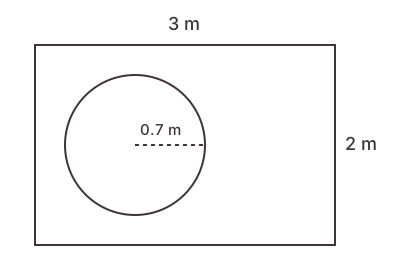
Show solution
Given: Rectangle 3 m × 2 m; circle radius 0.7 m; use the uniform landing-point model.
To find: The probability of landing inside the circle.
Model / formula: For a uniformly distributed landing point, P(inside circle) = . Area of circle = πr²; area of rectangle = length × breadth. Take π = , as in the marking scheme.
Substitution: Area of circle = × × m².
Calculation: Area of circle = m².
Area of rectangle = 3 × 2 = 6 m².
P(inside circle) = ÷ 6 = .
Check: The probability lies between 0 and 1. Area units cancel in the ratio.
Answer: P(inside circle) =
Related method: Question 38.
OR
Alternative (b)
A die is thrown twice. Find the probability that (i) the difference between the two numbers is 3; (ii) their sum is 8.
Show solution
Given: Two independent throws of a fair six-sided die; 36 ordered outcomes.
To find: The probability of (i) a difference of 3; (ii) a sum of 8.
Formula: P(E) = , where n(E) is the number of favourable outcomes and n(S) is the number of equally likely possible outcomes.
Event: Let E1 be the event “(i) a difference of 3”.
Counting: The favourable pairs are (1,4), (2,5), (3,6), (4,1), (5,2) and (6,3). “Difference” is taken as the non-negative difference.
n(S) = 36; n(E1) = 6.
Substitution: P(E1) = .
Calculation: P(E1) = .
Event: Let E2 be the event “(ii) a sum of 8”.
Counting: The favourable pairs are (2,6), (3,5), (4,4), (5,3) and (6,2).
n(S) = 36; n(E2) = 5.
Substitution: P(E2) = .
Calculation: P(E2) = .
Check: Each probability is between 0 and 1. Probabilities have no physical unit.
Answer: (i) a difference of 3: ; (ii) a sum of 8:
Related method: Question 38.
The area-model alternative is retained with its original OR partner. Its solution states the uniform landing-point assumption.
Answer key · 48 worked alternatives
| Question | Answer |
|---|---|
| Q1 | a king: |
| Q2 | (i) a red card: ; (ii) an ace: |
| Q3 | the queen of hearts: |
| Q4 | (i) the queen of hearts: ; (ii) not a jack: |
| Q5 | (i) a club: ; (ii) a red card: |
| Q6 | (i) not a face card: ; (ii) a black king: |
| Q7 | (i) a spade: ; (ii) not an ace: |
| Q8 | (i) a face card: ; (ii) a red card: |
| Q9 | (i) a red card: ; (ii) a king or queen: |
| Q10 | a multiple of 15: |
| Q11 | (i) a two-digit number: ; (ii) a number less than 10: |
| Q12 | (a) divisible by 6: ; (b) greater than 25: |
| Q13 | divisible by 6: |
| Q14 | not divisible by 8: |
| Q15 | (i) a perfect square: ; (ii) a two-digit number: |
| Q16 | (i) a two-digit number: ; (ii) a multiple of 1: 1 |
| Q17 | (i) a two-digit number: ; (ii) a perfect square: |
| Q18 | (i) a perfect square: ; (ii) a multiple of 8: |
| Q19 | (i) a prime number: ; (ii) divisible by 5: |
| Q20(a) | (i) prime: ; (ii) a multiple of 6: |
| Q20(b) | (i) a vowel: ; (ii) present in BALL: |
| Q21 | (i) red: ; (ii) yellow: |
| Q22 | a good pen: |
| Q23 | a pen Rakshita will buy: |
| Q24 | acceptable to Anmol: |
| Q25(a) | a perfect square: |
| Q25(b) | not a ₹2 coin: |
| Q26 | at most one head: |
| Q27 | (i) S = {HHH, HHT, HTH, THH, HTT, THT, TTH, TTT}; (ii) at most two heads: |
| Q28(a) | (i) greater than 3: ; (ii) an even prime number: |
| Q28(b) | (i) white: ; (ii) not green: |
| Q29(a) | an odd product: |
| Q29(b) | Number of such integers = 10. hundreds digit 8 and units digit 5: |
| Q30 | 5 at least once: |
| Q31(a) | a face card or a spade: |
| Q31(b) | at least two tails: |
| Q32 | a prime product: |
| Q33 | P(yellow) = |
| Q34(a) | 16 white marbles |
| Q34(b) | (i) prime: ; (ii) a perfect square: |
| Q35 | x = 2 |
| Q36 | 69 balls |
| Q37 | 10 yellow balls |
| Q38 | (i) the same birthday: ; (ii) different birthdays: |
| Q39 | (i) different birthdays: ; (ii) the same birthday: |
| Q40 | (i) the same birthday: ; (ii) different birthdays: |
| Q41(a) | P(inside circle) = |
| Q41(b) | (i) a difference of 3: ; (ii) a sum of 8: |
Official sources and question details
Pages are physical PDF pages counted from the first page. Question-paper references identify the selected question. Scheme references include its surrounding Section B answer span where the source layout does not isolate question numbers. ZIP sources include the exact PDF member name.
Question 1
2023 · Basic · Main · 430/2/1 · Q25 · 2 marks
Official Question paper · PDF pp. 15
MATHEMATICS_BASIC/430_2_1_Maths Basic.pdf
Official Marking scheme · PDF pp. 9, 10, 11
Math_Basic/430_2_1.pdf
2023 · Basic · Main · 430/2/2 · Q23 · 2 marks
Official Question paper · PDF pp. 15
MATHEMATICS_BASIC/430_2_2_Maths Basic.pdf
Official Marking scheme · PDF pp. 8, 9
Math_Basic/430_2_2.pdf
Question 2
2023 · Basic · Compartment · 430/C/2 · Q25 · 2 marks
Official Question paper · PDF pp. 15
Maths_Basic/430_C_2 Mathematics Basic.pdf
Official Marking scheme · PDF pp. 8, 9
Mathematics_Basic/241_C_2.pdf
Question 3
2024 · Standard · Main · 30/1/1 · Q22 · 2 marks
Official Question paper · PDF pp. 9
MATHEMATICS_STANDARD/30-1-1(Mathematics Standard).pdf
Official Marking scheme · PDF pp. 7, 8, 9
Mathematics_Standard/MS 041_30-1-1 Mathematics 2023-24.pdf
2024 · Standard · Main · 30/1/2 · Q25 · 2 marks
Official Question paper · PDF pp. 9
MATHEMATICS_STANDARD/30-1-2(Mathematics Standard).pdf
Official Marking scheme · PDF pp. 7, 8
Mathematics_Standard/MS 041_30-1-2 Mathematics 2023-24.pdf
2024 · Standard · Main · 30/1/3 · Q21 · 2 marks
Official Question paper · PDF pp. 9
MATHEMATICS_STANDARD/30-1-3(Mathematics Standard).pdf
Official Marking scheme · PDF pp. 7, 8
Mathematics_Standard/MS 041_30-1-3 Mathematics 2023-24.pdf
Question 4
2024 · Standard · Main · 30/3/1 · Q21 · 2 marks
Official Question paper · PDF pp. 15
MATHEMATICS_STANDARD/30-3-1(Mathematics Standard).pdf
Official Marking scheme · PDF pp. 8, 9, 10, 11
Mathematics_Standard/MS 041_30-3-1 Mathematics 2023-24.pdf
2024 · Standard · Main · 30/3/2 · Q23 · 2 marks
Official Question paper · PDF pp. 15
MATHEMATICS_STANDARD/30-3-2(Mathematics Standard).pdf
Official Marking scheme · PDF pp. 8, 9, 10
Mathematics_Standard/MS 041_30-3-2 Mathematics 2023-24.pdf
2024 · Standard · Main · 30/3/3 · Q24 · 2 marks
Official Question paper · PDF pp. 15
MATHEMATICS_STANDARD/30-3-3(Mathematics Standard).pdf
Official Marking scheme · PDF pp. 8, 9, 10, 11
Mathematics_Standard/MS 041_30-3-3 Mathematics 2023-24.pdf
Question 5
2024 · Standard · Main · 30/5/3 · Q21 · 2 marks
Official Question paper · PDF pp. 13
MATHEMATICS_STANDARD/30-5-3(Mathematics Standard).pdf
Official Marking scheme · PDF pp. 7, 8, 9
Mathematics_Standard/MS 041_30-5-3 Mathematics 2023-24.pdf
Question 6
2025 · Standard · Main · 30/5/1 · Q25 · 2 marks
Official Question paper · PDF pp. 13
041_Mathematics_Standard/30-5-1_Mathematics Standard.pdf
Official Marking scheme · PDF pp. 6, 7, 8
Math/041 Mathematics Standard/X_MS_041_Mathematics Standard_30-5-1_2024-25.pdf
Question 7
2025 · Standard · Main · 30/5/2 · Q22 · 2 marks
Official Question paper · PDF pp. 13
041_Mathematics_Standard/30-5-2_Mathematics Standard.pdf
Official Marking scheme · PDF pp. 6, 7, 8
Math/041 Mathematics Standard/X_MS_041_Mathematics Standard_30-5-2_2024-25.pdf
Question 8
2025 · Standard · Main · 30/5/3 · Q24 · 2 marks
Official Question paper · PDF pp. 13
041_Mathematics_Standard/30-5-3_Mathematics Standard.pdf
Official Marking scheme · PDF pp. 6, 7, 8
Math/041 Mathematics Standard/X_MS_041_Mathematics Standard_30-5-3_2024-25.pdf
Question 9
2026 · Basic · Main · 430/B · Q25 · 2 marks
Official Question paper · PDF pp. 15
Mathematics_Standard/1167_430(B)_Mathematics (Basic).pdf
Official Marking scheme · PDF pp. 8
241_MATHEMATICS BASIC\X_241_MS_430(B)_unsigned.pdf
Question 10
2023 · Basic · Main · 430/2/3 · Q22 · 2 marks
Official Question paper · PDF pp. 15
MATHEMATICS_BASIC/430_2_3_Maths Basic.pdf
Official Marking scheme · PDF pp. 8, 9, 10
Math_Basic/430_2_3.pdf
Question 11
2023 · Basic · Main · 430/6/1 · Q24 · 2 marks
Official Question paper · PDF pp. 15
MATHEMATICS_BASIC/430_6_1_Maths Basic.pdf
Official Marking scheme · PDF pp. 8, 9
Math_Basic/430_6_1.pdf
2023 · Basic · Main · 430/6/2 · Q21 · 2 marks
Official Question paper · PDF pp. 13
MATHEMATICS_BASIC/430_6_2_Maths Basic.pdf
Official Marking scheme · PDF pp. 8, 9
Math_Basic/436 -6-2.pdf
Question 12
2023 · Basic · Main · 430/6/3 · Q21 · 2 marks
Official Question paper · PDF pp. 13
MATHEMATICS_BASIC/430_6_3_Maths Basic.pdf
Official Marking scheme · PDF pp. 7, 8
Math_Basic/430-6-3.pdf
Question 13
2024 · Basic · Main · 430/B · Q22 · 2 marks
Official Question paper · PDF pp. 15
MATHEMATICS_BASIC/430(B) Maths Basic for VI.pdf
Official Marking scheme · PDF pp. 8
Mathematics/X_241_MS_430(B)_Unsigned.pdf
Question 14
2024 · Basic · Main · 430/3/1 · Q25 · 2 marks
Official Question paper · PDF pp. 15
MATHEMATICS_BASIC/430-3-1MATHEMATICS (BASIC).pdf
Official Marking scheme · PDF pp. 7, 8, 9
Mathematics/X_241_MS_430_3_1_Unsigned.pdf
2024 · Basic · Main · 430/3/2 · Q22 · 2 marks
Official Question paper · PDF pp. 13
MATHEMATICS_BASIC/430-3-2MATHEMATICS (BASIC).pdf
Official Marking scheme · PDF pp. 8, 9, 10
Mathematics/X_241_MS_430_3_2_Unsigned.pdf
2024 · Basic · Main · 430/3/3 · Q24 · 2 marks
Official Question paper · PDF pp. 15
MATHEMATICS_BASIC/430-3-3MATHEMATICS (BASIC).pdf
Official Marking scheme · PDF pp. 7, 8, 9
Mathematics/X_241_MS_430_3_3_Unsigned.pdf
Question 15
2025 · Standard · Main · 30/6/2 · Q22 · 2 marks
Official Question paper · PDF pp. 13
041_Mathematics_Standard/30-6-2_Mathematics Standard.pdf
Official Marking scheme · PDF pp. 7, 8, 9
Math/041 Mathematics Standard/X_MS_041_Mathematics Standard_30-6-2_2024-25.pdf
Question 16
2025 · Standard · Main · 30/6/3 · Q24 · 2 marks
Official Question paper · PDF pp. 13
041_Mathematics_Standard/30-6-3_Mathematics Standard.pdf
Official Marking scheme · PDF pp. 7, 8, 9
Math/041 Mathematics Standard/X_MS_041_Mathematics Standard_30-6-3_2024-25.pdf
Question 17
2025 · Basic · Main · 430/6/1 · Q23 · 2 marks
Official Question paper · PDF pp. 15
241_Mathematics_Basic/430-6-1_Mathematics Basic.pdf
Official Marking scheme · PDF pp. 9
Math/241 Mathematics Basic/X_241_Mathematics Basic_MS_430_6_1.pdf
2025 · Basic · Main · 430/6/2 · Q22 · 2 marks
Official Question paper · PDF pp. 15
241_Mathematics_Basic/430-6-2_Mathematics Basic.pdf
Official Marking scheme · PDF pp. 8
Math/241 Mathematics Basic/X_241_Mathematics Basic_MS_430_6_2.pdf
2025 · Basic · Main · 430/6/3 · Q21 · 2 marks
Official Question paper · PDF pp. 13
241_Mathematics_Basic/430-6-3_Mathematics Basic.pdf
Official Marking scheme · PDF pp. 8
Math/241 Mathematics Basic/X_241_Mathematics Basic_MS_430_6_3.pdf
Question 18
2026 · Basic · Second board · 430/7/1 · Q25 · 2 marks
Official Question paper · PDF pp. 15
Mathmatics_Basic/430-7-1_Maths Basic_E2_10_2026.pdf
Official Marking scheme · PDF pp. 7, 8, 9
Mathematics_Basic/Mathematisc Basic-241 E2 (430-7-1).pdf
2026 · Basic · Second board · 430/7/2 · Q22 · 2 marks
Official Question paper · PDF pp. 15
Mathmatics_Basic/430-7-2_Maths Basic_E2_10_2026.pdf
Official Marking scheme · PDF pp. 8
Mathematics_Basic/Mathematics Basic-241 E2 (430-7-2).pdf
Question 19
2026 · Basic · Second board · 430/7/3 · Q22 · 2 marks
Official Question paper · PDF pp. 13
Mathmatics_Basic/430-7-3_Maths Basic_E2_10_2026.pdf
Official Marking scheme · PDF pp. 8
Mathematics_Basic/Mathematics Basic-241 E2 (430-7-3).pdf
Question 20
2026 · Basic · Main · 430/5/1 · Q24 · 2 marks
Official Question paper · PDF pp. 13
Mathematics_Standard/1159-1_430-5-1 Mathematics (Basic).pdf
Official Marking scheme · PDF pp. 8
241_MATHEMATICS BASIC\X_241_MS_ 430_5_1_unsigned.pdf
2026 · Basic · Main · 430/5/2 · Q25 · 2 marks
Official Question paper · PDF pp. 15
Mathematics_Standard/1159-2_430-5-2 Mathematics (Basic).pdf
Official Marking scheme · PDF pp. 9
241_MATHEMATICS BASIC\X_241_MS_ 430_5_2_unsigned.pdf
2026 · Basic · Main · 430/5/3 · Q21 · 2 marks
Official Question paper · PDF pp. 13
Mathematics_Standard/1159-3_430-5-3 Mathematics (Basic).pdf
Official Marking scheme · PDF pp. 7
241_MATHEMATICS BASIC\X_241_MS_ 430_5_3_unsigned.pdf
Question 21
2023 · Standard · Main · 30/1/1 · Q25 · 2 marks
Official Question paper · PDF pp. 13
MATHEMATICS_STANDARD/30_1_1_Maths Standard.pdf
Official Marking scheme · PDF pp. 7, 8, 9
Maths_Standard/MS 041_30-1-1 Mathematics 2022-23.pdf
2023 · Standard · Main · 30/1/2 · Q22 · 2 marks
Official Question paper · PDF pp. 11
MATHEMATICS_STANDARD/30_1_2_Maths Standard.pdf
Official Marking scheme · PDF pp. 7, 8, 9
Maths_Standard/MS 041_30-1-2 Mathematics 2022-23.pdf
2023 · Standard · Main · 30/1/3 · Q23 · 2 marks
Official Question paper · PDF pp. 13
MATHEMATICS_STANDARD/30_1_3_Maths Standard.pdf
Official Marking scheme · PDF pp. 7, 8, 9
Maths_Standard/MS 041_30-1-3 Mathematics 2022-23.pdf
Question 22
2024 · Basic · Main · 430/2/1 · Q23 · 2 marks
Official Question paper · PDF pp. 13
MATHEMATICS_BASIC/430-2-1MATHEMATICS (BASIC).pdf
Official Marking scheme · PDF pp. 7, 8, 9
Mathematics/X_241_MS_430_2_1_Unsigned.pdf
2024 · Basic · Main · 430/2/3 · Q21 · 2 marks
Official Question paper · PDF pp. 11
MATHEMATICS_BASIC/430-2-3MATHEMATICS (BASIC).pdf
Official Marking scheme · PDF pp. 6, 7, 8, 9
Mathematics/X_241_MS_430_2_3_Unsigned.pdf
Question 23
2024 · Basic · Main · 430/2/2 · Q22 · 2 marks
Official Question paper · PDF pp. 13
MATHEMATICS_BASIC/430-2-2MATHEMATICS (BASIC).pdf
Official Marking scheme · PDF pp. 6, 7, 8, 9
Mathematics/X_241_MS_430_2_2_Unsigned.pdf
Question 24
2024 · Standard · Main · 30/5/1 · Q25 · 2 marks
Official Question paper · PDF pp. 13
MATHEMATICS_STANDARD/30-5-1(Mathematics Standard).pdf
Official Marking scheme · PDF pp. 7, 8, 9
Mathematics_Standard/MS 041_30-5-1 Mathematics 2023-24.pdf
2024 · Standard · Main · 30/5/2 · Q24 · 2 marks
Official Question paper · PDF pp. 13
MATHEMATICS_STANDARD/30-5-2(Mathematics Standard).pdf
Official Marking scheme · PDF pp. 7, 8, 9
Mathematics_Standard/MS 041_30-5-2 Mathematics 2023-24.pdf
Question 25
2025 · Basic · Main · 430/B · Q24 · 2 marks
Official Question paper · PDF pp. 15
241_Mathematics_Basic/430 B_Maths Basic for Visually Impaired candiddates.pdf
Official Marking scheme · PDF pp. 8
Math/241 Mathematics Basic/X_241_Mathematics Basic_MS_430 B.pdf
Question 26
2023 · Standard · Main · 30/4/1 · Q24 · 2 marks
Official Question paper · PDF pp. 9
MATHEMATICS_STANDARD/30_4_1 Maths Standard.pdf
Official Marking scheme · PDF pp. 7, 8, 9
Maths_Standard/MS 041_30-4-1 Mathematics 2022-23.pdf
2023 · Standard · Main · 30/4/2 · Q22 · 2 marks
Official Question paper · PDF pp. 9
MATHEMATICS_STANDARD/30_4_2 Maths Standard.pdf
Official Marking scheme · PDF pp. 6, 7, 8
Maths_Standard/MS 041_30-4-2 Mathematics 2022-23.pdf
2023 · Standard · Main · 30/4/3 · Q23 · 2 marks
Official Question paper · PDF pp. 9
MATHEMATICS_STANDARD/30_4_3 Maths Standard.pdf
Official Marking scheme · PDF pp. 7, 8, 9
Maths_Standard/MS 041_30-4-3 Mathematics 2022-23.pdf
Question 27
2023 · Basic · Compartment · 430/C/1 · Q23 · 2 marks
Official Question paper · PDF pp. 15
Maths_Basic/430_C_1 Mathematics Basic.pdf
Official Marking scheme · PDF pp. 8, 9
Mathematics_Basic/241_C_1.pdf
2023 · Basic · Compartment · 430/C/3 · Q21 · 2 marks
Official Question paper · PDF pp. 15
Maths_Basic/430_C_3 Mathematics Basic.pdf
Official Marking scheme · PDF pp. 7, 8, 9
Mathematics_Basic/241_C_3.pdf
Question 28
2024 · Basic · Compartment · 430/B · Q23 · 2 marks
Official Question paper · PDF pp. 15
430(B)-S Mathematics Basic.pdf
Official Marking scheme · PDF pp. 10
Maths Basic/X_241_MS_ 430_B_S.pdf
Question 29
2024–25 · Standard · Official sample paper · Official sample paper · Q22 · 2 marks
Official Question paper · PDF pp. 4
MathsStandard-SQP.pdf
Official Marking scheme · PDF pp. 2, 3
MathsStandard-MS.pdf
Question 30
2025 · Basic · Main · 430/B · Q25 · 2 marks
Official Question paper · PDF pp. 15
241_Mathematics_Basic/430 B_Maths Basic for Visually Impaired candiddates.pdf
Official Marking scheme · PDF pp. 9
Math/241 Mathematics Basic/X_241_Mathematics Basic_MS_430 B.pdf
Question 31
2025 · Standard · Compartment · 30/B · Q22 · 2 marks
Official Question paper · PDF pp. 15
Maths_Standard/30(B)-S Maths Standard Blind.pdf
Official Marking scheme · PDF pp. 7, 8
MATHEMATICS_STANDARD/MS_X_041_Mathematics_30(B)-S_2024-25.pdf
Question 32
2026–27 · Standard · Official sample paper · Official sample paper · Q25 · 2 marks
Official Question paper · PDF pp. 4
MathsStandard-SQP.pdf
Official Marking scheme · PDF pp. 3, 4
MathsStandard-MS.pdf
Question 33
2024 · Basic · Main · 430/1/1 · Q25 · 2 marks
Official Question paper · PDF pp. 9
MATHEMATICS_BASIC/430-1-1MATHEMATICS (BASIC).pdf
Official Marking scheme · PDF pp. 6, 7, 8
Mathematics/X_241_MS_430_1_1_Unsigned.pdf
2024 · Basic · Main · 430/1/2 · Q22 · 2 marks
Official Question paper · PDF pp. 9
MATHEMATICS_BASIC/430-1-2MATHEMATICS (BASIC).pdf
Official Marking scheme · PDF pp. 6, 7, 8
Mathematics/X_241_MS_430_1_2_Unsigned.pdf
2024 · Basic · Main · 430/1/3 · Q25 · 2 marks
Official Question paper · PDF pp. 9
MATHEMATICS_BASIC/430-1-3MATHEMATICS (BASIC).pdf
Official Marking scheme · PDF pp. 6, 7, 8, 9
Mathematics/X_241_MS_430_1_3_Unsigned.pdf
Question 34
2025 · Basic · Main · 430/5/1 · Q24 · 2 marks
Official Question paper · PDF pp. 15
241_Mathematics_Basic/430-5-1_Mathematics Basic.pdf
Official Marking scheme · PDF pp. 8
Math/241 Mathematics Basic/X_241_Mathematics Basic_MS_430_5_1.pdf
2025 · Basic · Main · 430/5/2 · Q25 · 2 marks
Official Question paper · PDF pp. 15
241_Mathematics_Basic/430-5-2_Mathematics Basic.pdf
Official Marking scheme · PDF pp. 9
Math/241 Mathematics Basic/X_241_Mathematics Basic_MS_430_5_2.pdf
2025 · Basic · Main · 430/5/3 · Q21 · 2 marks
Official Question paper · PDF pp. 13
241_Mathematics_Basic/430-5-3_Mathematics Basic.pdf
Official Marking scheme · PDF pp. 7
Math/241 Mathematics Basic/X_241_Mathematics Basic_MS_430_5_3.pdf
Question 35
2025 · Standard · Main · 30/3/1 · Q22 · 2 marks
Official Question paper · PDF pp. 13
041_Mathematics_Standard/30-3-1_Mathematics Standard.pdf
Official Marking scheme · PDF pp. 8, 9, 10
Math/041 Mathematics Standard/X_MS_041_Mathematics Standard_30-3-1_2024-25.pdf
2025 · Standard · Main · 30/3/2 · Q25 · 2 marks
Official Question paper · PDF pp. 13
041_Mathematics_Standard/30-3-2_Mathematics Standard.pdf
Official Marking scheme · PDF pp. 7, 8, 9
Math/041 Mathematics Standard/X_MS_041_Mathematics Standard_30-3-2_2024-25.pdf
2025 · Standard · Main · 30/3/3 · Q23 · 2 marks
Official Question paper · PDF pp. 13
041_Mathematics_Standard/30-3-3_Mathematics Standard.pdf
Official Marking scheme · PDF pp. 8, 9, 10
Math/041 Mathematics Standard/X_MS_041_Mathematics Standard_30-3-3_2024-25.pdf
Question 36
2025 · Standard · Main · 30/6/1 · Q25 · 2 marks
Official Question paper · PDF pp. 13
041_Mathematics_Standard/30-6-1_Mathematics Standard.pdf
Official Marking scheme · PDF pp. 7, 8, 9
Math/041 Mathematics Standard/X_MS_041_Mathematics Standard_30-6-1_2024-25.pdf
Question 37
2026 · Standard · Main · 30/5/1 · Q25 · 2 marks
Official Question paper · PDF pp. 15
Mathematics_Standard/1172-1_30-5-1 (Mathematics Standard).pdf
Official Marking scheme · PDF pp. 7, 8, 9
041_MATHEMATICS STANDARD\MS_X_041_Mathematics_30-5-1_2025-26 (1).pdf
2026 · Standard · Main · 30/5/2 · Q24 · 2 marks
Official Question paper · PDF pp. 13
Mathematics_Standard/1172-2_30-5-2 (Mathematics Standard).pdf
Official Marking scheme · PDF pp. 7, 8, 9
041_MATHEMATICS STANDARD\MS_X_041_Mathematics_30-5-2_2025-26 (1).pdf
2026 · Standard · Main · 30/5/3 · Q23 · 2 marks
Official Question paper · PDF pp. 13
Mathematics_Standard/1172-3_30-5-3 (Mathematics Standard).pdf
Official Marking scheme · PDF pp. 7, 8, 9
041_MATHEMATICS STANDARD\MS_X_041_Mathematics_30-5-3_2025-26 (1).pdf
Question 38
2025 · Standard · Main · 30/4/1 · Q25 · 2 marks
Official Question paper · PDF pp. 9
041_Mathematics_Standard/30-4-1_Mathematics Standard.pdf
Official Marking scheme · PDF pp. 6, 7, 8
Math/041 Mathematics Standard/X_MS_041_Mathematics Standard _30-4-1_2024-25_.pdf
Question 39
2025 · Standard · Main · 30/4/2 · Q22 · 2 marks
Official Question paper · PDF pp. 9
041_Mathematics_Standard/30-4-2_Mathematics Standard.pdf
Official Marking scheme · PDF pp. 6, 7, 8
Math/041 Mathematics Standard/X_MS_041_Mathematics Standard_30-4-2_2024-25_.pdf
Question 40
2025 · Standard · Main · 30/4/3 · Q24 · 2 marks
Official Question paper · PDF pp. 9
041_Mathematics_Standard/30-4-3_Mathematics Standard.pdf
Official Marking scheme · PDF pp. 6, 7, 8
Math/041 Mathematics Standard/X_MS_041_Mathematics Standard_30-4-3_2024-25_.pdf
Question 41
2025 · Basic · Main · 430/4/1 · Q23 · 2 marks
Official Question paper · PDF pp. 9
241_Mathematics_Basic/430-4-1_Mathematics Basic.pdf
Official Marking scheme · PDF pp. 7
Math/241 Mathematics Basic/X_241_Mathematics Basic_MS_430_4_1.pdf
2025 · Basic · Main · 430/4/2 · Q25 · 2 marks
Official Question paper · PDF pp. 9
241_Mathematics_Basic/430-4-2_Mathematics Basic.pdf
Official Marking scheme · PDF pp. 8, 9
Math/241 Mathematics Basic/X_241_Mathematics Basic_MS_430_4_2.pdf
2025 · Basic · Main · 430/4/3 · Q25 · 2 marks
Official Question paper · PDF pp. 9
241_Mathematics_Basic/430-4-3_Mathematics Basic.pdf
Official Marking scheme · PDF pp. 9
Math/241 Mathematics Basic/X_241_Mathematics Basic_MS_430_4_3.pdf
Coverage · Left out and why
The available official 2022–2026 Basic and Standard board archives and ten official sample papers for sessions 2022–23 to 2026–27 were screened. No eligible standalone two-mark Probability question was identified in the 2022 Term II section screening. The selected board set includes main, compartment and 2026 second-board questions; exact year/exam coverage is recorded above.
One-mark MCQs/assertion–reason questions, three-/five-mark questions and two-mark subparts of complete case studies are excluded. Keep those subparts with the complete Probability case-study questions. Three 2023 archive members contain only front pages. Translated equivalents are not counted as additional appearances; eligible visually impaired versions are included.
The two eligible sample-paper groups are 2024–25 Standard Q22 (an original OR pair) and 2026–27 Standard Q25. The other eight screened sample papers have no eligible standalone Probability question in Section B. Only identical complete question groups are merged. Similar questions with different numbers, events or conditions remain separate.
The birthday solutions use the textbook model of independent, uniformly distributed dates. The area alternative uses a uniform landing-point model and is retained with its original OR partner. These assumptions are stated locally. Source wording such as “multiple of 1” is preserved and explained rather than silently changed.
Frequently asked questions
How many outcomes are possible when two dice are thrown?
For two fair six-sided dice, use 6 × 6 = 36 equally likely ordered outcomes. The sum has only 11 possible values, but those sums are not equally likely.
Why do (2,5) and (5,2) count separately?
One outcome has 2 on the first die and 5 on the second; the other reverses them. Keeping a fixed order prevents missing outcomes and double counting.
Is an ace a face card?
No. In a standard 52-card deck, the face cards are the jacks, queens and kings: 3 per suit and 12 altogether. Aces are counted separately.
What is the difference between at least and at most?
At least two means two or more; at most two means two or fewer. For three coin tosses, at most two heads includes zero, one and two heads but excludes three heads.
What changes when cards are removed from a deck?
Recalculate both the total remaining cards and the favourable remaining cards. Use the remaining deck as the denominator. A removed card cannot be counted as a possible result.
Can I add the probabilities of two events?
For disjoint events, add their probabilities. If they overlap, subtract the overlap once. For a face card or a spade, the spade face cards belong to both sets and must not be counted twice.
Make probability counting clearer
Get 1-to-1 help defining events, counting outcomes and writing clear exam solutions.
Book a Free Assessment