Some Applications of Trigonometry: Case Study PYQs with Answers
A case study on heights and distances asks you to turn the passage into right triangles, choose a trigonometric ratio and interpret the result. These 31 selected cases cover towers, kites, ladders, lighthouses and moving objects. Try each part before opening its solution.
31 distinct cases · 66 board-paper appearances + 5 official-sample appearances Solutions prepared by Team TutorVertex Verified by Siddharth Sir · Last reviewed 27 October 2026
Which relationship?
Known and required sides
Use
Vertical rise and horizontal distance
tan θ =
Vertical rise and slant distance
sin θ =
Horizontal and slant distances
cos θ =
Measure the angle from the horizontal. Subtract the observer’s height before using a ratio; add it back if the total height is asked. Angles of elevation and depression are equal when formed with parallel horizontal lines.
Follow the marks printed beside each part. The 2022 cases use the earlier term-based pattern; both OR alternatives are solved for practice.
Find a case study
Showing all 31 cases
No cases match these filters. Change a selection or use Reset to show all cases.
Standard4 marks
Case 1. Gadisar Lake and a reflection
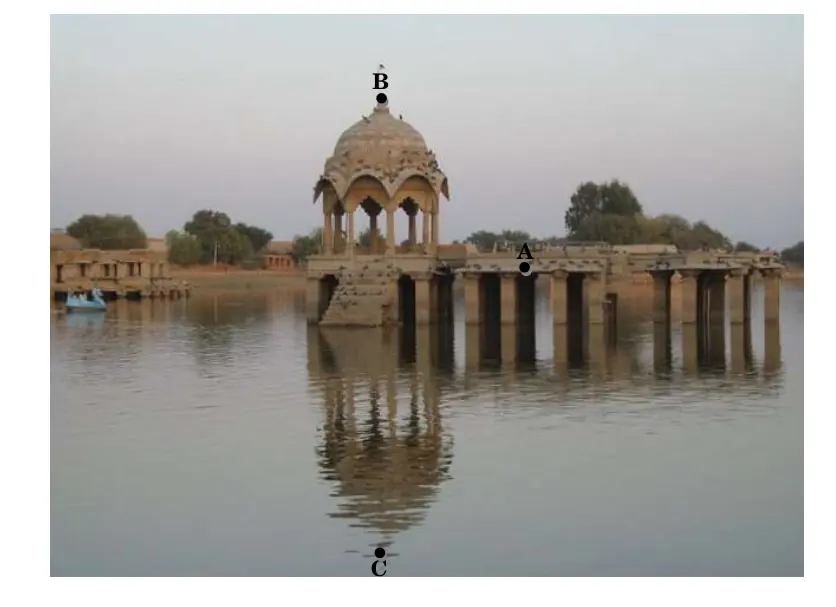
Gadisar Lake is located in the Jaisalmer district of Rajasthan. It was built by the King of Jaisalmer and rebuilt by Gadsi Singh in 14th century. The lake has many Chhatris. One of them is shown below:
Observe the picture. From a point A h m above from water level, the angle of elevation of top of Chhatri (point B) is 45° and angle of depression of its reflection in water (point C) is 60°. If the height of Chhatri above water level is (approximately) 10 m, then
Original CBSE case illustration.
Describe the figure
Photograph of a Chhatri and its reflection in Gadisar Lake. B is the top, C its reflection, and A the observation point above the water.
Appeared in: 2022 · Standard · Main
(a) Draw a well-labelled figure based on the above information. [2 marks]
Show answer and solution
See the labelled solution diagram.
TutorVertex solution diagram · Not to scale.
Take O on the water vertically below A, and D on the water vertically below B.
Join AB and AC, and draw AH horizontal to meet BC at H.
Mark BD = DC = 10 m, AO = HD = h m, ∠BAH = 45° and ∠HAC = 60°.
(b) Find the height (h) of the point A above water level. (Use √3 = 1.73.) [2 marks]
Show answer and solution
h = 10(2 − √3) m ≈ 2.7 m.
Let AH = x m. Then BH = 10 − h and HC = 10 + h.
In △ABH, tan 45° = , so x = 10 − h.
In △ACH, tan 60° = , so √3(10 − h) = 10 + h.
h(√3 + 1) = 10(√3 − 1).
h = = 10(2 − √3).
Using √3 = 1.73, h = 10 × 0.27 = 2.7 m.
Standard4 marks
Case 2. Two kites at different heights
Kite Festival. Kite festival is celebrated in many countries at different times of the year. In India, every year 14th January is celebrated as International Kite Day. On this day many people visit India and participate in the festival by flying various kinds of kites.
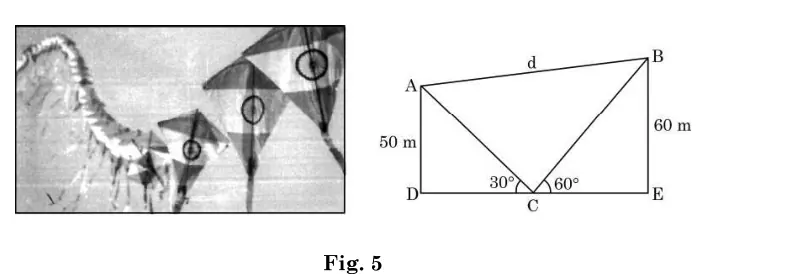
The picture given below shows three kites flying together. In Fig. 5, the angles of elevation of two kites (Points A and B) from the hands of a man (Point C) are found to be 30° and 60° respectively. Taking AD = 50 m and BE = 60 m, find
Original CBSE case illustration.
Describe the figure
The original strip contains a kite photograph and Fig. 5. D, C and E lie on a horizontal line, with C between D and E. AD = 50 m and BE = 60 m are vertical; ∠ACD = 30° and ∠BCE = 60°. AB is labelled d.
Appeared in: 2022 · Standard · Main
(1) The lengths of strings used (take them straight) for kites A and B as shown in the figure. [2 marks]
Show answer and solution
AC = 100 m; BC = 40√3 m.
In right △ADC, sin 30° = = .
= , so AC = 100 m.
In right △BEC, sin 60° = = .
= , so BC = = 40√3 m.
(2) The distance d between these two kites. [2 marks]
Show answer and solution
d = 20√37 m ≈ 121.7 m.
Since D, C, E are collinear, ∠ACB = 180° − 30° − 60° = 90°.
By Pythagoras in △ACB, AB² = AC² + BC².
AB² = 100² + (40√3)² = 10000 + 4800 = 14800.
d = AB = √14800 = 20√37 m ≈ 121.7 m.
Basic4 marks
Case 3. The Pitampura TV Tower
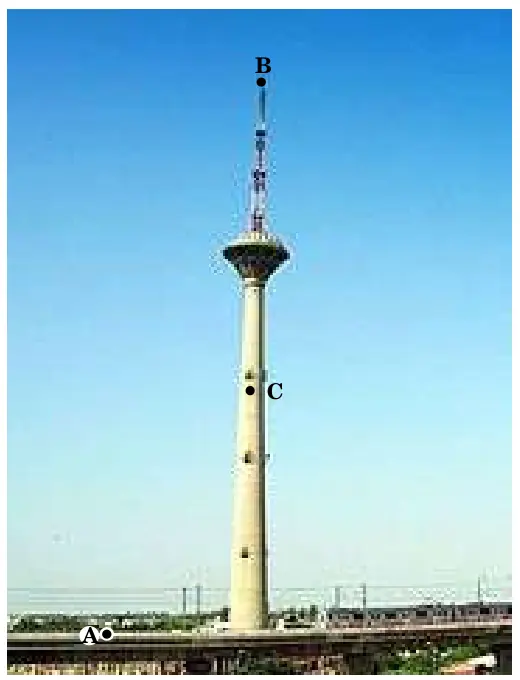
The following TV Tower was built in 1988 and is located in Pitampura, Delhi. It has an observation deck. Observe the picture given below:
The TV Tower stands vertically on the ground. From a point A on the ground, the angle of elevation of top of the tower (point B) is 60°. There is a point C on the tower which is 78 m (approx.) above the ground. The angle of elevation of the point C from point A is found to be 30°.
Original CBSE case illustration.
Describe the figure
Original photograph of the TV Tower, with B at its top, C at a point about 78 m above ground and A on the ground.
Appeared in: 2022 · Basic · Main
(a) Draw a well-labelled figure, based on the information given above. [2 marks]
Show answer and solution
See the labelled solution diagram.
TutorVertex solution diagram · Not to scale.
Let D be the foot of the vertical tower, with C between D and B.
Place A on the horizontal ground, join AC and AB, and mark CD = 78 m.
Mark ∠CAD = 30° and ∠BAD = 60°.
(b) Find the height of the tower and the distance of the tower from point A. [2 marks]
Show answer and solution
Tower height = 234 m; horizontal distance AD = 78√3 m ≈ 135.1 m, using the printed 78 m.
Let AD = x m and BD = H m.
In △ACD, tan 30° = , so x = 78√3.
In △ABD, tan 60° = , so H = √3 × 78√3 = 234.
Using the printed 78 m gives BD = 234 m and AD = 78√3 m ≈ 135.1 m.
Basic4 marks
Case 4. Charu and Daljeet at Qutub Minar
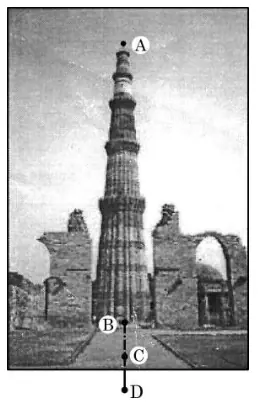
Qutub Minar, located in South Delhi, India, was built in the year 1193. It is 72 m high tower. Working on a school project, Charu and Daljeet visited the monument. They used trigonometry to find their distance from the tower. Observe the picture given below. Points C and D represent their positions on the ground in line with the base of tower, the angles of elevation of top of the tower (Point A) are 60° and 45° from points C and D respectively.
Original CBSE case illustration.
Describe the figure
The source photograph labels A at the top, B at the foot and C and D at the two observation positions. B, C, D are collinear, with C nearer the tower.
Appeared in: 2022 · Basic · Main
(1) Based on above information, draw a well-labelled diagram. [1 mark]
Show answer and solution
See the labelled solution diagram.
TutorVertex solution diagram · Not to scale.
Draw AB perpendicular to the ground, with AB = 72 m.
On the same side of B, place C nearer B and D farther away.
Join AC and AD; mark ∠ACB = 60° and ∠ADB = 45°.
(2) Find the distances CD, BC and BD. (Use √3 = 1.73.) [3 marks]
Show answer and solution
CD = 30.48 m; BC = 41.52 m; BD = 72 m.
In △ABC, tan 60° = .
BC = = 24√3 = 24 × 1.73 = 41.52 m.
In △ABD, tan 45° = , so BD = 72 m.
CD = BD − BC = 72 − 41.52 = 30.48 m.
Basic4 marks · Accessible paper
Case 5. Two ships on the same side of a lighthouse
The concept of trigonometry is used to calculate the heights of objects or distances between points and alternatively, if the heights or distances are known, then angles can be determined.
As observed from the top of a 75 m high lighthouse from sea level, the angles of depression of two ships are 30° and 45°. One ship is exactly behind the other on the same side of the lighthouse. Based on the above, find:
This accessible question has no source illustration. Both ships are on the same side; the 30° ship is farther away.
Appeared in: 2022 · Basic · Supplementary
(a) The distance of each ship from the base of the lighthouse. [2 marks]
Show answer and solution
Farther ship: 129.75 m; nearer ship: 75 m.
The ships’ angles of elevation equal the corresponding angles of depression, since the horizontal lines are parallel.
Let x and y be the horizontal distances for 30° and 45° respectively.
tan 30° = , so x = 75√3 = 129.75 m using √3 = 1.73.
tan 45° = , so y = 75 m.
(b) The distance between the two ships. (Use √3 = 1.73.) [2 marks]
Show answer and solution
Distance between the ships = 54.75 m.
The ships lie on the same side of the lighthouse, one behind the other.
Their separation is the difference of their distances from the base.
Separation = 75√3 − 75 = 75(1.73 − 1) = 54.75 m.
Basic4 marks · Accessible paper
Case 6. A flagstaff on a five-metre tower
A flagstaff stands on the top of a 5 m high tower. From a point on the ground, the angle of elevation of the top of the flagstaff is 60° and from the same point the angle of elevation of the top of tower is 45°.
The accessible source supplies no illustration. The flagstaff is vertical on a 5 m tower; the two elevations from one ground point are 60° and 45°.
Appeared in: 2023 · Basic · Main
(a) What is the distance of the point from the foot of the tower? [1 mark]
Show answer and solution
Distance = 5 m.
Let x m be the horizontal distance.
tan 45° = = 1, so x = 5 m.
(b) What is the height of the flagstaff? [1 mark]
Show answer and solution
Flagstaff height = 5(√3 − 1) m.
Let the flagstaff height be h m; the total height is 5 + h.
tan 60° = , so 5 + h = 5√3.
h = 5√3 − 5 = 5(√3 − 1) m.
(c) If at some other point, the top of tower’s angle of elevation is 30°, then find the distance of this new point from the foot of the tower. [2 marks]
Show answer and solution
New horizontal distance = 5√3 m.
Use the tower’s height 5 m for this new observation.
tan 30° = , so x = = 5√3 m.
OR
(c) Find the distance between the top of the tower and the point at which the angle of elevation of the top of tower is 30°. [2 marks]
Show answer and solution
Slant distance = 10 m.
Let the required slant distance be L m.
sin 30° = , so = .
L = 10 m.
Standard4 marks
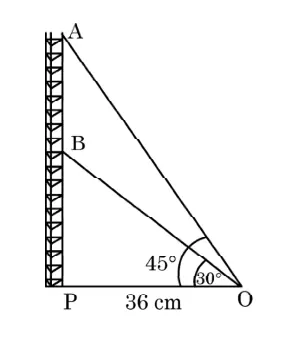
Case 7. A two-section radio tower: 36 cm
Radio towers are used for transmitting a range of communication services including radio and television. The tower will either act as an antenna itself or support one or more antennas on its structure. On a similar concept, a radio station tower was built in two Sections A and B. Tower is supported by wires from a point O.
Distance between the base of the tower and point O is 36 cm. From point O, the angle of elevation of the top of the Section B is 30° and the angle of elevation of the top of Section A is 45°.
Original CBSE case illustration.
Describe the figure
A is the upper point, B the lower point and P the foot of the tower. OP = 36 cm, ∠BOP = 30° and ∠AOP = 45°. The printed unit is cm.
(i) Find the length of the wire from the point O to the top of Section B. [1 mark]
Show answer and solution
OB = 24√3 cm.
In right △OPB, cos 30° = = .
OB = = 24√3 cm.
(ii) Find the distance AB. [2 marks]
Show answer and solution
AB = (36 − 12√3) cm.
AP = OP tan 45° = 36 cm.
BP = OP tan 30° = = 12√3 cm.
AB = AP − BP = (36 − 12√3) cm.
OR
(ii) Find the area of △OPB. [2 marks]
Show answer and solution
Area of △OPB = 216√3 cm².
BP = OP tan 30° = = 12√3 cm.
Area = × OP × BP.
Area = × 36 × 12√3 = 216√3 cm².
(iii) Find the height of the Section A from the base of the tower. [1 mark]
Show answer and solution
AP = 36 cm.
tan 45° = = .
AP = 36 cm. The source uses centimetres throughout.
Basic4 marks
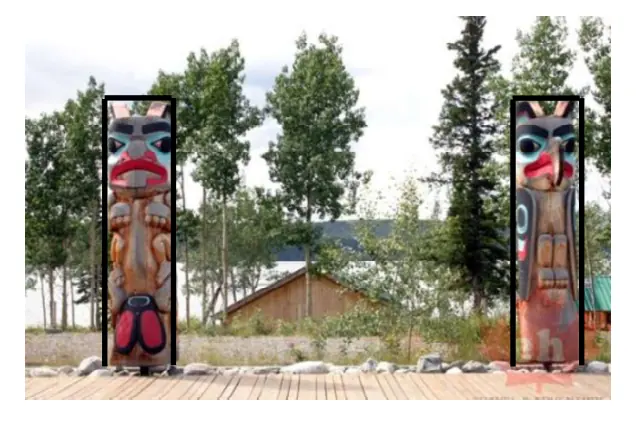
Case 8. Two equal totem poles
Totem poles are made from large trees. These poles are carved with symbols or figures and mostly found in western Canada and northwestern United States.
In the given picture, two such poles of equal heights are standing 28 m apart. From a point somewhere between them in the same line, the angles of elevation of the top of the two poles are 60° and 30° respectively.
Original CBSE case illustration.
Describe the figure
The original photograph shows two carved totem poles. For the solution, call their bases A and C, their tops B and D, and the observation point M between A and C.
Appeared in: 2023 · Basic · Supplementary
(i) Draw a neat labelled diagram. [1 mark]
Show answer and solution
See the labelled solution diagram.
TutorVertex solution diagram · Not to scale.
Draw equal perpendicular poles AB and CD on the same ground line, with AC = 28 m.
Place M between A and C; join MB and MD.
Mark ∠BMA = 60° and ∠DMC = 30°.
(ii)(a) Find the height of the poles. [2 marks]
Show answer and solution
Each pole is 7√3 m high.
Let AM = x m, MC = 28 − x m and the common height be h m.
tan 60° = , so h = √3x.
tan 30° = , so h = .
3x = 28 − x, so x = 7.
h = 7√3 m.
OR
(ii)(b) If the distances of the top of the poles from the point of observation are taken as p and q, then find a relation between p and q. [2 marks]
Show answer and solution
q = √3p, with p towards the 60° pole and q towards the 30° pole.
Use p = BM and q = DM in the labelled solution diagram.
sin 60° = , so h = .
sin 30° = , so h = .
Equating the equal heights gives q = √3p.
(iii) Find the location of the point of observation. [1 mark]
Show answer and solution
7 m from the 60° pole and 21 m from the 30° pole.
The equal-height equations give 3AM = MC.
AM + MC = 28, so 4AM = 28.
AM = 7 m and MC = 21 m.
Standard4 marks · Accessible paper
Case 9. Radio stations A and B: 36 m
Radio towers are used for transmitting a range of communication services including radio and television. The tower will either act as an antenna itself or support one or more antennas on its structure.
On a similar concept, a radio station tower was built in two stations A and B (B vertically below A). The tower is supported by wires AO and BO from a point O on the ground. Distance between the base C of the tower and the point O is 36 m. From O, the angles of elevation of the tops of station B and station A are 30° and 45° respectively.
This accessible source has no illustration. C is the foot, B lies below A, OC = 36 m and the elevations of B and A are 30° and 45°.
(iii)(a) Find the length of the wire OA. [2 marks]
Show answer and solution
OA = 36√2 m.
cos 45° = = .
= , so OA = 36√2 m.
OR
(iii)(b) Find the length of the wire OB. [2 marks]
Show answer and solution
OB = 24√3 m.
cos 30° = = .
OB = = 24√3 m.
Basic4 marks
Case 10. Two poles and a wire coupling
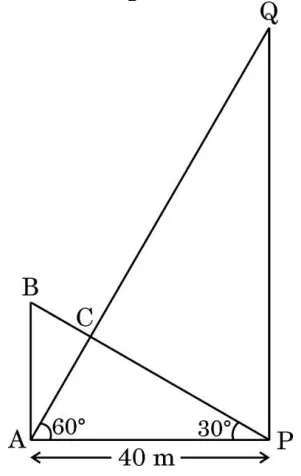
Two poles of different heights stand on level ground and at a distance of 40 m. Both poles are supported by wires attached from the top of each pole to the bottom of the other. A coupling is placed at point C, where the two wires cross (as shown in the figure).
Original CBSE case illustration.
Describe the figure
AB and PQ are perpendicular poles, with AP = 40 m. Wire AQ makes 60° with AP, wire PB makes 30° with PA, and the wires meet at C.
Appeared in: 2024 · Basic · Main
(i) Find the height of pole AB. [1 mark]
Show answer and solution
AB = m ≈ 23.1 m.
In right △PAB, tan 30° = .
AB = 40 tan 30° = m ≈ 23.1 m.
(ii) Find the height of pole PQ. [1 mark]
Show answer and solution
PQ = 40√3 m.
In right △APQ, tan 60° = .
PQ = 40 tan 60° = 40√3 m.
(iii)(a) If the angle of elevation of the top of the pole PQ from the top of the pole AB is 30°, find the distance BQ. [2 marks]
Show answer and solution
BQ = m.
Use the new 30° condition in this subpart separately, as in the marking scheme. Do not combine it with both pole heights found above.
Draw BM horizontal from B to PQ, so BM = AP = 40 m.
In right △BMQ, cos 30° = = .
BQ = m.
OR
(iii)(b) If the coupling is at a height of 20 m from the ground, how far down the wire from the smaller pole AB is the coupling? [2 marks]
Show answer and solution
BC = ( − 40) m ≈ 6.19 m.
The stated 20 m coupling height is a separate condition for this OR. With both wires as drawn, they cross at 10√3 ≈ 17.3 m, so do not carry the 20 m into other parts.
For this OR, use the smaller pole and its 30° wire.
The vertical drop from B to C is AB − 20 = − 20 m.
Along wire BP, sin 30° = .
BC = 2( − 20) = − 40 m.
Source note: the 2024 Basic 430/5/1 marking scheme, printed page 20, works out AC = 40/√3 m on the other wire. It states: “In case students find BC correctly, full marks may be awarded.” The answer here measures down from B as the question asks.
Standard4 marks
Case 11. A fire engine between two buildings
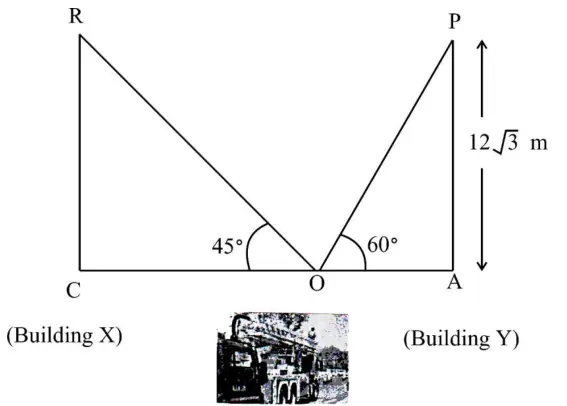
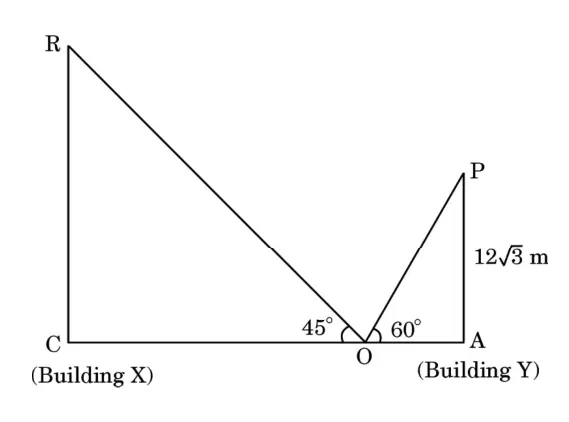
Due to short circuit, a fire has broken out in New Home Complex. Two buildings, namely X and Y have mainly been affected. The fire engine has arrived and it has been stationed at a point which is in between the two buildings. A ladder at point O is fixed in front of the fire engine.
The ladder inclined at an angle 60° to the horizontal is leaning against the wall of the terrace (top) of the building Y. The foot of the ladder is kept fixed and after some time it is made to lean against the terrace (top) of the opposite building X at an angle of 45° with the ground. Both the buildings along with the foot of the ladder, fixed at O, are in a straight line.
Original CBSE case illustration.
Describe the figure
The original diagram places C, O, A on level ground, with X at C and Y at A. AP = 12√3 m, ∠POA = 60° and ∠ROC = 45°. The same ladder reaches P or R. A fire-engine photograph is included below the diagram.
(ii) Find the distance of the building Y from point O, i.e. OA. [1 mark]
Show answer and solution
OA = 12 m.
OA = OP cos 60° = 24 × = 12 m.
(iii)(a) Find the horizontal distance between the two buildings. [2 marks]
Show answer and solution
CA = 12(1 + √2) m.
The ladder has the same length, so OR = 24 m.
OC = OR cos 45° = = 12√2 m.
CA = CO + OA = 12√2 + 12 = 12(1 + √2) m.
OR
(iii)(b) Find the height of the building X. [2 marks]
Show answer and solution
CR = 12√2 m.
The unchanged ladder gives OR = 24 m.
CR = OR sin 45° = = 12√2 m.
Standard4 marks · Accessible paper
Case 12. A slide with a raised lower end
A class VI student went to a park and went up the slide to play. The angle of elevation of the slide is 30°, but the base from which the angle of elevation is measured is 50 cm above the ground level and the distance of this point from the bottom of the staircase (which is vertical) is 4√3 m.
There is no source illustration. The lower end of the slide is 0.5 m above the ground; use 4√3 m as the horizontal separation in the intended right-triangle model.
Appeared in: 2024 · Standard · Supplementary
(i) Write the angle of depression from the top of the slide to its base. [1 mark]
Show answer and solution
Angle of depression = 30°.
The horizontal lines at the two ends of the slide are parallel.
The angle of depression equals the angle of elevation by alternate interior angles.
(ii)(a) Find the height of the staircase. [2 marks]
Show answer and solution
Staircase height = 4.5 m.
Let H m be the height of the staircase above ground.
The vertical rise above the slide’s lower end is H − 0.5 m.
tan 30° = .
H − 0.5 = 4, so H = 4.5 m.
OR
(ii)(b) Find the length of the slide. [2 marks]
Show answer and solution
Slide length = 8 m.
Let L m be the slide length.
cos 30° = .
= , so L = 8 m.
(iii) Will the angle of elevation increase or decrease if the staircase was made taller? [1 mark]
Show answer and solution
The angle of elevation increases.
Keeping the horizontal separation and lower-end height unchanged, a taller staircase increases the vertical rise.
Thus rise ÷ horizontal distance increases, so the acute angle of elevation increases.
Basic4 marks
Case 13. Reena and Ravi fly kites
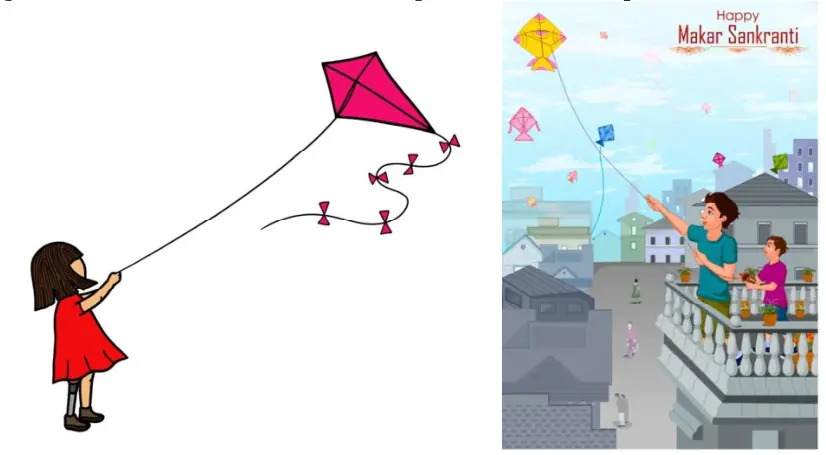
Kite festival is a popular festival in India which takes place during Makar Sankranti. The festival is celebrated by people flying kites from their rooftops. Reena and Ravi are also flying kites to enjoy the festival. The height of Reena’s kite is 60 m above the ground. The string attached to the kite is temporarily tied to a point on the ground, and the inclination of the string with the ground is 30°. Ravi is flying a kite from a 10 m high building. His kite is also flying 60 m above the ground and length of the string used by Ravi is same as that of Reena’s. θ is the angle of elevation of Ravi’s kite from a point on the rooftop.
Original CBSE case illustration.
Describe the figure
Both original illustrations are retained: a girl flying a kite from ground level and children flying kites from a rooftop. Their decorative details add no measurements.
Appeared in: 2025 · Basic · Main
(i) Find the length of string used by Reena. [1 mark]
Show answer and solution
String length = 120 m.
Let the string length be L m.
sin 30° = , so L = 120 m.
(ii) Find the value of sin θ. [1 mark]
Show answer and solution
sin θ = .
For Ravi, the vertical rise above the rooftop is 60 − 10 = 50 m.
sin θ = = .
(iii)(a) If θ changes to 60°, without changing the length of the string, what will be the height of Ravi’s kite above the ground? (Use √3 = 1.7.) [2 marks]
Show answer and solution
Height above ground = 112 m.
Rise above the rooftop = 120 sin 60° = 60√3 m.
Total height = 10 + 60√3.
Using √3 = 1.7, height = 10 + 102 = 112 m.
OR
(iii)(b) What would have been the height of Ravi’s kite above the ground, if the string had an inclination of 30° with the ground, assuming that the length of the string does not change? [2 marks]
Show answer and solution
Height above ground = 70 m.
Rise above the rooftop = 120 sin 30° = 60 m.
Add the rooftop height: 60 + 10 = 70 m.
Basic4 marks
Case 14. Two motorboats under a bridge
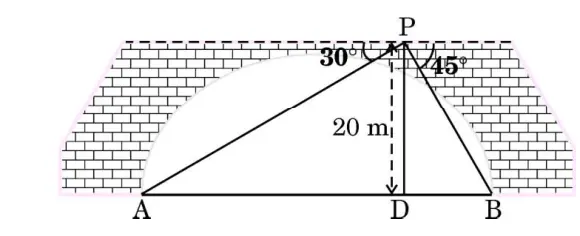
Two motorboats A and B are waiting at the opposite banks of a river in order to reach the opposite side. From a point P on the bridge, 20 m above the river, the angles of depression of the boats are 30° and 45° respectively, as shown in the figure given below. Both the boats leave at the same time at the speed of 10 m/s and 5 m/s, respectively.
Original CBSE case illustration.
Describe the figure
P is 20 m vertically above D in the river. A and B are on opposite banks with D between them. The depressions to A and B are 30° and 45°. Both boats head towards D.
Appeared in: 2025 · Basic · Main
(i) Find the distance travelled by boat A to reach point D in the river, vertically below the point P. (Use √3 = 1.73.) [1 mark]
Show answer and solution
AD = 34.6 m.
∠PAD = 30°, equal to the angle of depression.
tan 30° = , so AD = 20√3 = 34.6 m.
(ii) What is the width of the river? [1 mark]
Show answer and solution
Width AB = 54.6 m.
tan 45° = , so DB = 20 m.
AB = AD + DB = 34.6 + 20 = 54.6 m.
(iii)(a) Which boat will reach point D first, and how much earlier, than the other boat? [2 marks]
Show answer and solution
Boat A reaches D 0.54 seconds earlier.
Time = .
Boat A takes = 3.46 seconds.
Boat B takes = 4 seconds.
Boat A is earlier by 4 − 3.46 = 0.54 seconds.
OR
(iii)(b) What is the distance between the two boats after 3 seconds? [2 marks]
Show answer and solution
Separation after 3 seconds = 9.6 m.
In 3 seconds, A travels 10 × 3 = 30 m and B travels 5 × 3 = 15 m.
Neither boat has reached D by then.
Their separation is AB − 30 − 15 = 54.6 − 45 = 9.6 m.
Standard4 marks · Accessible paper
Case 15. Harish uses a clinometer
Clinometer is a tool that is used to measure the angle of elevation. We can use the clinometer to measure the height of tall things that you can’t possibly reach. With the help of a clinometer, Harish measured the angle of elevation of the roof of a building from a point P on the ground as 45°. On the same wall, at some height below the top, there was a society logo, whose angle of elevation from the same point P was measured as 30°. The point P is at a distance of 24 m from the base of the building.
The accessible source contains no illustration. The building is vertical, P is 24 m horizontally from its foot, and the logo is below its roof.
Appeared in: 2025 · Standard · Main
(a)(i) What is the height of the building logo from the ground? [2 marks]
Show answer and solution
Logo height = 8√3 m.
Let the logo height be h m.
tan 30° = , so h = = 8√3 m.
OR
(a)(ii) What is the height of the building from the ground? [2 marks]
Show answer and solution
Building height = 24 m.
Let the roof height be H m.
tan 45° = = 1, so H = 24 m.
(b) What is the aerial (slant) distance of point P from the top of the building? [1 mark]
Show answer and solution
Slant distance = 24√2 m.
cos 45° = .
Slant distance = = 24√2 m.
(c) If θ is the angle of elevation of the top of building when the point P is moved 9 m towards the base of the building, then find tan θ. [1 mark]
Show answer and solution
tan θ = .
New horizontal distance = 24 − 9 = 15 m.
The roof remains 24 m high.
tan θ = = .
Standard4 marks
Case 16. Amrita climbs an observation deck
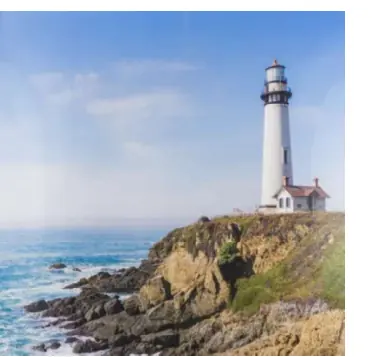
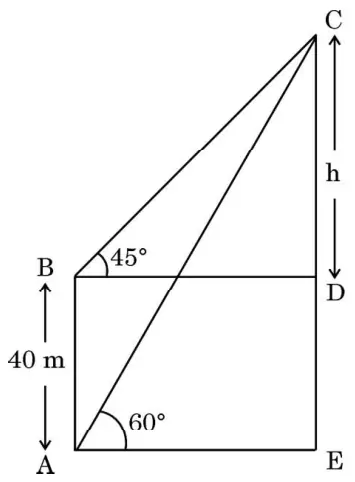
Amrita stood near the base of a lighthouse, gazing up at its towering height. She measured the angle of elevation to the top and found it to be 60°. Then, she climbed a nearby observation deck, 40 metres higher than her original position and noticed the angle of elevation to the top of lighthouse to be 45°.
Original CBSE case illustration.Original CBSE case illustration.
Describe the figure
The original lighthouse photograph accompanies a diagram: AB = DE = 40 m, BD is horizontal, CD = h, ∠CAE = 60° and ∠CBD = 45°. A and B are vertically aligned.
Appeared in: 2025 · Standard · Main
(i) If CD is h metres, find the distance BD in terms of h. [1 mark]
Show answer and solution
BD = h m.
In right △BDC, tan 45° = = .
BD = h m.
(ii) Find distance BC in terms of h. [1 mark]
Show answer and solution
BC = h√2 m.
In △BDC, BD = CD = h.
By Pythagoras, BC² = h² + h² = 2h².
BC = h√2 m.
(iii)(a) Find the height CE of the lighthouse. (Use √3 = 1.73.) [2 marks]
Show answer and solution
CE = 20(3 + √3) m ≈ 94.6 m.
AE = BD = h and CE = h + 40.
In △AEC, tan 60° = .
h(√3 − 1) = 40, so h = = 20(√3 + 1).
CE = h + 40 = 20(√3 + 3) = 20 × 4.73 = 94.6 m.
OR
(iii)(b) Find distance AE, if AC = 100 m. [2 marks]
Show answer and solution
AE = 50 m.
This OR supplies AC = 100 m separately; use its own condition rather than the height calculated in (iii)(a).
In △AEC, cos 60° = .
AE = 100 × = 50 m.
Standard4 marks
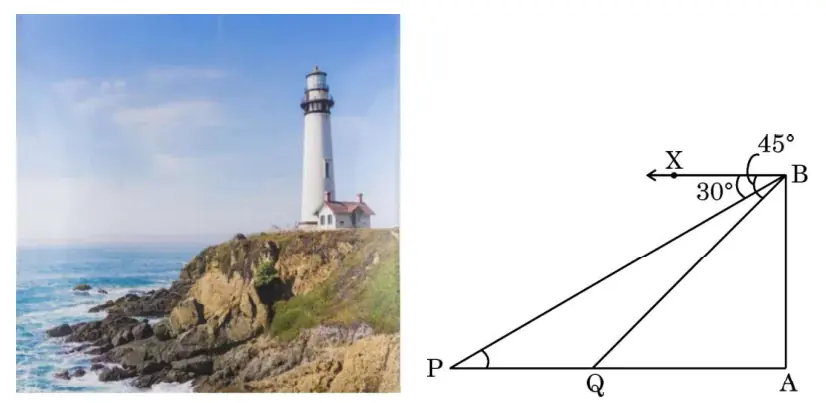
Case 17. A ship approaches a fifty-metre lighthouse
A lighthouse stands tall on a cliff by the sea, watching over ships that pass by. One day a ship is seen approaching the shore and from the top of the lighthouse, the angles of depression of the ship are observed to be 30° and 45° as it moves from point P to point Q. The height of the lighthouse is 50 metres.
Original CBSE case illustration.
Describe the figure
The original photograph and diagram are both retained. AB = 50 m is vertical; P, Q, A are collinear, with Q nearer A. The depressions from B to P and Q are 30° and 45°.
Appeared in: 2025 · Standard · Main
(i) Find the distance of the ship from the base of the lighthouse when it is at point Q, where the angle of depression is 45°. [1 mark]
Show answer and solution
AQ = 50 m.
The angle of elevation ∠BQA equals the 45° depression.
tan 45° = = , so AQ = 50 m.
(ii) Find the measures of ∠PBA and ∠QBA. [1 mark]
Show answer and solution
∠PBA = 60°; ∠QBA = 45°.
BA is perpendicular to the horizontal through B.
∠PBA = 90° − 30° = 60°.
∠QBA = 90° − 45° = 45°.
(iii)(a) Find the distance travelled by the ship between points P and Q. [2 marks]
Show answer and solution
PQ = 50(√3 − 1) m.
tan 30° = , so AP = 50√3 m.
Since Q lies between P and A, PQ = AP − AQ.
PQ = 50√3 − 50 = 50(√3 − 1) m.
OR
(iii)(b) If the ship continues moving towards the shore and takes 10 minutes to travel from Q to A, calculate the speed of the ship in km/h, from Q to A. [2 marks]
Show answer and solution
Speed = 0.3 km/h.
AQ = 50 m = 0.05 km.
Time = 10 minutes = hour.
Speed = = 0.3 km/h.
Standard4 marks
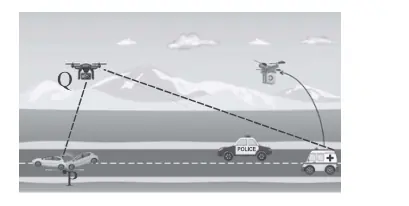
Case 18. A drone guides an ambulance
A drone was used to facilitate movement of an ambulance on the straight highway to a point P on the ground where there was an accident. The ambulance was travelling at the speed of 60 km/h. The drone stopped at a point Q, 100 m vertically above the point P. The angle of depression of the ambulance was found to be 30° at a particular instant.
Original CBSE case illustration.
Describe the figure
The original illustration shows an ambulance on a straight highway, the accident point P and a drone at Q. The later 45° and 60° positions must be labelled on the solution diagram.
Appeared in: 2025 · Standard · Main
(i) Represent the above situation with the help of a diagram. [1 mark]
Show answer and solution
See the labelled solution diagram.
TutorVertex solution diagram · Not to scale.
Draw QP perpendicular to the highway, with QP = 100 m.
Place A, B, T on the same side of P, in that order towards P, for elevations 30°, 45° and 60°.
Join QA, QB, QT. Their elevations equal the corresponding depressions from Q.
(ii) Find the distance between the ambulance and the site of accident P at the particular instant. (Use √3 = 1.73.) [1 mark]
Show answer and solution
Initial horizontal distance AP = 173 m.
tan 30° = .
AP = 100√3 = 100 × 1.73 = 173 m.
(iii)(a) Find the time (in seconds) in which the angle of depression changes from 30° to 45°. [2 marks]
Show answer and solution
Time = 6(√3 − 1) seconds ≈ 4.38 seconds.
At 45°, BP = = 100 m.
Distance AB = 100√3 − 100 = 100(√3 − 1) m.
Speed = 60 × = m/s.
Time = = 6(√3 − 1) seconds.
Using √3 = 1.73 gives 6 × 0.73 = 4.38 seconds.
OR
(iii)(b) How long (in seconds) will the ambulance take to reach point P from a point T on the highway such that angle of depression of the ambulance at T is 60° from the drone? [2 marks]
Show answer and solution
Time = 2√3 seconds ≈ 3.46 seconds.
At T, tan 60° = , so TP = m.
Speed = m/s.
Time = = = 2√3 seconds.
Using √3 = 1.73 gives 3.46 seconds.
Standard4 marks
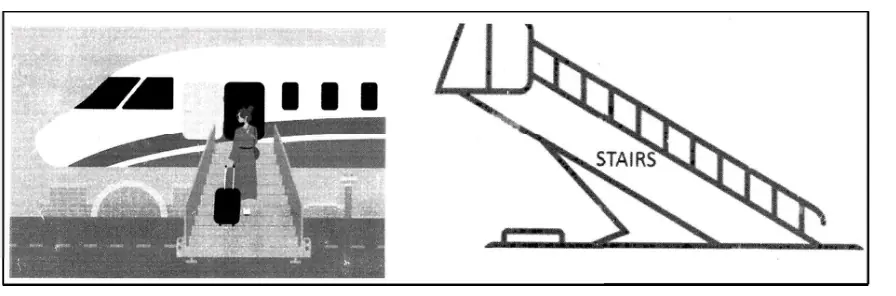
Case 19. Passenger boarding stairs
Passenger boarding stairs, sometimes referred to as boarding ramps, stair cars or aircraft steps, provide a mobile means to travel between the aircraft doors and the ground. Larger aircraft have door sills 5 to 20 feet (1 foot = 30 cm) high. Stairs facilitate safe boarding and de-boarding.
An aircraft has a door sill at a height of 15 feet above the ground. A stair car is placed at a horizontal distance of 15 feet from the plane. Based on given information, answer the questions given in part (i) and (ii).
Original CBSE case illustration.
Describe the figure
Both source images are included: a photograph of boarding stairs beside an aircraft and a drawing labelled STAIRS. The 15-foot dimensions are stated in the passage, not marked on these images.
Appeared in: 2025 · Standard · Main
(i) Find the angle at which stairs are inclined to reach the door sill 15 feet high above the ground. [1 mark]
Show answer and solution
Angle of inclination = 45°.
Let the angle be θ.
tan θ = = = 1.
Therefore θ = 45°.
(ii) Find the length of stairs used to reach the door sill. [1 mark]
Show answer and solution
Length of stairs = 15√2 feet.
By Pythagoras, L² = 15² + 15² = 450.
L = √450 = 15√2 feet.
(iii)(a) If the 20 feet long stairs is inclined at an angle of 60° to reach the door sill, then find the height of the door sill above the ground. (Use √3 = 1.732.) [2 marks]
Show answer and solution
Height = 17.32 feet.
This subpart gives a new stair length and angle; use these independently of parts (i) and (ii).
Height = 20 sin 60° = 10√3 feet.
Using √3 = 1.732, height = 17.32 feet.
OR
(iii)(b) What should be the shortest possible length of stairs to reach the door sill of the plane 20 feet above the ground, if the angle of elevation cannot exceed 30°? Also, find the horizontal distance of base of stair car from the plane. [2 marks]
For a fixed height, a steeper permitted inclination needs a shorter stair. Use the largest allowed angle, 30°.
sin 30° = , so L = 40 feet.
Horizontal distance = L cos 30° = 40 × = 20√3 feet.
Standard4 marks
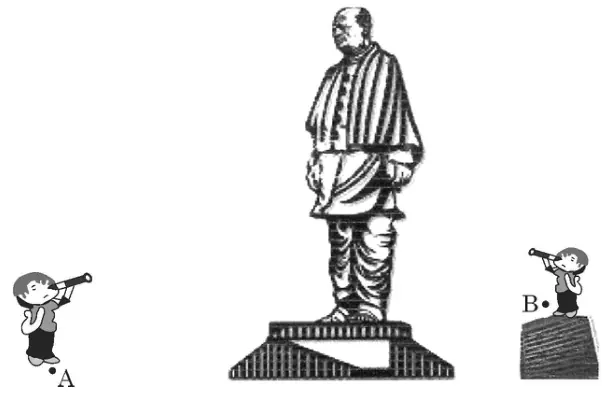
Case 20. Two observations of the Statue of Unity
The Statue of Unity situated in Gujarat is the world’s largest Statue which stands over a 58 m high base. As part of the project, a student constructed an inclinometer and wishes to find the height of Statue of Unity using it. He noted following observations from two places:
Situation I: The angle of elevation of the top of Statue from Place A which is 80√3 m away from the base of the Statue is found to be 60°.
Situation II: The angle of elevation of the top of Statue from a Place B which is 40 m above the ground is found to be 30° and entire height of the Statue including the base is found to be 240 m.
Original CBSE case illustration.
Describe the figure
The original illustration shows the statue on its pedestal, observer A at ground level and observer B on a raised platform. The two situations have their own observation positions.
Appeared in: 2025 · Standard · Main
(i) Represent the Situation I with the help of a diagram. [1 mark]
Show answer and solution
See the labelled Situation I diagram.
TutorVertex solution diagram · Not to scale.
Let O be the ground foot, T the statue top and S the top of the 58 m pedestal.
Draw OT perpendicular to OA, with OA = 80√3 m, OS = 58 m and ∠TAO = 60°.
(ii) Represent the Situation II with the help of a diagram. [1 mark]
Show answer and solution
See the labelled Situation II diagram.
TutorVertex solution diagram · Not to scale.
Draw B at a height of 40 m and BH horizontal to OT.
Mark OT = 240 m, OS = 58 m, ∠TBH = 30° and ∠SBH = α.
(iii)(a) Calculate the height of Statue excluding the base and also find the height including the base with the help of Situation I. [2 marks]
Show answer and solution
Statue alone = 182 m; including the base = 240 m.
In Situation I, tan 60° = .
OT = 80√3 × √3 = 240 m.
Statue height ST = OT − OS = 240 − 58 = 182 m.
OR
(iii)(b) Find the horizontal distance of point B (Situation II) from the Statue and the value of tan α, where α is the angle of elevation of top of base of the Statue from point B. [2 marks]
Show answer and solution
Horizontal distance = 200√3 m; tan α = .
In Situation II, the top rises 240 − 40 = 200 m above B.
tan 30° = , so BH = 200√3 m.
The pedestal top rises 58 − 40 = 18 m above B.
tan α = = .
Basic4 marks · Accessible paper
Case 21. A ship observed ten seconds apart
An observer from the top of a 30 m tall lighthouse observes a ship at an angle of depression 30° coming towards the base of the lighthouse along a straight line joining the ship and the base of the lighthouse. The angle of depression changes to 45° after 10 seconds.
The accessible source has no illustration. The ship approaches on a straight line, so the distance travelled is the difference of the two horizontal distances.
Appeared in: 2025 · Basic · Supplementary
(i) Determine the distance of the ship from the base of the lighthouse, when the angle of depression is 30°. [1 mark]
Show answer and solution
Initial distance = 30√3 m.
The ship’s angle of elevation equals the angle of depression.
tan 30° = , so x = 30√3 m.
(ii) Determine the distance of the ship from the base, after 10 seconds from the initial position. [1 mark]
Show answer and solution
Distance after 10 seconds = 30 m.
At the later position, tan 45° = .
Thus y = 30 m.
(iii)(a) Find the distance between the two positions of the ship between 30° and 45°. [2 marks]
Show answer and solution
Distance travelled = 30(√3 − 1) m.
The ship is approaching the base on the same side.
Distance travelled = 30√3 − 30 = 30(√3 − 1) m.
OR
(iii)(b) Find the speed of the ship between its two positions. [2 marks]
Show answer and solution
Speed = 3(√3 − 1) m/s ≈ 2.196 m/s.
Distance travelled = 30(√3 − 1) m and time = 10 seconds.
Speed = = 3(√3 − 1) m/s.
For a decimal approximation, √3 ≈ 1.732 gives 2.196 m/s.
Standard4 marks
Case 22. Kites and a tower-mounted camera
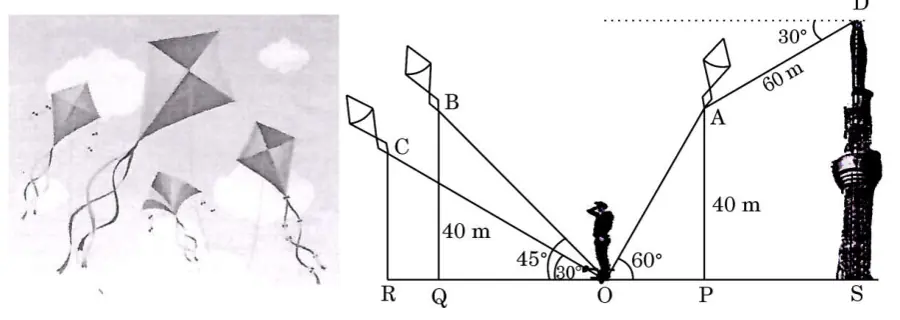
The International Kite Festival takes place every year on 14th January. The main attractions of the festival include national and international Kite Flyers’ Parade, kite flying, traditional stalls etc. On this day, few kite flyers had assembled at a point O on the ground. The position of 3 kites A, B, C was such that A and B were at the same vertical height of 40 m from the ground level. The angles of elevation of A, B and C from O were 60°, 45° and 30° respectively. A vertical tower SD has been erected at point S and a camera is set at the top of the tower for photography.
Original CBSE case illustration.
Describe the figure
The original strip combines a kite photograph and a labelled diagram. A is to the right of O, B and C to the left. A and B are 40 m high. Camera D is above A, with slant AD = 60 m and a 30° depression to A.
Appeared in: 2025 · Standard · Supplementary
(i) What is the length of the string of the kite at A? [1 mark]
Show answer and solution
OA = m.
sin 60° = .
OA = m.
(ii) If the length of the string of kite at C is 40 m, then find the height of that kite C from the ground. [1 mark]
Show answer and solution
Height of C = 20 m.
Height = OC sin 30° = 40 × = 20 m.
(iii)(a) What is the horizontal distance between the kites at A and B? [2 marks]
Show answer and solution
Horizontal separation = (40 + ) m.
The horizontal distance from O to the foot of A is = m.
The horizontal distance from O to the foot of B is = 40 m.
The kites are on opposite sides of O, so add these distances.
Horizontal separation = 40 + m.
OR
(iii)(b) If the angle of depression of the kite at A is 30° from the camera at D and the distance between A and D is 60 m, then find the height of the tower. [2 marks]
Show answer and solution
Tower height = 70 m.
The vertical rise from kite A to camera D is 60 sin 30° = 30 m.
A is already 40 m above ground.
Tower height SD = 40 + 30 = 70 m.
Standard4 marks
Case 23. A water tank viewed from a window
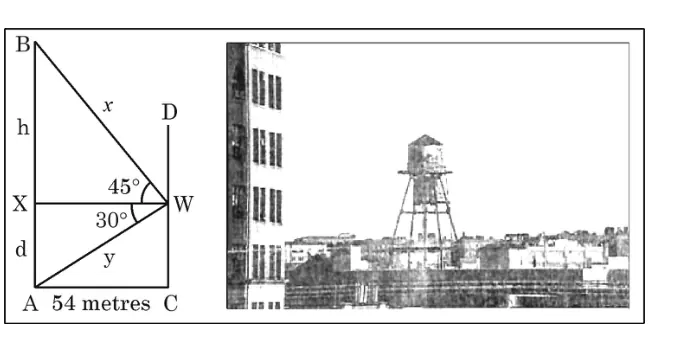
Elevated water storage tanks are built to store and supply water to nearby colonies. In the diagram given above, AB is an elevated water tank and CD is a nearby multistorey building. The building is 54 metres away from the water tank.
From a window W of the building, the angle of elevation of top of the tank is 45° and angle of depression of its foot is 30°.
Original CBSE case illustration.
Describe the figure
The original diagram and photograph are both included. AB is the vertical tank; W is the window. WX is horizontal and 54 m long, AX = WC = d, BX = h, BW = x and AW = y.
Appeared in: 2026 · Standard · Main
(i) Write a relation between d (the height of window) and y. [1 mark]
Show answer and solution
y = 2d.
In right △AXW, sin 30° = = .
= , so y = 2d.
(ii) Determine the value of h. [1 mark]
Show answer and solution
h = 54 m.
In right △BXW, tan 45° = .
Thus h = 54 m.
(iii)(a) Determine height of the water tank. [2 marks]
Show answer and solution
AB = (54 + 18√3) m.
In △AXW, tan 30° = .
d = = 18√3 m.
Total tank height AB = AX + XB = d + h = (18√3 + 54) m.
OR
(iii)(b) Find the value of x and height of the window above ground level. [2 marks]
Show answer and solution
x = 54√2 m; window height = 18√3 m.
cos 45° = , so x = 54√2 m.
tan 30° = , so d = = 18√3 m.
The window is d = 18√3 m above ground.
Standard4 marks
Case 24. A two-section radio tower: 6 m
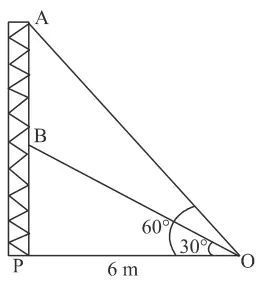
Radio towers are used for transmitting a range of communication services including radio and television. The tower will either act as an antenna itself or support one or more antennas on its structure. On a similar concept, a radio station tower was built in two sections A and B. Tower is supported by wires from a point O (as shown in figure).
Distance between the base of the tower and point O is 6 m. From point O, the angle of elevation of the top of the section B is 30° and the angle of elevation of the top of section A is 60°.
Original CBSE case illustration.
Describe the figure
The source diagram marks OP = 6 m, ∠BOP = 30° and ∠AOP = 60°. A and B lie above P on a vertical tower.
(i) Find the length of the wire from the point O to the top of section B. [1 mark]
Show answer and solution
OB = 4√3 m.
cos 30° = = .
OB = = 4√3 m.
(ii) Find the length of the wire from the point O to the top of section A. [1 mark]
Show answer and solution
OA = 12 m.
cos 60° = = .
= , so OA = 12 m.
(iii)(a) Find the distance AB. [2 marks]
Show answer and solution
AB = 4√3 m.
AP = OP tan 60° = 6√3 m.
BP = OP tan 30° = = 2√3 m.
AB = AP − BP = 4√3 m.
OR
(iii)(b) Find the area of △OPB. [2 marks]
Show answer and solution
Area = 6√3 m².
BP = OP tan 30° = 2√3 m.
Area of right △OPB = × OP × BP.
Area = × 6 × 2√3 = 6√3 m².
Standard4 marks
Case 25. A ladder turns towards the opposite building
A ladder inclined at an angle of 60° to the horizontal is leaning against the vertical wall of the terrace (top) of the building Y. The foot of the ladder is kept fixed and after some time it is made to lean against the terrace (top) of the opposite building X, at an angle of 45° with the ground. Both buildings along with the foot of the ladder, fixed at O, are in a straight line.
Original CBSE case illustration.
Describe the figure
The source diagram has C, O, A on the ground. Building Y has height AP = 12√3 m, ∠POA = 60°, and ∠ROC = 45° for building X. Unlike Case 11, part (ii) asks for OC, towards X.
Appeared in: 2026 · Standard · Second Board Examination
(ii) Find the distance of the building X from point O, i.e. OC. [1 mark]
Show answer and solution
OC = 12√2 m.
In △OCR, OC = OR cos 45°.
OC = = 12√2 m.
(iii)(a) Find the horizontal distance between the two buildings. [2 marks]
Show answer and solution
CA = 12(1 + √2) m.
OA = OP cos 60° = 24 × = 12 m.
OC = OR cos 45° = 12√2 m.
CA = CO + OA = 12√2 + 12 = 12(1 + √2) m.
OR
(iii)(b) Find the height of the building X. [2 marks]
Show answer and solution
CR = 12√2 m.
In △OCR, CR = OR sin 45°.
CR = = 12√2 m.
Standard4 marks
Case 26. Tejas watches an approaching car
Tejas is standing at the top of a building and observes a car at an angle of depression of 30° as it approaches the base of the building at a uniform speed. 6 seconds later, the angle of depression increases to 60°, and at that moment, the car is 25 m away from the building.
Original CBSE case illustration.
Describe the figure
The original strip has a car/building illustration and a diagram. A is the observer, B the foot, D the initial car position and C its later position. D, C, B are collinear and CB = 25 m.
Appeared in: 2026 · Standard · Main
(i) What is the height of the building? [1 mark]
Show answer and solution
AB = 25√3 m.
At C, the angle of elevation is 60°.
tan 60° = , so AB = 25√3 m.
(ii) What is the distance between the two positions of the car? [1 mark]
Show answer and solution
DC = 50 m.
At D, tan 30° = , so DB = 75 m.
DC = DB − CB = 75 − 25 = 50 m.
(iii)(a) What would be the total time taken by the car to reach the foot of the building from the starting point? [2 marks]
Show answer and solution
Total time from D to B = 9 seconds.
Uniform speed = = = m/s.
Total distance DB = 75 m.
Total time = = 9 seconds.
OR
(iii)(b) What is the distance of the observer from the car when it makes an angle of 60°? [2 marks]
Show answer and solution
AC = 50 m.
The question asks for the slant distance AC.
cos 60° = = .
= , so AC = 50 m.
Basic4 marks
Case 27. A visit to Lakshman Jhula
Lakshaman Jhula is located 5 kilometers north-east of the city of Rishikesh in the Indian state of Uttarakhand. The bridge connects the villages of Tapovan to Jonk. Tapovan is in Tehri Garhwal district, on the west bank of the river, while Jonk is in Pauri Garhwal district, on the east bank. Lakshman Jhula is a pedestrian bridge also used by motorbikes. It is a landmark of Rishikesh.
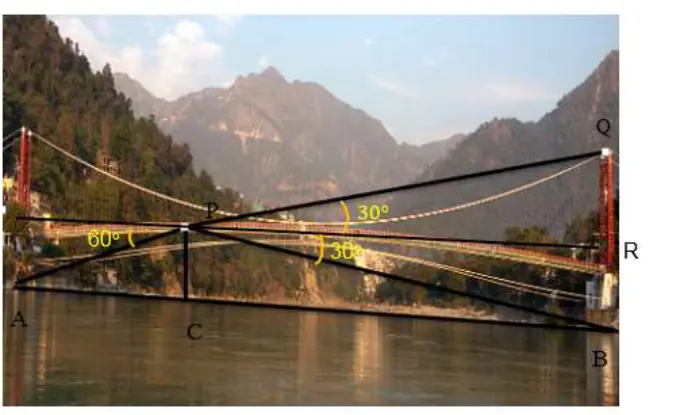
A group of Class X students visited Rishikesh in Uttarakhand on a trip. They observed from a point P on a river bridge that the angles of depression of opposite banks of the river are 60° and 30° respectively. The height of the bridge is about 18 meters from the river.
Original CBSE case illustration.
Describe the figure
The original bridge photograph carries the geometry. PC = 18 m is vertical; A, C, B lie along river level. The depressions to A and B are 60° and 30°. R is level with P on vertical BQ; the elevation of Q from P is 30°.
Appeared in: 2022–23 · Basic · Official Sample
I Find the distance PA. [1 mark]
Show answer and solution
PA = 12√3 m.
In △PCA, sin 60° = = .
PA = = 12√3 m.
II Find the distance PB. [1 mark]
Show answer and solution
PB = 36 m.
In △PCB, sin 30° = = .
PB = 36 m.
III Find the width AB of the river. [2 marks]
Show answer and solution
AB = 24√3 m.
AC = = 6√3 m.
CB = = 18√3 m.
The banks are on opposite sides of C, so AB = AC + CB = 24√3 m.
OR
III Find the height BQ if the angle of the elevation from P to Q be 30°. [2 marks]
Show answer and solution
BQ = 36 m.
PR = CB = 18√3 m, and BR = PC = 18 m.
RQ = PR tan 30° = 18√3 × = 18 m.
BQ = BR + RQ = 18 + 18 = 36 m.
Standard4 marks
Case 28. Air Traffic Control follows an aircraft
We all have seen the airplanes flying in the sky but might have not thought of how they actually reach the correct destination. Air Traffic Control (ATC) is a service provided by ground-based air traffic controllers who direct aircraft on the ground and through a given section of controlled airspace, and can provide advisory services to aircraft in non-controlled airspace. Actually, all this air traffic is managed and regulated by using various concepts based on coordinate geometry and trigonometry.
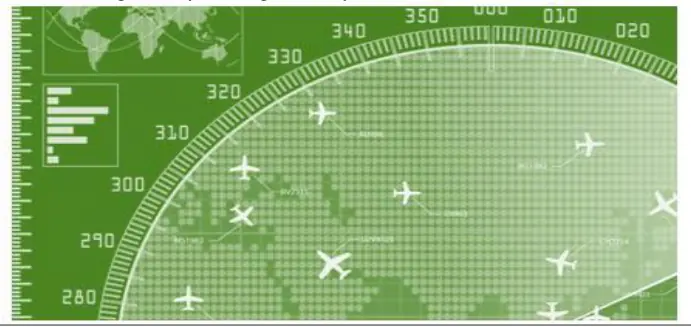
At a given instance, ATC finds that the angle of elevation of an airplane from a point on the ground is 60°. After a flight of 30 seconds, it is observed that the angle of elevation changes to 30°. The height of the plane remains constantly as 3000√3 m.
Original CBSE case illustration.
Describe the figure
The original image is an air-traffic radar display. It supplies no additional measurements. In the solution model, the aircraft moves horizontally away from the observer at the stated constant altitude.
Appeared in: 2022–23 · Standard · Official Sample
(i) Draw a neat labelled figure to show the above situation diagrammatically. [1 mark]
Show answer and solution
See the labelled solution diagram.
TutorVertex solution diagram · Not to scale.
Place observer O on the ground and draw horizontal flight line AB above it.
Drop perpendiculars AC and BD to the ground, each of height 3000√3 m.
Join OA and OB; mark ∠AOC = 60° and ∠BOD = 30°, with C and D on the same side of O.
(ii) What is the distance travelled by the plane in 30 seconds? [2 marks]
Show answer and solution
Distance travelled = 6000 m.
Let h = 3000√3 m.
Initial horizontal distance OC = = 3000 m.
Later horizontal distance OD = = 9000 m.
Horizontal flight distance AB = OD − OC = 6000 m.
OR
(ii) Keeping the height constant, during the above flight, it was observed that after 15(√3 − 1) seconds, the angle of elevation changed to 45°. How much is the distance travelled in that duration? [2 marks]
(iii) What is the speed of the plane in km/hr? [1 mark]
Show answer and solution
Speed = 720 km/h.
The plane travels 6000 m in 30 seconds.
Speed = = 200 m/s.
In km/h, speed = 200 × = 720 km/h.
Basic4 marks
Case 29. Boats on opposite sides of a lighthouse
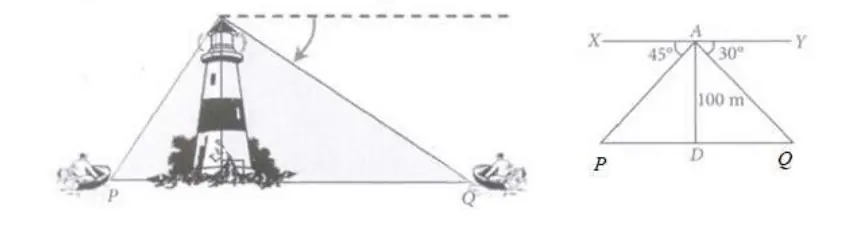
A boy is standing on the top of light house. He observed that boat P and boat Q are approaching the light house from opposite directions. He finds that angle of depression of boat P is 45° and angle of depression of boat Q is 30°. He also knows that height of the light house is 100 m.
Original CBSE case illustration.
Describe the figure
The original strip shows a lighthouse illustration and a line diagram. A is the top, D the foot, AD = 100 m, with P and Q on opposite sides. XAY is the horizontal through A. ∠XAP = 45° and ∠YAQ = 30°.
Appeared in: 2023–24 · Basic · Official Sample
(i) What is the measure of ∠APD? [1 mark]
Show answer and solution
∠APD = 45°.
XA and PD are parallel horizontal lines.
∠APD = ∠XAP = 45° by alternate interior angles.
(ii) If ∠YAQ = 30°, then ∠AQD is also 30°. Why? [1 mark]
Show answer and solution
Alternate interior angles are equal because AY ∥ DQ.
The horizontal AY is parallel to the horizontal DQ.
AQ is a transversal, so ∠YAQ = ∠AQD = 30°.
(iii) Find length of PD. [2 marks]
Show answer and solution
PD = 100 m.
In right △ADP, tan 45° = = .
PD = 100 m.
OR
(iii) Find length of DQ. [2 marks]
Show answer and solution
DQ = 100√3 m.
In right △ADQ, tan 30° = = .
DQ = = 100√3 m.
Standard4 marks
Case 30. A bird and a cricket ball
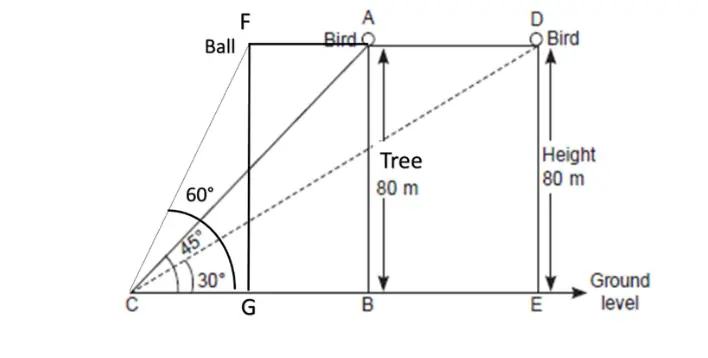
One evening, Kaushik was in a park. Children were playing cricket. Birds were singing on a nearby tree of height 80 m. He observed a bird on the tree at an angle of elevation of 45°. When a sixer was hit, a ball flew through the tree frightening the bird to fly away. In 2 seconds, he observed the bird flying at the same height at an angle of elevation of 30° and the ball flying towards him at the same height at an angle of elevation of 60°.
Original CBSE case illustration.
Describe the figure
C is the observer, AB the 80 m tree and A the bird’s initial point. Bird D is farther from C, ball F nearer C, and F, A, D are at the same height. B, G, E are the corresponding ground points, with G between C and B.
Appeared in: 2023–24 · Standard · Official Sample
(i) At what distance from the foot of the tree was he observing the bird sitting on the tree? [1 mark]
Show answer and solution
CB = 80 m.
tan 45° = = .
CB = 80 m.
(ii) How far did the bird fly in the mentioned time? [2 marks]
Show answer and solution
AD = 80(√3 − 1) m.
At D, tan 30° = , so CE = 80√3 m.
The bird’s horizontal flight distance AD = BE = CE − CB.
AD = 80√3 − 80 = 80(√3 − 1) m.
OR
(ii) After hitting the tree, how far did the ball travel in the sky when Kaushik saw the ball? [2 marks]
Show answer and solution
AF = 80(1 − ) m.
At F, tan 60° = , so CG = m.
The ball is at the same height as A, so AF = BG = CB − CG.
AF = 80 − = 80(1 − ) m.
(iii) What is the speed of the bird in m/min if it had flown 20(√3 + 1) m? [1 mark]
Show answer and solution
Speed = 600(√3 + 1) m/min.
This part separately supplies distance 20(√3 + 1) m; use it instead of the distance found in part (ii).
Time = 2 seconds = minute.
Speed = = 600(√3 + 1) m/min.
Standard4 marks
Case 31. Shreya visits India Gate
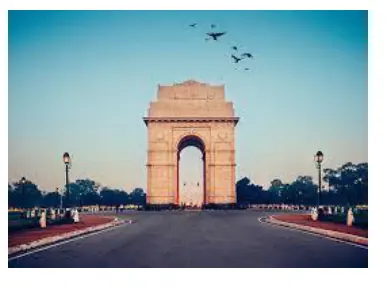
India gate (formerly known as All India war memorial) is located near Karthavya path (formerly Rajpath) at New Delhi. It stands as a memorial to 74187 soldiers of Indian Army, who gave their life in the first world war. This 42 m tall structure was designed by Sir Edwin Lutyens in the style of Roman triumphal arches. A student Shreya of height 1 m visited India Gate as a part of her study tour.
Original CBSE case illustration.
Describe the figure
The original India Gate photograph is retained. The working uses the stated monument height 42 m and Shreya’s eye level 1 m above the ground.
Appeared in: 2025–26 · Standard · Official Sample
(i) What is the angle of elevation from Shreya’s eye to the top of India Gate, if she is standing at a distance of 41 m away from the India Gate? [1 mark]
Show answer and solution
Angle of elevation = 45°.
Height of the top above her eye = 42 − 1 = 41 m.
tan θ = = 1, so θ = 45°.
(ii) If Shreya observes the angle of elevation from her eye to the top of India Gate to be 60°, then how far is she standing from the base of the India Gate? [1 mark]
Show answer and solution
Horizontal distance = m.
Let the horizontal distance be x m.
tan 60° = , so x = m.
(iii)(A) If the angle of elevation from Shreya’s eye changes from 45° to 30°, when she moves some distance back from the original position, find the distance she moves back. [2 marks]
Show answer and solution
Distance moved back = 41(√3 − 1) m.
The initial distance at 45° is 41 m.
At 30°, the distance is = 41√3 m.
Distance moved back = 41√3 − 41 = 41(√3 − 1) m.
OR
(iii)(B) If Shreya moves to a point which is at a distance of m from the India Gate, then find the angle of elevation made by her eye to the top of India Gate. [2 marks]
Show answer and solution
Angle of elevation = 60°.
The vertical rise above her eye remains 42 − 1 = 41 m.
tan θ = = √3.
Therefore θ = 60°.
Questions students ask
When should I add distances and when should I subtract them?
Draw the ground positions first. For points on opposite sides of a foot, add the horizontal distances. For two positions on the same side, subtract. Distinguish the distance between two positions from the distance of either position to the base.
Does an angle of depression equal an angle of elevation?
Yes, for the same line of sight between parallel horizontals. They are alternate interior angles. The angle between the line of sight and a vertical is its complement, not the angle of depression.
How do I include an observer’s height?
Use the vertical difference between the target and the observer’s eye or platform. For Shreya at India Gate, the rise is 42 − 1 = 41 m. For the deck and statue cases, use the stated platform height before forming the ratio.
How do I recognise a slant distance?
A string, wire, ladder or line of sight is the hypotenuse. A ground distance is horizontal. Use sine or cosine for a slant distance and tangent for vertical rise compared with horizontal distance.
How do I find speed from changing angles?
Find the horizontal distance at each observation, then find the distance travelled. Divide by the elapsed time, using consistent units. Multiply m/s by 18/5 to get km/h, or km/h by 5/18 to get m/s.
Which value of √3 should I use?
Keep √3 exact until the final calculation, then use the approximation printed in that question. Some cases specify 1.7, others 1.73 or 1.732. If none is prescribed, an exact surd is suitable.
Can I carry every answer into the next subpart?
Only when the conditions stay the same. Some OR alternatives or conditional subparts give new heights, lengths, angles or distances. Use those stated conditions separately, as explained beside the affected solutions.
Should I answer both OR alternatives in the examination?
Answer one alternative where an OR is printed, following the marks beside that part. Both alternatives are solved here for practice.
Question file: MATHEMATICS_BASIC/430_B_Maths Basic for VI candidates.pdf Marking-scheme file: Math_Basic/430_VISUALLY IMPAIRED MATHEMATICS BASIC FINAL.pdf Question starts on PDF page 21.