Circles: Class 10 Case Study Previous Year Questions with Answers
The current CBSE sample-paper format has three 4-mark case studies in Section E. These Circles cases test tangent lengths, angles, inscribed circles and surrounding frames. Read the passage and figure, then try each part before opening its solution.
12 distinct cases · 31 board-paper appearances + 1 official-sample appearance Solutions prepared by Team TutorVertex Verified by Siddharth Sir · Last reviewed 27 October 2026
Key results
A radius is perpendicular to the tangent at its point of contact.
Tangents drawn from the same external point are equal in length.
For tangents PA and PB, right triangles OAP and OBP are congruent by RHS. Therefore OP bisects the angle between the tangents.
The angle between two tangents and the angle between their contact radii add to 180°.
In right △OAP, PA² = OP² − OA². Establish the right angle before using Pythagoras.
If ABCD circumscribes a circle, AB + CD = AD + BC. This follows by adding equal tangent segments.
Follow the marks beside each part. Both OR alternatives are solved for practice; answer one alternative in the examination.
Basic4 marks
Case 1. A circular object hung from a nail
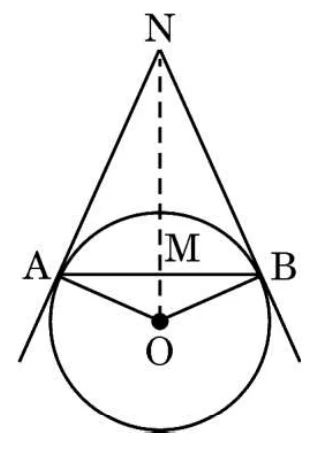
Circles play an important part in our life. When a circular object is hung on the wall with a cord at nail N, the cords NA and NB work like tangents. Observe the figure, given that ∠ANO = 30° and OA = 5 cm.
Diagram retained from the official paper.
Describe the figure
N is above the circle with centre O. NA and NB touch it at A and B. NO meets chord AB at M. The given radius is OA = 5 cm and the given angle is ∠ANO = 30°.
OA ⟂ AN, since a radius is perpendicular to the tangent at its point of contact.
In right △OAN, tan 30° = = .
= , so AN = 5√3 cm.
(ii) Find the measure of ∠AOB. [1 mark]
Show answer and solution
∠AOB = 120°.
In right triangles OAN and OBN, ON is common and OA = OB (radii).
Thus △OAN ≅ △OBN by RHS, so ∠BNO = ∠ANO = 30°.
∠ANB = 30° + 30° = 60°.
In quadrilateral OANB, ∠OAN = ∠OBN = 90°.
∠AOB = 360° − 90° − 90° − 60° = 120°.
(iii)(a) Find the total length of cords NA, NB and the chord AB. [2 marks]
Show answer and solution
NA + NB + AB = 15√3 cm.
NA = NB, since tangents from the same external point are equal.
∠ANB = 60°, as found above.
The base angles of isosceles △ANB are each (180° − 60°)/2 = 60°.
Thus △ANB is equilateral, so AB = NA = NB = 5√3 cm.
Total length = 3 × 5√3 = 15√3 cm.
OR
(iii)(b) If ∠ANO is 45°, then name the type of quadrilateral OANB. Justify your answer. [2 marks]
Show answer and solution
OANB is a square.
Use the new angle ∠ANO = 45° for this alternative.
By RHS congruence, ∠BNO = ∠ANO = 45°, so ∠ANB = 90°.
The angles at A and B are 90°, since the radii are perpendicular to the tangents.
The angle at O is also 360° − 90° − 90° − 90° = 90°.
Thus OANB is a rectangle.
OA = OB because they are radii; these are adjacent sides of the rectangle.
A rectangle with equal adjacent sides is a square.
Basic4 marks
Case 2. A road beside Dharamkot village
Illustration retained from the official paper.Diagram retained from the official paper.
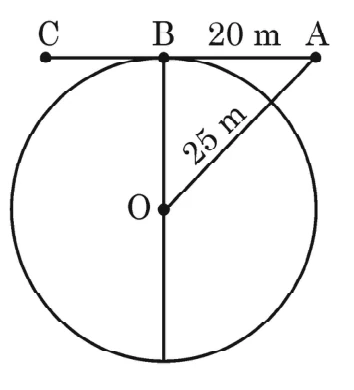
People of a circular village Dharamkot want to construct a road nearest to it. The road cannot pass through the village. But the people want the road at a shortest distance from the centre of the village. Suppose the road starts from A which is outside the circular village (as shown in the figure) and touch the boundary of the circular village at B such that AB = 20 m. Also the distance of the point A from the centre O of the village is 25 m.
Describe the figure
The decorative village illustration is retained. In the mathematical diagram, C, B and A lie on the straight road, which touches the circular village at B; O is the centre, AB = 20 m and OA = 25 m.
Shared case: this complete question also appears in Areas Related to Circles Case 1, where the emphasis is circumference and area. Here the emphasis is the radius–tangent theorem and the shortest distance to the road.
Appeared in: 2023 · Basic · Main
(i) If B is the mid-point of AC, then find the distance AC. [1 mark]
Show answer and solution
AC = 40 m.
B is the midpoint of AC, so BC = BA = 20 m.
AC = AB + BC = 20 + 20 = 40 m.
(ii) Find the shortest distance of the road from the centre of the village. [1 mark]
Show answer and solution
Shortest distance OB = 15 m.
OB ⟂ AB, since the road is tangent to the circle at B.
The perpendicular OB gives the shortest distance from O to the road.
By Pythagoras in right △OBA, OB² = OA² − AB².
OB² = 25² − 20² = 225.
OB = 15 m.
(iii) Find the circumference of the village. [2 marks]
Show answer and solution
Circumference = 30π m.
The radius is OB = 15 m.
Circumference = 2πr = 2π × 15 = 30π m.
If π is taken as 22/7, this is m, as also accepted in the marking scheme.
OR
(iii) Find the area of the village. [2 marks]
Show answer and solution
Area = 225π m².
The radius is OB = 15 m.
Area = πr² = π × 15² = 225π m².
If π is taken as 22/7, this is m², as also accepted in the marking scheme.
Standard4 marks
Case 3. The tangent path of a discus
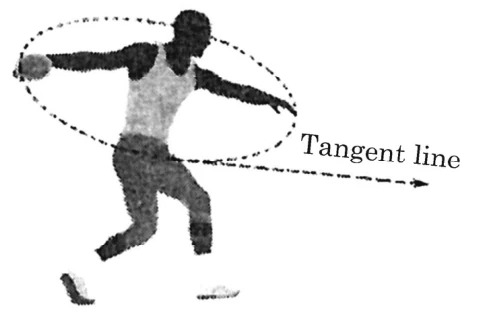
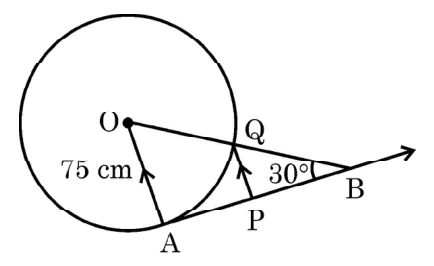
The discus throw is an event in which an athlete attempts to throw a discus. The athlete spins anti-clockwise around one and a half times through a circle, then releases the throw. When released, the discus travels along tangent to the circular spin orbit.
Illustration retained from the official paper.
In the given figure, AB is one such tangent to a circle of radius 75 cm. Point O is centre of the circle and ∠ABO = 30°. PQ is parallel to OA.
Diagram retained from the official paper.
Describe the figure
The athlete illustration is retained. AB touches the circle at A, OA = 75 cm, and ∠ABO = 30°. Q is the point where OB meets the circle between O and B. P lies on AB with PQ parallel to OA.
Appeared in: 2023 · Standard · Main
(a) Find the length of AB. [1 mark]
Show answer and solution
AB = 75√3 cm.
OA ⟂ AB, since OA is the radius to the point of contact.
In right △OAB, tan 30° = = .
AB = 75√3 cm.
(b) Find the length of OB. [1 mark]
Show answer and solution
OB = 150 cm.
In right △OAB, sin 30° = = .
= , so OB = 150 cm.
(c) Find the length of AP. [2 marks]
Show answer and solution
AP = cm.
OQ = OA = 75 cm, since both are radii.
QB = OB − OQ = 150 − 75 = 75 cm.
Thus Q is the midpoint of OB.
Since QP ∥ OA, the midpoint theorem in △BOA gives P as the midpoint of BA.
AP = = cm.
OR
(c) Find the length of PQ. [2 marks]
Show answer and solution
PQ = cm = 37.5 cm.
OQ = OA = 75 cm, so BQ = 150 − 75 = 75 cm.
Since PQ ∥ OA, △BQP ∼ △BOA by AA similarity.
= = = .
PQ = cm = 37.5 cm.
Standard4 marks
Case 4. Four poles around a circular fountain
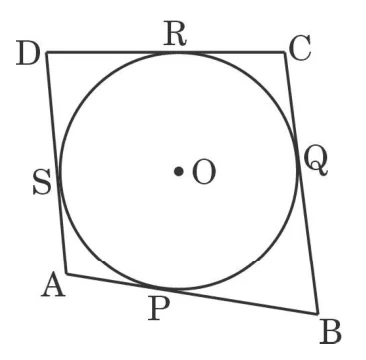
In a park, four poles are standing at positions A, B, C and D around the circular fountain such that the cloth joining the poles AB, BC, CD and DA touches the circular fountain at P, Q, R and S respectively as shown in the figure.
Diagram retained from the official paper.Photograph retained from the official paper.
Describe the figure
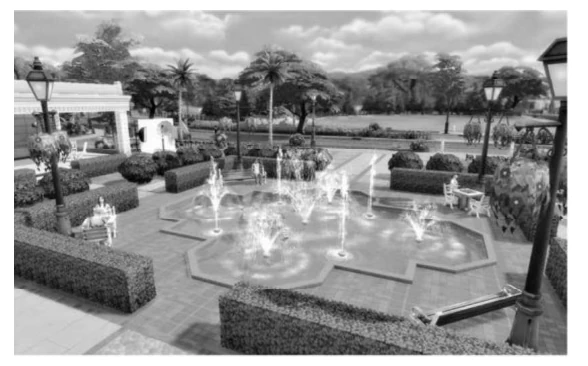
The fountain photograph is retained. ABCD surrounds a circle with centre O; the circle touches AB at P, BC at Q, CD at R and DA at S. Each subpart gives its own additional lengths or angle.
Appeared in: 2023 · Standard · Supplementary
(i) If O is the centre of the circular fountain, then ∠OSA = … [1 mark]
Show answer and solution
∠OSA = 90°.
OS is the radius to contact point S, and SA lies along the tangent AD.
Therefore OS ⟂ SA, so ∠OSA = 90°.
(ii) If AB = AD, then write the name of the figure ABCD. [1 mark]
Show answer and solution
ABCD is a kite.
Tangents from A, B, C and D are equal in pairs: AP = AS, BP = BQ, CQ = CR and DR = DS.
Adding these equalities gives AB + CD = AD + BC.
Given AB = AD, subtracting them gives CD = BC.
Thus AB = AD and BC = CD: ABCD has two pairs of equal adjacent sides, so it is a kite.
(iii)(a) If DR = 7 cm and AD = 11 cm, then find the length of AP. [2 marks]
Show answer and solution
AP = 4 cm.
DS = DR = 7 cm, since tangents from D are equal.
AS = AD − DS = 11 − 7 = 4 cm.
AP = AS, since tangents from A are equal.
Hence AP = 4 cm.
OR
(iii)(b) If O is the centre of the circular fountain with ∠QCR = 60°, then find the measure of ∠QOR. [2 marks]
Show answer and solution
∠QOR = 120°.
OQ ⟂ CQ and OR ⟂ CR, since each radius is perpendicular to its tangent.
In quadrilateral OQCR, ∠OQC = ∠ORC = 90°.
∠QOR = 360° − 90° − 90° − 60° = 120°.
Basic4 marks
Case 5. A circular mirror hanging from a cord
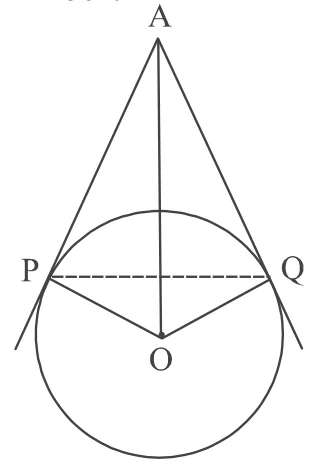
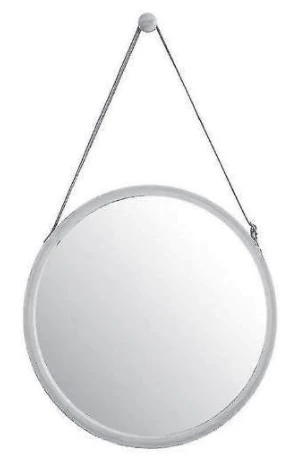
The picture given below shows a circular mirror hanging on the wall with a cord. The diagram represents the mirror as a circle with centre O. AP and AQ are tangents to the circle at P and Q respectively such that AP = 30 cm and ∠PAQ = 60°.
Diagram retained from the official paper.Photograph retained from the official paper.
Describe the figure
The mirror photograph and its mathematical diagram are both retained. A is the point above the mirror; AP and AQ touch it at P and Q. OP and OQ are radii, and AO is drawn. AP = 30 cm and ∠PAQ = 60°.
In right triangles OPA and OQA, OA is common and OP = OQ (radii).
Thus △OPA ≅ △OQA by RHS; hence OA bisects ∠PAQ.
∠PAO = 60°/2 = 30°.
In right △OPA, cos 30° = = .
OA = = 20√3 cm.
OR
(iii)(b) Find the radius of the mirror. [2 marks]
Show answer and solution
Radius OP = 10√3 cm.
By RHS congruence of △OPA and △OQA, ∠PAO = 30°.
In right △OPA, tan 30° = = .
OP = = 10√3 cm.
Basic4 marks · Accessible paper
Case 6. An ice-cream viewed as a circle and two tangents
Hari was eating ice-cream on his way back home from school. When he observed the shape of the ice-cream from the side view, he found it to be a circle with two tangents.
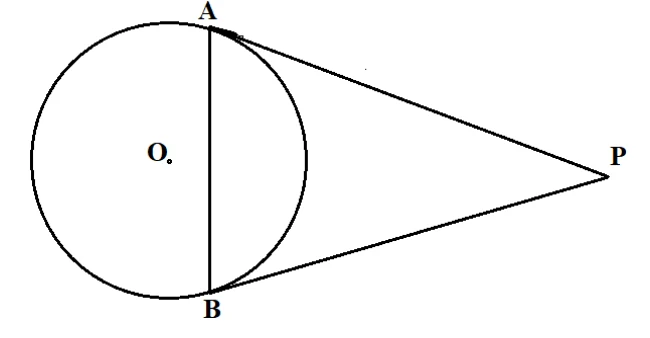
If PA and PB are the two tangents to the circle from an external point P and ∠APB = 60°, then answer the following:
The accessible source is text-only and contains no case illustration. P is outside a circle with centre O; PA and PB touch it at A and B, and ∠APB = 60°. The radius of 3 cm is given in part (ii).
(iii)(b) Join AB and find the measure of ∠OAB. [2 marks]
Show answer and solution
∠OAB = 30°.
PA = PB because tangents from P are equal.
With ∠APB = 60°, △PAB is equilateral, so ∠PAB = 60°.
OA ⟂ PA, so ∠OAP = 90°.
∠OAB = ∠OAP − ∠BAP = 90° − 60° = 30°.
Standard4 marks
Case 7. A circular pit inside a triangular backyard
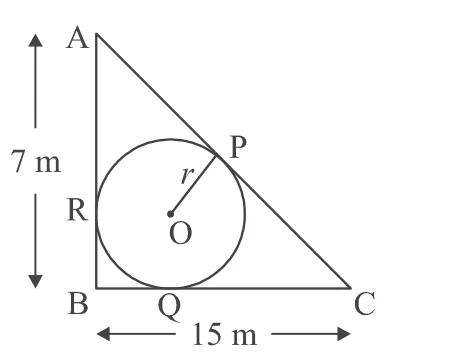
A backyard is in the shape of a triangle ABC with right angle at B. AB = 7 m and BC = 15 m. A circular pit was dug inside it such that it touches the walls AC, BC and AB at P, Q and R respectively such that AP = x m.
Diagram retained from the official paper.Photograph retained from the official paper.
Describe the figure
The source diagram and backyard photograph are retained. AB = 7 m is vertical and BC = 15 m is horizontal, with ∠ABC = 90°. The incircle, with centre O and radius r, touches AC at P, BC at Q and AB at R. AP = x m.
Appeared in: 2024 · Standard · Main
(i) Find the length of AR in terms of x. [1 mark]
Show answer and solution
AR = x m.
AP and AR are tangents from the same external point A.
Therefore AR = AP = x m.
(ii) Write the type of quadrilateral BQOR. [1 mark]
Show answer and solution
BQOR is a square.
OQ ⟂ BQ and OR ⟂ BR, since the radii meet tangents at right angles.
Also ∠QBR = 90°, because AB ⟂ BC.
The fourth angle is 90°, so BQOR is a rectangle.
OQ = OR because they are radii; these are adjacent sides of the rectangle.
Thus BQOR is a square.
(iii)(a) Find the length PC in terms of x and hence find the value of x. [2 marks]
Show answer and solution
PC = (8 + x) m; x = m ≈ 4.28 m.
AR = x, so BR = AB − AR = 7 − x.
BQ = BR = 7 − x, since tangents from B are equal.
CQ = BC − BQ = 15 − (7 − x) = 8 + x.
CP = CQ = 8 + x, since tangents from C are equal.
AC = AP + PC = x + (8 + x) = 8 + 2x.
By Pythagoras, AC² = AB² + BC² = 7² + 15² = 274.
8 + 2x = √274, since AC is positive.
x = m ≈ 4.28 m.
OR
(iii)(b) Find x and hence find the radius r of circle. [2 marks]
Show answer and solution
x = m; r = m ≈ 2.72 m.
Let AR = AP = x m.
BR = BQ = 7 − x m, and CP = CQ = 15 − (7 − x) = 8 + x m.
AC = AP + PC = 8 + 2x m.
By Pythagoras, (8 + 2x)² = 7² + 15² = 274.
Thus x = m.
Since BQOR is a square, r = OR = BR = 7 − x.
r = 7 − = m ≈ 2.72 m.
Basic4 marks
Case 8. Neelima’s circular design in an equilateral triangle
Illustration retained from the official paper.Diagram retained from the official paper.
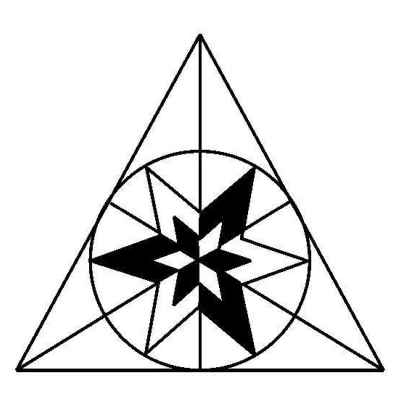
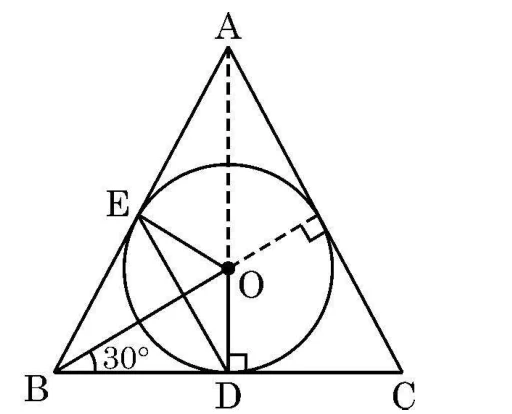
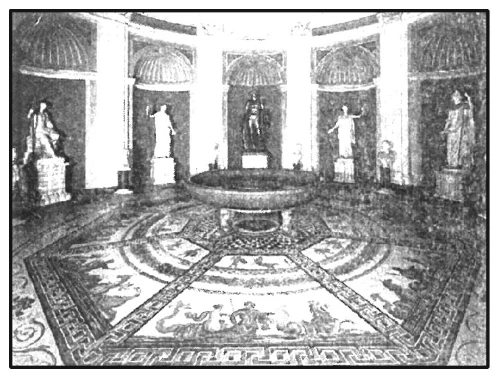
In a Fine Arts class, students were asked to design triangular tiles in geometric pattern.
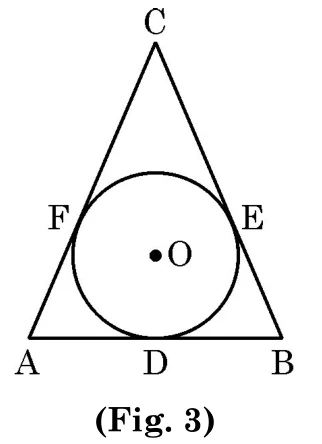
Neelima made a circular design inside an equilateral triangle ABC. The radius of the circle is 4 cm. Observe the diagram and answer the following questions:
Describe the figure
Both the decorative tile pattern and the labelled diagram are retained. ABC is equilateral, O is the incircle’s centre, D is the contact point on BC and E is the contact point on AB. A, O and D are collinear, OD = 4 cm and ∠OBD = 30°; the source marks right angles at the contacts.
Appeared in: 2025 · Basic · Main
(i) Determine the length OB. [1 mark]
Show answer and solution
OB = 8 cm.
OD ⟂ BD because OD is the radius to tangent BC.
In right △ODB, sin 30° = = .
OB = 8 cm.
(ii) Is DE ∥ CA? Give reason for your answer. [1 mark]
Show answer and solution
Yes, DE ∥ CA.
A, O and D lie on one line and OD ⟂ BC, so AD is an altitude.
In an equilateral triangle, an altitude is also a median, so D is the midpoint of BC.
Tangents from B are equal, so BE = BD = .
Since AB = BC, BE = ; hence E is the midpoint of AB.
The segment joining the midpoints of AB and BC is parallel to AC, by the midpoint theorem.
Therefore DE ∥ CA.
(iii)(a) Write all angles of quadrilateral OEBD and show that it is a cyclic quadrilateral. [2 marks]
OE ⟂ BE and OD ⟂ BD, since radii are perpendicular to tangents.
Thus ∠OEB = ∠BDO = 90°.
∠EBD = ∠ABC = 60°, because ABC is equilateral.
The angle sum of quadrilateral OEBD gives ∠DOE = 360° − 90° − 60° − 90° = 120°.
Opposite angles ∠OEB + ∠BDO = 90° + 90° = 180°.
Therefore OEBD is cyclic, by the converse of the cyclic-quadrilateral angle theorem.
OR
(iii)(b) Find the perimeter of △ABC. (Use √3 = 1.73.) [2 marks]
Show answer and solution
Perimeter of △ABC = 41.52 cm.
OB = 8 cm, as found in part (i).
In right △OBD, BD = OB cos 30° = 8 × = 4√3 cm.
D is the midpoint of BC, so BC = 2BD = 8√3 cm.
Since ABC is equilateral, perimeter = 3BC = 24√3 cm.
Using √3 = 1.73, perimeter = 24 × 1.73 = 41.52 cm.
Basic4 marks
Case 9. Fencing a statue in a circular museum
Photograph retained from the official paper.Diagram retained from the official paper.
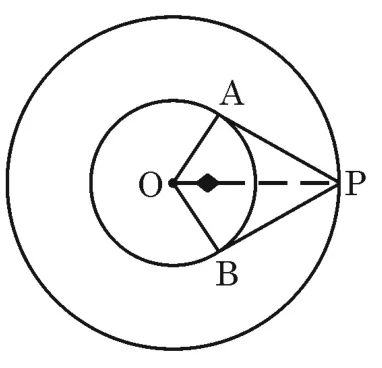
In a circular museum hall of radius 14 m, some statues are displayed. Statues are kept inside the inner concentric circle of radius 7 m. One such statue lying in sector OAB, is fenced along line segments OA, AP, PB and BO where P is a point on outer circle.
Describe the figure
The museum photograph and diagram are both retained. The circles have centre O and radii 7 m and 14 m. P is on the outer circle. AP and BP join P to A and B on the inner circle; OA and OB are inner radii and OP is drawn. The marking-scheme interpretation is explained in the first solution.
Appeared in: 2026 · Basic · Main
(i) Find m∠AOP. [1 mark]
Show answer and solution
∠AOP = 60°.
The passage does not explicitly call AP and BP tangents. The 430/5/1 marking scheme (printed p. 17) treats them as tangents; this solution follows that reading.
OA ⟂ AP, so △OAP is right-angled at A.
OA = 7 m and OP = 14 m.
cos ∠AOP = = = .
Hence ∠AOP = 60°.
(ii) Prove that △OAP ≅ △OBP. [1 mark]
Show answer and solution
△OAP ≅ △OBP by RHS congruence.
∠OAP = ∠OBP = 90°, since radii are perpendicular to the tangents.
OP = OP, the common hypotenuse.
OA = OB, radii of the same circle.
Therefore △OAP ≅ △OBP by RHS congruence.
(iii)(a) Find the length of fencing required to protect the statue. (Take √3 = 1.73.) [2 marks]
Show answer and solution
Length of fencing = 38.22 m.
In right △OAP, AP² = OP² − OA² = 14² − 7² = 147.
AP = 7√3 m, and BP = AP because tangents from P are equal.
Total fencing = OA + AP + PB + BO.
Total fencing = 7 + 7√3 + 7√3 + 7 = 14 + 14√3 m.
Using √3 = 1.73, fencing = 14 + 14 × 1.73 = 38.22 m.
OR
(iii)(b) Find area of quadrilateral OAPB. (Take √3 = 1.73.) [2 marks]
Show answer and solution
Area of OAPB = 84.77 m².
AP = BP = 7√3 m, and OA = OB = 7 m.
OP divides OAPB into right triangles OAP and OBP.
Area = × OA × AP + × OB × BP.
Area = 2 × × 7 × 7√3 = 49√3 m².
Using √3 = 1.73, area = 49 × 1.73 = 84.77 m².
Basic4 marks
Case 10. A circular gate in a rectangular frame
Photograph retained from the official paper.Diagram retained from the official paper.
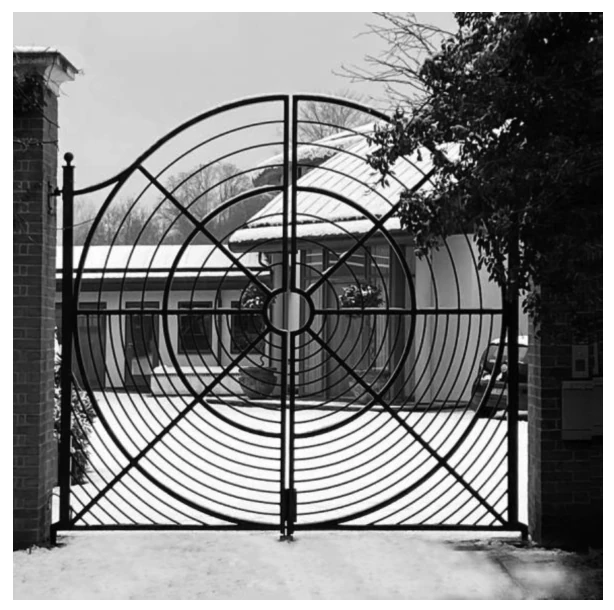
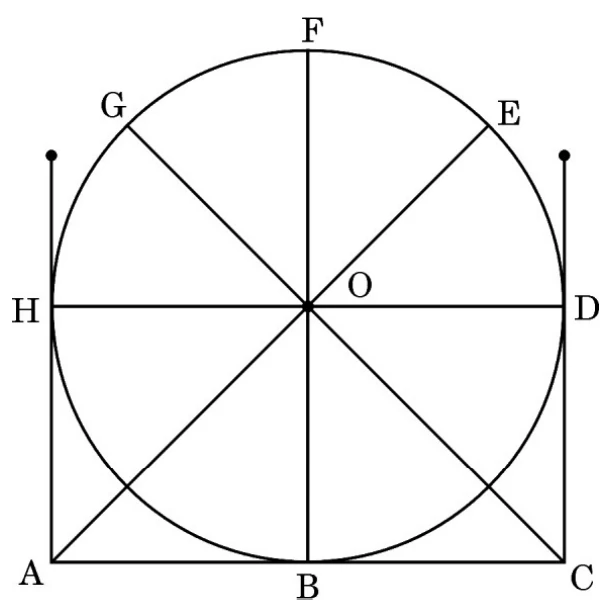
The picture given above shows a circular gate fixed in a rectangular frame HACD. Observe the diagram of the same. Four rods are placed evenly along the circumference, intersecting at centre O. The circumference of the circle is 22 feet.
Describe the figure
The gate photograph and diagram are retained. The circle has centre O, top F, bottom B, left contact H and right contact D. A and C are the lower corners of the rectangular frame HACD. Four evenly spaced diameters divide the circle into eight equal central angles. The rectangular frame extends only from the bottom tangent AC up to diameter HD, not to F.
Appeared in: 2026 · Basic · Second Board Examination
(i) Find the height of the gate. [1 mark]
Show answer and solution
Height of the gate = 7 feet, using π = 22/7.
The full circular gate has height equal to its diameter, 2r.
Circumference = 2πr = 22 feet.
Using π = , as in the marking scheme, 2r = 22 × = 7 feet.
Thus the gate’s height is 7 feet; the rectangular frame’s height is only r = 3.5 feet.
(ii) Determine m∠HOC. [1 mark]
Show answer and solution
∠HOC = 135°.
Four evenly spaced diameters give eight equal central angles.
Each central angle = 360°/8 = 45°.
The non-reflex angle from OH to OC spans three such angles in the diagram.
∠HOC = 3 × 45° = 135°.
(iii)(a) Show that OHAB is a square. [2 marks]
Show answer and solution
OHAB is a square.
HA and AB are tangents to the circle at H and B.
Thus OH ⟂ HA and OB ⟂ AB.
∠HAB = 90°, because HACD is a rectangle.
The fourth angle ∠HOB is 90°, by the angle sum of a quadrilateral.
Hence OHAB is a rectangle.
OH = OB because they are radii, and these are adjacent sides of the rectangle.
Therefore OHAB is a square.
OR
(iii)(b) Find the area of the iron sheet, required to cover the rectangle HACD. [2 marks]
Show answer and solution
Area of iron sheet = square feet = 24.5 square feet.
Using π = 22/7, the circle has radius r = 3.5 feet.
The rectangle’s width AC = HD = 2r = 7 feet.
Its height CD = OB = r = 3.5 feet, from the diagram.
Area = AC × CD = 7 × 3.5 = 24.5 square feet.
The sheet covers rectangle HACD, not the full circular gate.
Standard4 marks
Case 11. A spinning ball and sticks around a circle
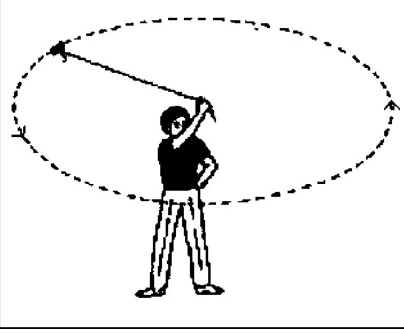
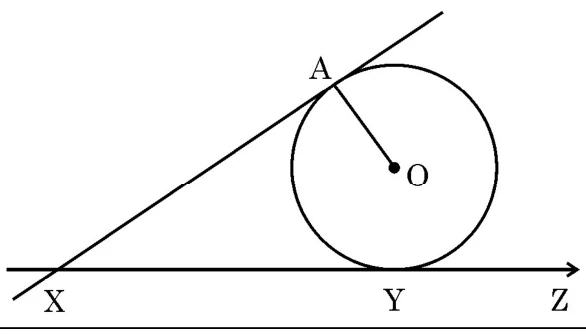
Ramesh was fond of spinning/revolving a ball tied with a rope of length 2 m. While playing, the ball slipped from the rope and hit his brother Suresh lightly. Suresh threw the ball back to Ramesh that made an angle of 60° with AX along the path XYZ which is a tangent to the imaginary circle as shown in fig. 1. i.e. ∠AXZ = 60°.
Illustration retained from the official paper.Diagram retained from the official paper.
Describe the figure
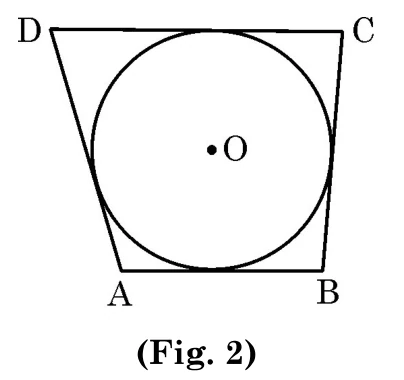
Figure 1 includes the spinning-ball illustration and the circle with centre O. XA and XY are tangents touching at A and Y, X, Y and Z are collinear, and ∠AXZ = 60°. Figure 2 shows a circle touching all four sides of ABCD. Figure 3 gives a separate circle of radius 4 m inside △ABC, touching AB at D, BC at E and CA at F.
Appeared in: 2026 · Standard · Second Board Examination
(i) If the length of rope used by Ramesh is 2 m, what is the diameter of the circle? [1 mark]
Show answer and solution
Diameter = 4 m.
The rope gives the radius r = 2 m.
Diameter = 2r = 2 × 2 = 4 m.
(ii) Find the length XY shown in figure. [1 mark]
Show answer and solution
XY = 2√3 m.
TutorVertex solution construction; not to scale. Added radii and centre line are shown here.
Join OX and OY.
OA ⟂ XA and OY ⟂ XY because the radii are perpendicular to the tangents.
In right triangles OAX and OYX, OX is common and OA = OY (radii).
Thus △OAX ≅ △OYX by RHS, so OX bisects ∠AXY = 60°.
∠OXY = 30°.
In right △OYX, tan 30° = = .
XY = 2√3 m.
(iii)(a) Ramesh made the same circle on the ground using the rope he had and placed 4 sticks around it as shown in the figure with AB = 3 m, AD = BC = 5 m. Find length of CD. Justify your answer. [2 marks]
Figure 2, retained from the official paper.
Show answer and solution
CD = 7 m.
Use the side lengths stated in this subpart.
Let the contact points on AB, BC, CD and DA be P, Q, R and S respectively.
AP = AS, BP = BQ, CQ = CR and DR = DS, since tangents from each external point are equal.
Adding and regrouping gives AB + CD = AD + BC.
3 + CD = 5 + 5.
CD = 7 m.
OR
(iii)(b) Suresh made another circle with radius 4 m and placed 3 sticks as shown in the figure. If AD = 6 m, BD = 8 m and area of triangle ABC is 84 sq. m., find the lengths of AC and BC. [2 marks]
Figure 3, retained from the official paper.
Show answer and solution
AC = 13 m; BC = 15 m.
TutorVertex solution construction; not to scale. The perpendicular height from O to each side is the radius.
Use this alternative’s separate circle of radius 4 m.
AF = AD = 6 m and BE = BD = 8 m, by equal tangents.
Let CF = CE = x m.
AB = 6 + 8 = 14 m, AC = 6 + x m and BC = 8 + x m.
Join O to A, B and C. The perpendicular distance from O to every side is 4 m.
Area of △ABC = × 4 × [14 + (6 + x) + (8 + x)].
84 = 2(28 + 2x) = 56 + 4x.
x = 7 m.
AC = 6 + 7 = 13 m and BC = 8 + 7 = 15 m.
Standard4 marks
Case 12. Arjun’s circular meditation garden
In a technology park in Hyderabad, a company installed a circular meditation garden for its employees as shown in the figure.
Diagram retained from the official paper.
Arjun, a designer, stood at a point P outside the garden and drew two tangents PA and PB to the circular boundary. The radius of the garden is 9 m, and the distance of point P from the centre O is 18 m. For preparing safety guidelines, Arjun needed the lengths of the tangents. During a demonstration to interns, he asked them to compute the angle formed between the two tangents using the properties of circle.
Describe the figure
The original sample-paper diagram shows a circle with centre O and tangents PA and PB from external point P. The text gives OA = OB = 9 m and OP = 18 m. Use the measurements given in the question; do not measure lengths or angles from the drawing.
Appeared in: 2026–27 · Standard · Official Sample
(i) What is the measure of ∠OAP? [1 mark]
Show answer and solution
∠OAP = 90°.
OA is the radius to the point of contact A of tangent PA.
Therefore OA ⟂ PA, so ∠OAP = 90°.
(ii) Calculate the length of the tangent PA. [1 mark]
Show answer and solution
PA = 9√3 m.
TutorVertex solution construction; not to scale. Added radii and centre line are shown here.
OA ⟂ PA, so △OAP is right-angled at A.
By Pythagoras, PA² = OP² − OA² = 18² − 9² = 243.
PA = √243 = 9√3 m.
(iii)(A) Calculate the measure of ∠AOB. [2 marks]
Show answer and solution
∠AOB = 120°.
Join OA, OB and OP.
In right △OAP, cos ∠AOP = = = .
Hence ∠AOP = 60°.
In right triangles OAP and OBP, OP is common and OA = OB (radii).
Thus △OAP ≅ △OBP by RHS, so ∠POB = ∠AOP = 60°.
∠AOB = ∠AOP + ∠POB = 120°.
OR
(iii)(B) In the above design, if PA and PB were inclined at 60°, then what would be their length? [2 marks]
Show answer and solution
PA = PB = 9√3 m.
By RHS congruence of △OAP and △OBP, OP bisects ∠APB.
∠APO = 60°/2 = 30°.
In right △OAP, tan 30° = = .
PA = 9√3 m.
PB = PA = 9√3 m, since tangents from the same external point P are equal.
Questions students ask
Why is the quadrilateral in Case 4 a kite, rather than necessarily a rhombus?
AB = AD is given. The equal-tangents property also gives BC = CD, so there are two pairs of equal adjacent sides: a kite. These conditions do not establish that all four sides are equal, which is required for a rhombus.
When can I use Pythagoras in a tangent question?
First join the centre to the contact point. That radius is perpendicular to the tangent, creating a right triangle. The segment from the external point to the centre is its hypotenuse.
Which tangent lengths can I set equal?
Set equal only the two tangent segments drawn from the same external point. For a circle touching a triangle at D, E and F, identify the common external vertex before writing each equality.
How do I find the angle between two tangents?
Subtract the angle between the two contact radii from 180°. The two right angles at the contact points account for the other 180° of the surrounding quadrilateral.
Does equal tangents mean the whole figure is a square?
No. To prove a square, establish four right angles and equal adjacent sides, or another valid square criterion. The nail and gate cases show the required steps.
Is a quadrilateral around a circle necessarily cyclic?
No. A tangential quadrilateral has a circle touching its sides; a cyclic quadrilateral has all four vertices on a circle. Their conditions differ. In Neelima’s case, OEBD is proved cyclic because its opposite angles sum to 180°.
Why is the gate height 7 feet but the frame height 3.5 feet?
The full circular gate extends from B to F, one diameter. Rectangle HACD extends from the bottom tangent AC only up to diameter HD, so its height is one radius. Read the named boundary before calculating its area.
Should I reuse earlier values in an OR alternative?
Reuse them only if its conditions stay the same. The nail alternative changes the angle to 45°; the spinning-ball alternative gives another circle of radius 4 m. Use those new conditions separately.
Should I keep surds or use decimal answers?
Keep exact surds until the final calculation. Use a value such as √3 = 1.73 when the question prescribes it. If no approximation is given, an exact surd or multiple of π is suitable.
Do I answer both OR alternatives in the examination?
Answer one of the alternatives where OR is printed. Both are solved here so you can practise either route.
2026 · Basic · second board examination · 430/7/1 · Q38 — Official question-paper archive · Official marking schemeQuestion file: Mathmatics_Basic/430-7-1_Maths Basic_E2_10_2026.pdf Marking-scheme file: Mathematics_Basic/Mathematisc Basic-241 E2 (430-7-1).pdf Question PDF page 27; marking-scheme PDF page 19.
2026 · Basic · second board examination · 430/7/2 · Q36 — Official question-paper archive · Official marking schemeQuestion file: Mathmatics_Basic/430-7-2_Maths Basic_E2_10_2026.pdf Marking-scheme file: Mathematics_Basic/Mathematics Basic-241 E2 (430-7-2).pdf Question PDF page 23; marking-scheme PDF page 18.
2026 · Basic · second board examination · 430/7/3 · Q37 — Official question-paper archive · Official marking schemeQuestion file: Mathmatics_Basic/430-7-3_Maths Basic_E2_10_2026.pdf Marking-scheme file: Mathematics_Basic/Mathematics Basic-241 E2 (430-7-3).pdf Question PDF page 25; marking-scheme PDF page 18.
Case 11 sources
2026 · Standard · second board examination · 30/8/1 · Q36 — Official question-paper archive · Official marking schemeQuestion file: Mathmatics_Std/30-8-1_Maths Std_E2_10_2026.pdf Marking-scheme file: Mathematics_Standard/MS_X_041_Mathematics_30-8-1_2025-26 F (1).pdf Question PDF pages 25, 27; marking-scheme PDF pages 17, 18.
2026 · Standard · second board examination · 30/8/2 · Q37 — Official question-paper archive · Official marking schemeQuestion file: Mathmatics_Std/30-8-2_Maths Std_E2_10_2026.pdf Marking-scheme file: Mathematics_Standard/MS_X_041_Mathematics_30-8-2_2025-26 F (1).pdf Question PDF pages 27, 29; marking-scheme PDF pages 19, 20.
2026 · Standard · second board examination · 30/8/3 · Q38 — Official question-paper archive · Official marking schemeQuestion file: Mathmatics_Std/30-8-3_Maths Std_E2_10_2026.pdf Marking-scheme file: Mathematics_Standard/MS_X_041_Mathematics_30-8-3_2025-26 F (1).pdf Question PDF pages 29, 31; marking-scheme PDF pages 22, 23.
Case 12 sources
2026–27 · Standard · Official sample · Q37 — Official sample question paper · Official marking schemeQuestion file: MathsStandard-SQP.pdf Marking-scheme file: MathsStandard-MS.pdf Question PDF page 6; marking-scheme PDF pages 10, 11.