Areas Related to Circles: Class 10 Case Study Previous Year Questions with Answers
These case studies ask you to find circle areas, arc lengths, shaded segments and complete boundaries. Read the passage and identify the required region before choosing a formula. Try each part, then open its worked solution.
20 distinct cases · 46 board-paper appearances + 3 official-sample variants Solutions prepared by Team TutorVertex Verified by Siddharth Sir · Last reviewed 27 October 2026
Key results
What is required?
Relationship
Whole circle
Circumference = 2πr; area = πr².
Arc or sector
Arc length l = × 2πr; sector area A = × πr² = .
Sector perimeter
Perimeter = arc length + 2r. A semicircle has perimeter πr + 2r.
Minor segment
Segment area = sector area − area of the triangle formed by the two radii and chord.
Annular sector
Area = π(R² − r²). Perimeter includes both arcs and two radial edges, each R − r.
Useful triangles
At a 90° central angle, triangle area = . At 60°, the triangle is equilateral and its area = .
Here θ is the central angle in degrees, r is a radius and R is the outer radius. Use the value of π specified in the question; approximation choices are stated in each solution. Lengths use units; areas use square units.
Keep exact values until the last step. Both OR alternatives are solved for practice; answer one where OR is printed.
Find a case
Showing all 20 cases
No cases match these filters. Try another combination or reset the filters.
Circles, slices and wire lengths
Basic4 marks · 1 + 1 + 2
Case 1. A circular village beside a road
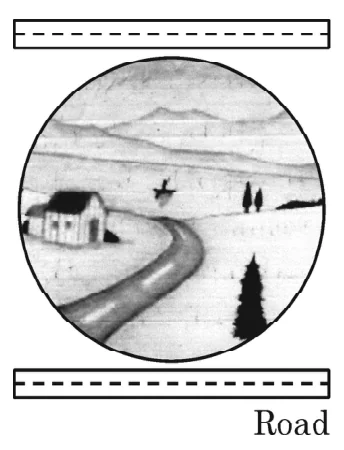
Illustration retained from the official paper.Diagram retained from the official paper.
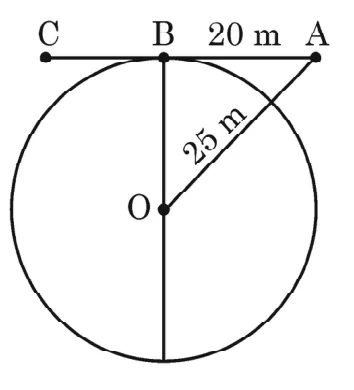
People of a circular village Dharamkot want to construct a road nearest to it. The road cannot pass through the village. But the people want the road at a shortest distance from the centre of the village. Suppose the road starts from A which is outside the circular village (as shown in the figure) and touches the boundary of the circular village at B such that AB = 20 m. Also the distance of point A from the centre O of the village is 25 m.
Describe the figure
The original village illustration and labelled diagram are retained. The straight road has C, B and A in that order and touches the circle at B. O is the centre, OA = 25 m and AB = 20 m. B is the midpoint of AC only in part (i).
Appeared in: 2023 · Basic · Main
Shared case: this complete question is kept on both chapter pages because it combines tangent geometry with circumference and area. Circles Case 2 emphasises the tangent geometry; this page emphasises the circle measurements.
(i) If B is the mid-point of AC, then find the distance AC. [1 mark]
Show answer and solution
AC = 40 m.
Since B is the midpoint of AC, BC = AB = 20 m.
AC = AB + BC = 20 + 20 = 40 m.
(ii) Find the shortest distance of the road from the centre of the village. [1 mark]
Show answer and solution
OB = 15 m.
The radius OB is perpendicular to the tangent road at B.
Thus OB is the shortest distance from O to the road.
In right △OBA, OB² = OA² − AB² = 25² − 20² = 225.
OB = 15 m.
(iii)(a) Find the circumference of the village. [2 marks]
Show answer and solution
Circumference = 30π m = m, using π = 22/7.
OB = √(25² − 20²) = 15 m, so the radius r = 15 m.
Circumference = 2πr = 2 × π × 15 = 30π m.
Using π = , circumference = m ≈ 94.29 m.
OR
(iii)(b) Find the area of the village. [2 marks]
Show answer and solution
Area = 225π m² = m², using π = 22/7.
The radius is r = √(25² − 20²) = 15 m.
Area of the circular village = πr² = π × 15² = 225π m².
Using π = , area = m² ≈ 707.14 m².
Basic4 marks · 1 + 1 + 2 · Accessible alternative
Case 2. Deepak’s pizza: eight slices or four
Deepak has to cut the circular pizza into 8 equal slices such that all 8 of them get a slice. The pizza is 35 cm in diameter. Using the information, answer the following:
This accessible paper contains no illustration for this case. The pizza is a circle of diameter 35 cm; each cut in part (i) is along a diameter.
Appeared in: 2025 · Basic · Main
Related setup: Harit’s pizza has a different OR question.
(i) How many times will he have to make a cut along the diameter to make 8 slices? [1 mark]
Show answer and solution
4 cuts.
Each cut along a diameter gives two radial edges.
Four suitably spaced diameters divide the circle into 8 equal sectors.
Hence 4 cuts are required.
(ii) What is the radius of each sector type slice? [1 mark]
Show answer and solution
Radius = 17.5 cm.
Radius = = = 17.5 cm.
(iii)(a) Find the area of each slice of pizza. [2 marks]
Show answer and solution
Area of each slice = 120.3125 cm² ≈ 120.31 cm².
Eight equal slices each occupy of the pizza.
Using π = , whole area = × 17.5² = 962.5 cm².
Area of one slice = = 120.3125 cm².
OR
(iii)(b) Find the area of a slice, if only four equal pieces are cut. [2 marks]
Show answer and solution
Area of one of four slices = 240.625 cm² ≈ 240.63 cm².
Use four equal slices for this alternative.
Whole area = × 17.5² = 962.5 cm².
Area of one slice = = 240.625 cm².
Standard4 marks · 1 + 1 + 2
Case 3. A silver brooch of diameter 35 mm
A brooch is a decorative piece often worn on clothing like jackets, blouses or dresses to add elegance. Made from precious metals and decorated with gemstones, brooches come in many shapes and designs.
Photograph retained from the official paper.
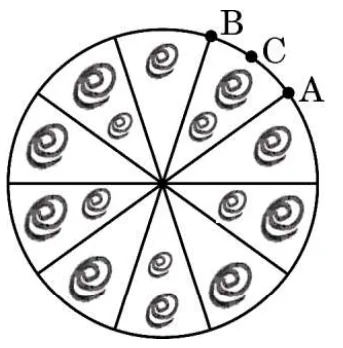
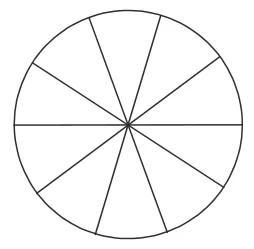
One such brooch is made with silver wire in the form of a circle with diameter 35 mm. The wire is also used in making 5 diameters which divide the circle into 10 equal sectors as shown in the figure.
Diagram retained from the official paper.
Describe the figure
The decorative brooch photograph and labelled circle are retained. Five diameters divide the circle into 10 equal sectors. A and B are the endpoints of one small arc, and C lies on that arc. The diameter is 35 mm, not 35 cm.
Appeared in: 2025 · Standard · Main
Related setup: the 2026 brooch uses centimetres and different subparts.
(i) Find the central angle of each sector. [1 mark]
Show answer and solution
Central angle = 36°.
The 10 equal sectors together make 360°.
Angle of each sector = = 36°.
(ii) Find the length of the arc ACB. [1 mark]
Show answer and solution
Arc ACB = 11 mm.
Arc ACB belongs to one of the 10 equal sectors.
Using π = , circumference = πd = × 35 = 110 mm.
Arc ACB = = 11 mm.
(iii)(a) Find the area of each sector of the brooch. [2 marks]
Show answer and solution
Area of each sector = 96.25 mm².
Radius r = = 17.5 mm.
Area of each sector = πr².
Using π = , area = × × 17.5² = 96.25 mm².
OR
(iii)(b) Find the total length of the silver wire used. [2 marks]
Show answer and solution
Total wire = 285 mm.
The wire forms the circumference and 5 complete diameters.
Circumference = × 35 = 110 mm.
Wire in the diameters = 5 × 35 = 175 mm.
Total wire = 110 + 175 = 285 mm.
Standard4 marks · 1 + 1 + 2 · Accessible alternative
Case 4. Harit’s pizza: one slice and the whole pizza
Harit has to cut a circular pizza into equal slices such that he and all of his 7 friends get a slice of same size. The pizza is 35 cm in diameter. Based on the information given above, answer the following questions:
This accessible supplementary paper has no case illustration. Harit and seven friends need eight equal slices of a pizza of diameter 35 cm.
Appeared in: 2025 · Standard · Supplementary
Related setup: Deepak’s pizza asks about four equal slices in its OR part.
(i) How many times will Harit have to make a cut along the diameter to make 8 slices? [1 mark]
Show answer and solution
4 cuts.
Four equally spaced diameter cuts give 8 equal sectors.
(ii) What is the radius of each sector type slice? [1 mark]
Show answer and solution
Radius = 17.5 cm.
Radius = = 17.5 cm.
(iii)(a) Find the area of each slice of pizza. [2 marks]
Show answer and solution
Area of each slice = 120.3125 cm² ≈ 120.31 cm².
Using π = , total area = × 17.5² = 962.5 cm².
Area of one of 8 equal slices = = 120.3125 cm².
OR
(iii)(b) Find the area of the entire pizza. [2 marks]
Show answer and solution
Area of the entire pizza = 962.5 cm².
Radius = 17.5 cm.
Using π = , area = πr² = × 17.5² = 962.5 cm².
Standard4 marks · 1 + 1 + 2
Case 5. A silver-wire brooch of diameter 35 cm
A brooch is crafted from silver wire in the shape of a circle with a diameter of 35 cm. The wire is also used to create 5 diameters, dividing the circle into 10 equal sectors as shown in figure.
Diagram retained from the official paper.
Describe the figure
The original circle diagram has five diameters and ten sectors. This case gives diameter 35 cm. Its questions and units differ from the earlier 35 mm brooch case.
Appeared in: 2026 · Standard · Main
Related setup: the 2025 brooch uses millimetres and different subparts.
(i) What is the radius of circle? [1 mark]
Show answer and solution
Radius = 17.5 cm.
Radius = = = 17.5 cm.
(ii) What is the circumference of the brooch? [1 mark]
Show answer and solution
Circumference = 110 cm.
Using π = , circumference = πd = × 35 = 110 cm.
(iii)(a) What is the total length of silver wire required? [2 marks]
Show answer and solution
Total wire = 285 cm.
The wire makes the circular boundary and 5 diameters.
Total length = πd + 5d.
Using π = , length = 110 + 5 × 35 = 285 cm.
OR
(iii)(b) What is the area of each sector of the brooch? [2 marks]
Show answer and solution
Area of each sector = 96.25 cm².
Each of the 10 equal sectors occupies of the circle.
Using π = and r = 17.5 cm, area = × × 17.5² = 96.25 cm².
Standard4 marks · 1 + 1 + 2
Case 6. Fencing and ploughing a circular field
Vaibhav had fenced a circular field, with the total cost amounting to ₹6,000 at a rate of ₹30 per m. He now plans to plough the field. Based on the given information, answer the following questions:
The original case is text-only. Fencing costs ₹30 per metre; ploughing costs ₹0.50 per square metre in the OR part.
Appeared in: 2026 · Standard · Second Board Examination
(i) What is the perimeter of the field? [1 mark]
Show answer and solution
Perimeter = 200 m.
Perimeter = = = 200 m.
(ii) What is the radius of the field? [1 mark]
Show answer and solution
Radius = m ≈ 31.82 m.
Circumference = 2πr = 200 m.
Using π = , r = = m.
(iii)(a) What is the area of the field? [2 marks]
Show answer and solution
Area = m² ≈ 3181.82 m².
Using π = and r = m, area = πr².
Area = × ()² = m².
Keep the exact radius until the final calculation.
OR
(iii)(b) Find the cost of ploughing the field at the rate of ₹0.50 per m². [2 marks]
Show answer and solution
Cost = ₹ ≈ ₹1590.91.
Area = m².
Cost = area × rate = × 0.50 = ₹.
Rounding once at the end gives ₹1590.91.
Segments and shaded designs
Basic4 marks · 1 + 1 + 2
Case 7. A square rangoli with a circle and four quadrants
Interschool Rangoli Competition was organized by one of the reputed schools of Odisha. The theme of the Rangoli Competition was Diwali celebrations where students were supposed to make mathematical designs. Students from various schools participated and made beautiful Rangoli designs. One such design is given below.
Diagram retained from the official paper.
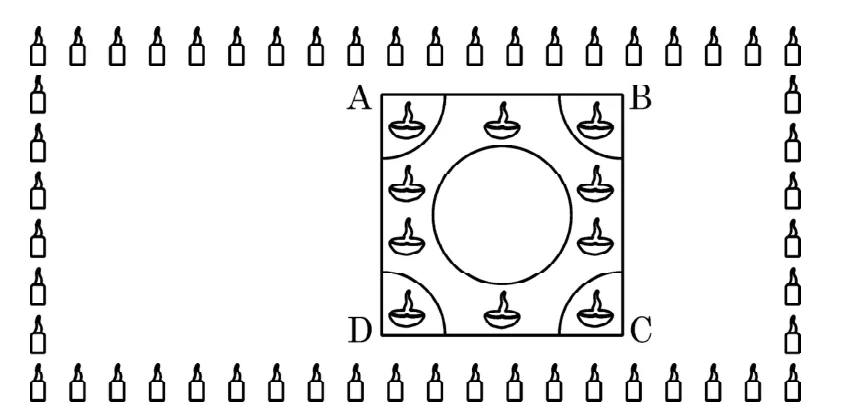
Rangoli is in the shape of square marked as ABCD, side of square being 40 cm. At each corner of a square, a quadrant of circle of radius 10 cm is drawn (in which diyas are kept). Also a circle of diameter 20 cm is drawn inside the square.
Describe the figure
The complete original design includes the outer border of diyas, the square ABCD, four corner quadrants and the central circle. The square side is 40 cm; each quadrant and the central circle have radius 10 cm.
Appeared in: 2023 · Basic · Main
(i) What is the area of the square ABCD? [1 mark]
Show answer and solution
Area = 1600 cm².
Area of square = side² = 40² = 1600 cm².
(ii) What is the area of the circle? [1 mark]
Show answer and solution
Area = cm² ≈ 314.29 cm².
The central circle has radius r = = 10 cm.
Using π = , area = πr² = × 100 = cm².
(iii)(a) If the circle and the four quadrants are cut off from the square ABCD and removed, then find the area of remaining portion of square ABCD. [2 marks]
Show answer and solution
Remaining area = cm² ≈ 971.43 cm².
Four quadrants of radius 10 cm together make one complete circle of radius 10 cm.
Area removed = 2 × π × 10² = 200π cm².
Using π = , remaining area = 1600 − = cm².
OR
(iii)(b) Find the combined area of 4 quadrants and the circle, removed. [2 marks]
Show answer and solution
Combined area removed = cm² ≈ 628.57 cm².
Four quadrants together have area π × 10² = 100π cm².
The central circle also has area 100π cm².
Using π = , total area removed = 200π = cm².
Basic4 marks · 1 + 1 + 2
Case 8. Two flower-bed segments in a circular park
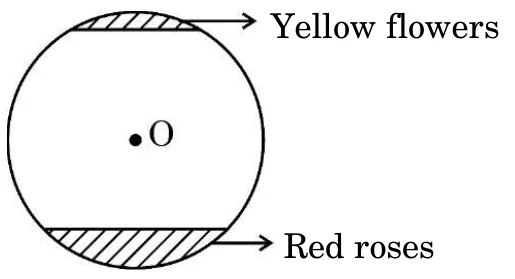
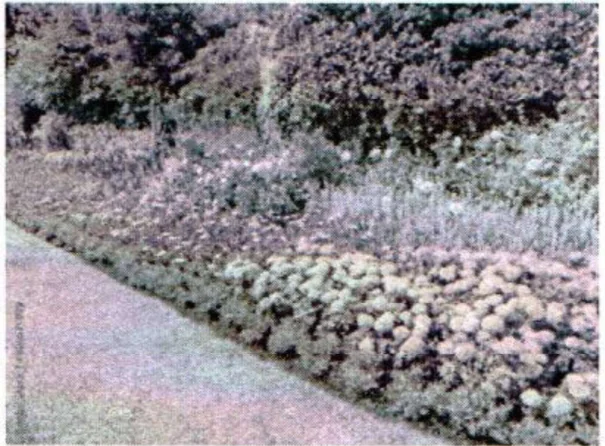
Flower beds look beautiful growing in gardens. One such circular park of radius r m, has two segments with flowers. One segment which subtends an angle of 90° at the centre is full of red roses, while the other segment with central angle 60° is full of yellow coloured flowers. [See figure]
It is given that the combined area of the two segments (of flowers) is 256 sq m. Based on the above, answer the following questions:
Diagram retained from the official paper.
Describe the figure
Both the labelled circle and original flower-bed photograph are retained. The red minor segment subtends 90° and the yellow minor segment subtends 60° at O. The combined area is the mixed number 256 2/3 m², equal to 770/3 m².
Appeared in: 2023 · Basic · Main
We use π = 3.14 and √3 = 1.73 to reproduce the scheme’s displayed segment areas. The scheme does not explicitly specify these approximation values.
(i) Write an equation representing the total area of the two segments in terms of r. [1 mark]
Show answer and solution
( − ) + ( − ) = .
Area of a minor segment = area of sector − area of its triangle.
For 90°, triangle area = .
For 60°, the triangle is equilateral and has area .
Adding the two segment areas gives the required equation.
(ii) Find the value of r. [1 mark]
Show answer and solution
r ≈ 26.1 m, using π = 3.14 and √3 = 1.73.
The equation becomes r²( − − ) = .
Thus r² = .
To reproduce the scheme’s displayed approximations, use π = 3.14 and √3 = 1.73.
With these values, r² = ≈ 682.926829 m².
Taking the positive square root gives r ≈ 26.13287 m ≈ 26.1 m.
Source note: the 2023 Basic 430/2/1 scheme (PDF and printed p. 19) prints 26.1 cm; the question gives metres, so the radius here is in metres. Its displayed segment areas are 194.63 m² and 62.03 m². The approximation values above reproduce those areas; the scheme does not explicitly prescribe them.
(iii)(a) Find the area of the segment with red roses. [2 marks]
Show answer and solution
Red-segment area ≈ 194.63 m².
Use π = 3.14 and √3 = 1.73, consistently with part (ii).
Retain r² = rather than squaring the rounded radius.
Red-segment area = − = (0.785 − 0.5)r².
Area = 0.285 × ≈ 194.63 m².
OR
(iii)(b) Find the area of the segment with yellow flowers. [2 marks]
Show answer and solution
Yellow-segment area ≈ 62.03 m².
Using π = 3.14, √3 = 1.73 and r² = ,
Yellow-segment area = ( − )r².
Area = ( − ) × ≈ 62.03 m².
Before rounding, the red and yellow areas sum to m².
Photograph retained from the official paper.
Basic4 marks · 1 + 1 + 2
Case 9. An Earth Day badge inside a square
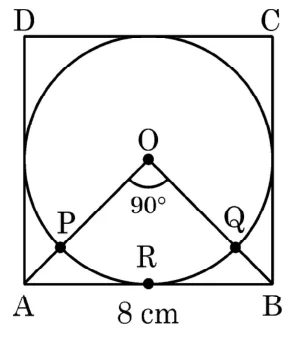
For the inauguration of ‘Earth day’ week in a school, badges were given to volunteers. Organisers purchased these badges from an NGO, who made these badges in the form of a circle inscribed in a square of side 8 cm.
Photograph retained from the official paper.Diagram retained from the official paper.
O is the centre of the circle and ∠AOB = 90°. Based on the above information, answer the following questions:
Describe the figure
The Earth Day photograph and mathematical diagram are both retained. ABCD is a square of side 8 cm. Its inscribed circle has centre O and radius 4 cm. The rays OA and OB meet the circle at P and Q, and R is on the minor arc PQ.
Appeared in: 2023 · Basic · Main
(i) What is the area of square ABCD? [1 mark]
Show answer and solution
Area = 64 cm².
Area of square = side² = 8² = 64 cm².
(ii) What is the length of diagonal AC of square ABCD? [1 mark]
Show answer and solution
AC = 8√2 cm.
In right △ABC, AC² = AB² + BC² = 8² + 8² = 128.
AC = √128 = 8√2 cm.
(iii)(a) Find the area of sector OPRQO. [2 marks]
Show answer and solution
Sector area = cm² ≈ 12.57 cm².
Diameter of the inscribed circle = side of square = 8 cm, so r = 4 cm.
Since OP lies along OA and OQ along OB, ∠POQ = ∠AOB = 90°.
Using π = , sector area = × × 4² = cm².
OR
(iii)(b) Find the area of remaining part of square ABCD when area of circle is excluded. [2 marks]
Show answer and solution
Remaining area = cm² ≈ 13.71 cm².
Area of square = 64 cm²; circle radius = 4 cm.
Using π = , area of circle = × 4² = cm².
Remaining area = 64 − = cm².
Basic4 marks · 1 + 1 + 2
Case 10. Painting a segment of a tree trunk
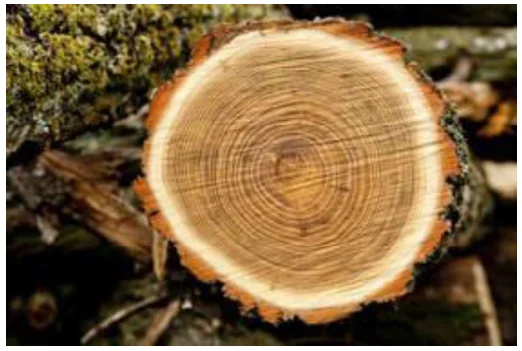
Age of a tree: The most accurate way to determine the age of a tree is to count the annual rings of wood growth. One such trunk has been shown here.
Photograph retained from the official paper.
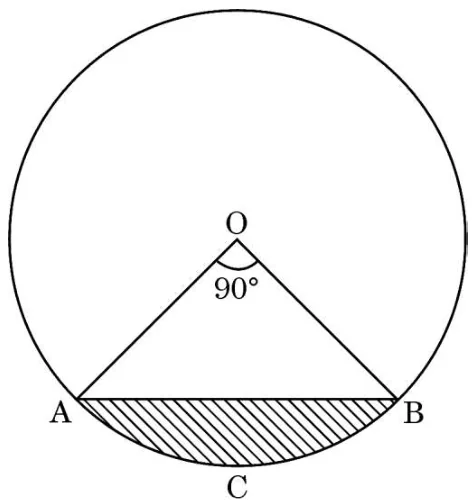
To make an identification mark, the forest department has painted segment ACBA. (See diagram) If chord AB makes an angle 90° at the centre and radius of the trunk is 21 cm, then find the following:
Diagram retained from the official paper.
Describe the figure
The trunk photograph and labelled circle are retained. OA = OB = 21 cm and ∠AOB = 90°. C lies on the minor arc AB; the painted region ACBA is the minor segment between chord AB and that arc.
Appeared in: 2023 · Basic · Supplementary
(i) Find the length of chord AB. [1 mark]
Show answer and solution
AB = 21√2 cm.
In right △OAB, AB² = OA² + OB² = 21² + 21² = 882.
AB = √882 = 21√2 cm.
(ii) Find the area of △OAB. [1 mark]
Show answer and solution
Triangle area = 220.5 cm².
OA ⟂ OB, so area = × OA × OB.
Area = × 21 × 21 = 220.5 cm².
(iii)(a) Find the area of segment ACBA. [2 marks]
Show answer and solution
Segment area = 126 cm².
Area of segment = area of 90° sector − area of △OAB.
Using π = , sector area = × × 21² = 346.5 cm².
Segment area = 346.5 − 220.5 = 126 cm².
OR
(iii)(b) Find the perimeter of sector OACBO. [2 marks]
Show answer and solution
Sector perimeter = 75 cm.
The boundary contains two radii and the minor arc ACB.
Using π = , arc length = × 2 × × 21 = 33 cm.
Perimeter = 21 + 21 + 33 = 75 cm.
Basic4 marks · 1 + 1 + 2
Case 11. The NSS wheel: an annular sector and a segment
NSS (National Service Scheme) aims to connect the students to the community and to involve them in problem solving process.
Diagram retained from the official paper.
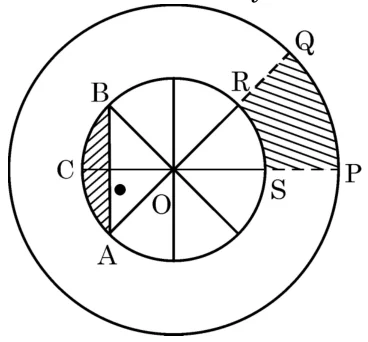
NSS symbol is based on the ‘Rath’ wheel of the Konark Sun Temple situated in Odisha. The wheel signifies the progress cycle of life. The diagramatic representation of the symbol is given below:
Observe the figure given above. The diameters of inner circle are equally placed. Given that OP = 21 cm, OS = 10 cm. Based on the above information, answer the following questions:
Describe the figure
The complete source wheel diagram is retained. There are eight equal central angles in the inner circle. OP = 21 cm is the outer radius and OS = 10 cm is the inner radius. PQRS is a 45° annular sector. ACB is a 90° minor segment of the inner circle.
Appeared in: 2024 · Basic · Main
Same annular-sector area method as Case 17, the windmill: subtract the inner sector from the outer sector.
(i) Find m∠ROS. [1 mark]
Show answer and solution
∠ROS = 45°.
Four equally placed diameters form 8 equal central angles.
∠ROS = = 45°.
(ii) Find the perimeter of sector OPQ. [1 mark]
Show answer and solution
Perimeter = 58.5 cm.
The outer sector has radius 21 cm and angle 45°.
Using π = , its arc length = × 2 × × 21 = 16.5 cm.
Perimeter = 21 + 21 + 16.5 = 58.5 cm.
(iii)(a) Find the area of shaded region PQRS. [2 marks]
Show answer and solution
Area = cm² ≈ 133.96 cm².
PQRS is the outer 45° sector minus the inner 45° sector.
Area = π(21² − 10²).
Using π = , area = × × 341 = cm².
OR
(iii)(b) Find the area of shaded region ACB, i.e. the segment ACB. [2 marks]
Show answer and solution
Area = cm² ≈ 28.57 cm².
The inner radii OA and OB form a 90° angle.
Area of segment = area of 90° sector − area of right △OAB.
Using π = , area = × × 10² − × 10 × 10.
Area = − 50 = cm².
Standard4 marks · 1 + 1 + 2
Case 12. Rangoli inside five Olympic rings
The Olympic symbol comprising five interlocking rings represents the union of the five continents of the world and the meeting of athletes from all over the world at the Olympic games. In order to spread awareness about Olympic games, students of Class-X took part in various activities organised by the school. One such group of students made 5 circular rings in the school lawn with the help of ropes. Each circular ring required 44 m of rope.
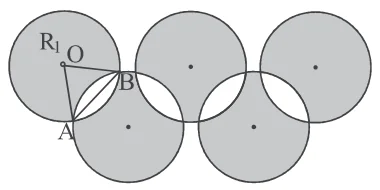
Also, in the shaded regions as shown in the figure, students made rangoli showcasing various sports and games. It is given that △OAB is an equilateral triangle and all unshaded regions are congruent.
Illustration retained from the official paper.Diagram retained from the official paper.
Describe the figure
The Olympic logo and mathematical diagram are retained. R₁ is the shaded part of the leftmost circle. A and B are its intersection points with the lower circle; △OAB is equilateral. The drawing contains four unshaded lenses; each lens consists of two congruent 60° minor segments.
Appeared in: 2025 · Standard · Main
(i) Find the radius of each circular ring. [1 mark]
Show answer and solution
Radius = 7 m.
Each ring has circumference 44 m.
Using π = , 2πr = 44 gives r = = 7 m.
(ii) What is the measure of ∠AOB? [1 mark]
Show answer and solution
∠AOB = 60°.
△OAB is equilateral, so each of its angles is 60°.
(iii)(a) Find the area of shaded region R₁. [2 marks]
Show answer and solution
Area of R₁ = ( + ) m².
Area of one 60° minor segment = π × 7² − × 7².
One unshaded lens contains two such segments.
Using π = , lens area = − m².
R₁ = area of one circle − area of one lens.
R₁ = 154 − ( − ) = + m².
Using √3 = 1.73 gives approximately 145.05 m².
OR
(iii)(b) Find the length of rope around the unshaded regions. [2 marks]
Show answer and solution
Total rope = m ≈ 58.67 m.
There are 4 unshaded lenses, each bounded by two 60° arcs of radius 7 m.
Length of each arc = × 44 = m.
Total rope = 4 × 2 × = m.
Land, parking and composite regions
Standard4 marks · 1 + 2 + 1
Case 13. A rectangular playground and semicircular parking
Governing council of a local public development authority of Dehradun decided to build an adventurous playground on the top of a hill, which will have adequate space for parking.
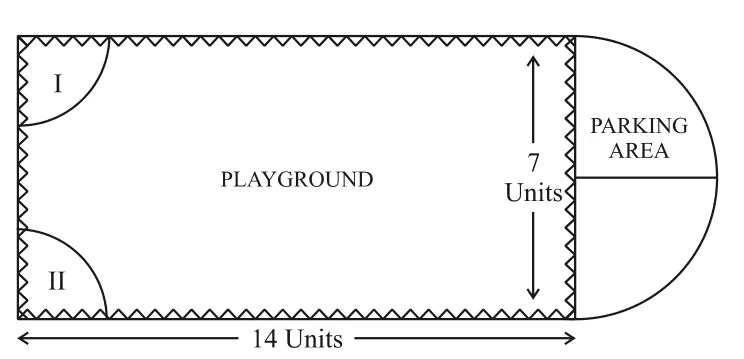
After survey, it was decided to build rectangular playground, with a semi-circular area allotted for parking at one end of the playground. The length and breadth of the rectangular playground are 14 units and 7 units, respectively. There are two quadrants of radius 2 units on one side for special seats.
Diagram retained from the official paper.
Describe the figure
The original site plan is retained. A 14 by 7 rectangle adjoins semicircular parking with diameter 7 units. Two quadrants of radius 2 units lie inside the left corners of the rectangle. The marking-scheme fencing includes the straight divider between playground and parking once.
Appeared in: 2023 · Standard · Main
(i) What is the total perimeter of the parking area? [1 mark]
Show answer and solution
Parking perimeter = 18 units.
The semicircle has radius r = = 3.5 units.
Its perimeter includes the curved arc and its diameter.
(ii)(a) What is the total area of parking and the two quadrants? [2 marks]
Show answer and solution
Total area = square units ≈ 25.54 square units.
Parking area = π(3.5)² = square units, using π = .
Two quadrants of radius 2 have total area = 2 × π × 2² = square units.
Total = + = square units.
OR
(ii)(b) What is the ratio of area of playground to the area of parking area? [2 marks]
Show answer and solution
Playground : parking = 56 : 11.
Area of rectangular playground = 14 × 7 = 98 square units.
Parking area = × × (3.5)² = square units.
Ratio = 98 : = 392 : 77 = 56 : 11.
(iii) Find the cost of fencing the playground and parking area at the rate of ₹2 per unit. [1 mark]
Show answer and solution
Fencing cost = ₹106, following the scheme’s divider-inclusive boundary.
Under “Required Perimeter”, the scheme uses 2(l + b) + πr: the full rectangular boundary plus the parking arc.
This calculation includes the straight 7-unit divider once, as well as the outside boundary.
Length = 2(14 + 7) + × 3.5 = 42 + 11 = 53 units.
Cost = 53 × 2 = ₹106.
Source: 2023 Standard 30/4/1 marking scheme, PDF and printed p. 23. The divider interpretation follows from its formula; counting only the outer boundary would give 46 units and ₹92.
Basic4 marks · 1 + 1 + 2
Case 14. Two circular lawns that touch externally
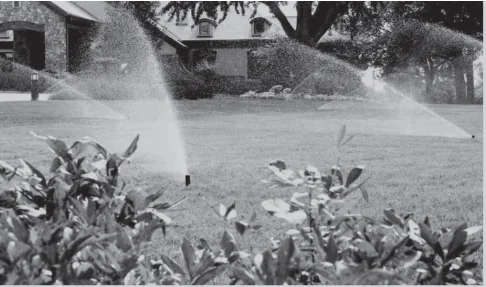
To keep the lawn green and cool, Sadhna uses water sprinklers which rotate in circular shape and cover a particular area.
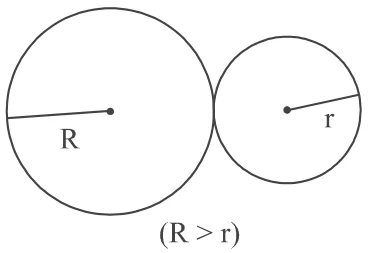
The diagram below shows the circular areas covered by two sprinklers. Two circles touch externally. The sum of their areas is 130π sq m and the distance between their centres is 14 m. Based on above information, answer the following questions:
Diagram retained from the official paper.Photograph retained from the official paper.
Describe the figure
The original sprinkler photograph and touching-circle diagram are retained. The larger radius is R and the smaller radius is r, with R > r. External touching gives R + r = 14 m; the sum of the areas is 130π m². This case combines circle areas with a quadratic equation.
(iii)(a) Find the radius r and the corresponding area irrigated. [2 marks]
Show answer and solution
r = 3 m; area = 9π m².
r² − 14r + 33 = (r − 3)(r − 11) = 0.
Thus r = 3 or 11.
As R > r and R + r = 14, r is the smaller value: r = 3 m.
Corresponding area = πr² = 9π m².
OR
(iii)(b) Find the radius R and the corresponding area irrigated. [2 marks]
Show answer and solution
R = 11 m; area = 121π m².
Factoring r² − 14r + 33 = 0 gives radii 3 m and 11 m.
R is the larger radius, so R = 11 m.
Corresponding area = πR² = 121π m².
Standard4 marks · 1 + 1 + 2
Case 15. A square house inside circular land
A farmer has a circular piece of land. He wishes to construct his house in the form of largest possible square within the land as shown below.
Illustration retained from the official paper.Diagram retained from the official paper.
The radius of circular piece of land is 35 m. Based on given information, answer the following questions:
Describe the figure
Both original house illustrations are retained. The largest square is inscribed in the circle of radius 35 m. Only the top and bottom segments are shaded for grass in part (iii)(a). The remaining land in part (iii)(b) includes all four segments outside the square.
Appeared in: 2025 · Standard · Main
(i) Find the length of wire needed to fence the entire land. [1 mark]
Show answer and solution
Wire length = 220 m.
Using π = , circumference = 2πr = 2 × × 35 = 220 m.
(ii) Find the length of each side of the square land on which house will be constructed. [1 mark]
Show answer and solution
Side of the square = 35√2 m.
The square’s diagonal is the diameter of the circle: 70 m.
If its side is s, then 2s² = 70² by Pythagoras.
s = = 35√2 m.
(iii)(a) The farmer wishes to grow grass on the shaded region around the house. Find the cost of growing the grass at the rate of ₹50 per square metre. [2 marks]
Show answer and solution
Grass area = 700 m²; cost = ₹35,000.
Only two of the four segments outside the square are shaded.
The square’s sides subtend equal central angles of 90°.
One segment = π × 35² − × 35².
Using π = , one segment = 962.5 − 612.5 = 350 m².
Shaded area = 2 × 350 = 700 m².
Cost = 700 × 50 = ₹35,000.
OR
(iii)(b) Find the ratio of area of land on which house is built to remaining area of circular piece of land. [2 marks]
Show answer and solution
House : all remaining land = 7 : 4.
House area = (35√2)² = 2450 m².
Using π = , circle area = × 35² = 3850 m².
All remaining land = 3850 − 2450 = 1400 m².
Ratio = 2450 : 1400 = 7 : 4.
This alternative asks for all land outside the house, not only the two shaded segments.
Standard4 marks · 1 + 1 + 2
Case 16. A semicircular farmhouse divided into three regions
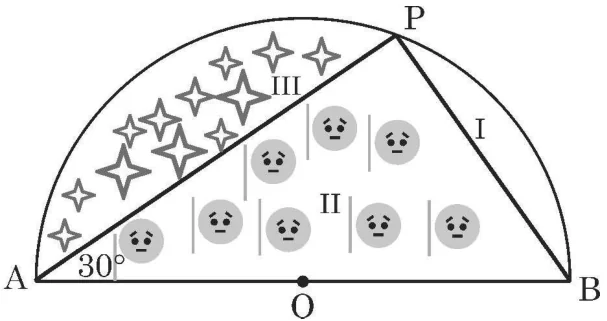
Anurag purchased a farmhouse which is in the form of a semicircle of diameter 70 m. He divides it into three parts by taking a point P on the semicircle in such a way that ∠PAB = 30° as shown in the following figure, where O is the centre of semicircle.
Diagram retained from the official paper.
In part I, he planted saplings of Mango tree, in part II, he grew tomatoes and in part III, he grew oranges. Based on given information, answer the following questions.
Describe the figure
The complete source drawing is retained. AB = 70 m is the diameter, O is its midpoint and ∠PAB = 30°. Region I is the smaller segment bounded by chord PB, region II is triangle APB and region III is the larger segment bounded by chord AP. The planting symbols and labels I, II and III are retained.
Appeared in: 2025 · Standard · Main
(i) What is the measure of ∠POA? [1 mark]
Show answer and solution
∠POA = 120°.
OA = OP, so △AOP is isosceles.
Since A, O and B are collinear, ∠PAO = ∠PAB = 30°.
∠APO = 30°, hence ∠POA = 180° − 30° − 30° = 120°.
(ii) Find the length of wire needed to fence entire piece of land. [1 mark]
Show answer and solution
Wire length = 180 m.
Radius = 35 m. A semicircle’s perimeter is πr + 2r.
Using π = , perimeter = × 35 + 70 = 180 m.
(iii)(a) Find the area of region in which saplings of Mango tree are planted. [2 marks]
Show answer and solution
Region I area = ( − ) m² ≈ 111.23 m².
Mango trees occupy region I, the smaller segment PB.
∠POB = 180° − 120° = 60°.
△POB is equilateral with side 35 m.
Segment area = π × 35² − × 35².
Using π = , area = − m².
The exact expression matches the 2025 Standard 30/6/1 scheme, PDF and printed p. 16; its printed decimal is 111.89. Evaluating the exact expression gives approximately 111.23 m².
OR
(iii)(b) Find the length of wire needed to fence the region III. [2 marks]
Show answer and solution
Region III perimeter = ( + 35√3) m ≈ 133.96 m.
Region III is bounded by chord AP and the 120° arc AP.
∠APB = 90°, since AB is a diameter.
In right △APB, cos 30° = , so AP = 70 × = 35√3 m.
Using π = , arc AP = × 2 × × 35 = m.
Perimeter = + 35√3 m.
The exact expression matches the same scheme (PDF and printed p. 16); its printed decimal is 133.8. The exact expression evaluates to approximately 133.96 m.
Annular sectors and changing angles
Basic4 marks · 1 + 1 + 2
Case 17. A decorative windmill with eight blades
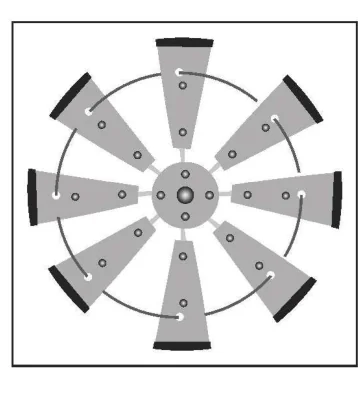
A farmer has put up a decorative windmill in his farm in which there are eight blades of equal width and equally placed in a circular arrangement. A circular wire goes through them.
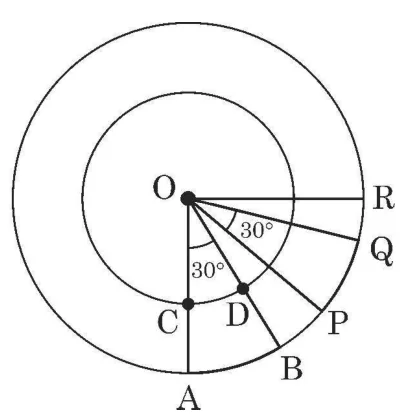
The diagram shows two blades OAB and OPQ in a quarter circle with centre O. ∠AOB = ∠POQ = 30°, OA = 28 cm, OC = 21 cm. O is the centre of both the circles.
Illustration retained from the official paper.Diagram retained from the official paper.
Describe the figure
The original windmill illustration and concentric-circle diagram are retained. OA = 28 cm is the outer radius and OC = 21 cm is the inner radius. The quarter-circle angle AOR contains two 30° blades and two equal gaps. CABD is the 30° annular strip between radii 21 cm and 28 cm.
Appeared in: 2025 · Basic · Main
Same annular-sector area method as Case 11, the NSS wheel. This case also asks for the complete boundary of the annular sector.
(i) Determine the measure of ∠BOP. [1 mark]
Show answer and solution
∠BOP = 15°.
The quarter circle contains two 30° blades and two equal gaps.
Let each gap be x°. Then 30° + x° + 30° + x° = 90°.
2x = 30, so ∠BOP = 15°.
(ii) Find the length of arc CD. [1 mark]
Show answer and solution
Arc CD = 11 cm.
Arc CD has radius 21 cm and central angle 30°.
Using π = , arc length = × 2 × × 21 = 11 cm.
(iii)(a) Find the area of region CABD. [2 marks]
Show answer and solution
Area = cm² ≈ 89.83 cm².
Region CABD is the difference of two 30° sectors.
Area = π(28² − 21²).
Using π = , area = × × 343 = cm².
OR
(iii)(b) Find the perimeter of region CABD. [2 marks]
Show answer and solution
Perimeter = cm ≈ 39.67 cm.
The boundary contains the outer arc AB, inner arc CD and two radial edges.
Outer arc = × 2 × × 28 = cm.
Inner arc = 11 cm; each radial edge = 28 − 21 = 7 cm.
Perimeter = + 11 + 7 + 7 = cm.
Basic4 marks · 1 + 1 + 2
Case 18. A sprinkler with a changing range
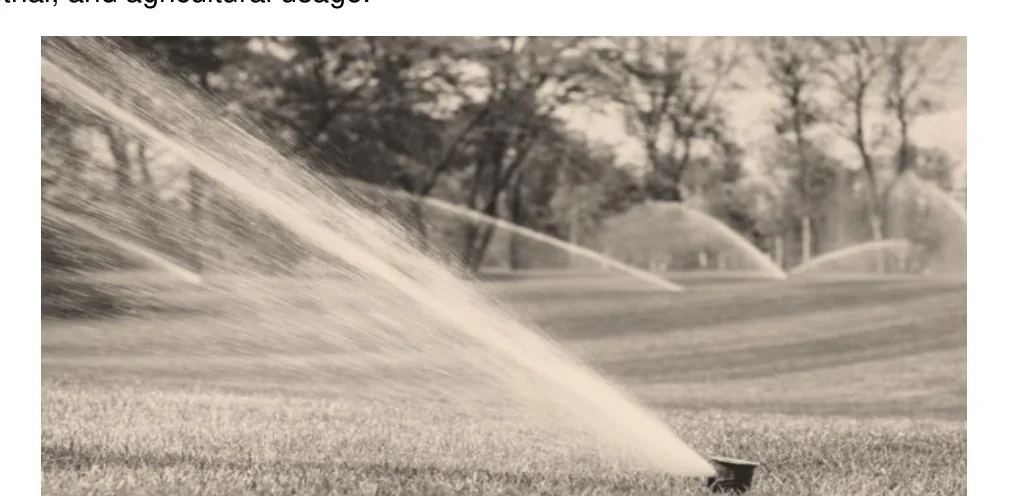
A water sprinkler is a device used to irrigate agricultural crops, lawns, landscapes, golf courses, and other areas. Water sprinklers can be used for residential, industrial, and agricultural usage.
Photograph retained from the official paper.
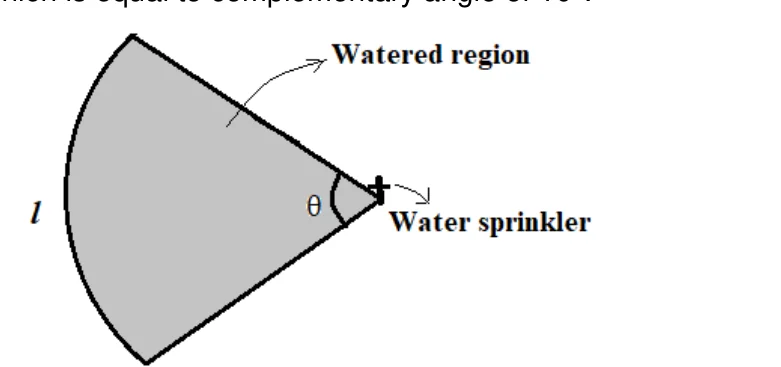
A water sprinkler is set to shoot a stream of water a distance of 21 m and rotate through an angle which is equal to complementary angle of 10°.
Diagram retained from the official paper.
Describe the figure
Both the sprinkler photograph and source sector diagram are retained. The range 21 m is the radius. The sector angle is the complement of 10°, hence 80°. The symbol l marks its arc length. The two OR alternatives impose different changes.
Appeared in: 2025–26 · Basic · Official Sample
(i) What is the area of sector in terms of arc length? [1 mark]
Show answer and solution
A = , where l is arc length and r is radius.
For a sector, l = × 2πr and A = × πr².
Thus A = r × ( × 2πr) = .
(ii) What is the area of the watered region (in terms of π)? [1 mark]
Show answer and solution
Area = 98π m².
The angle is 90° − 10° = 80° and the radius is 21 m.
Area = π × 21² = 98π m².
(iii)(A) If the radius r changes to 28 m, find the angle θ so that the area of the watered region remains the same. [2 marks]
Show answer and solution
New angle θ = 45°.
The original area is 98π m².
For the new sector, π × 28² = 98π.
θ = = 45°.
OR
(iii)(B) If the radius r is increased from 21 m to 28 m and the angle remains the same, what is the increase in the area of the watered region? [2 marks]
Show answer and solution
Increase = m².
Use the unchanged angle 80° in this alternative.
Increase = π(28² − 21²).
Increase = π × 343 = m².
Using π = gives approximately 239.56 m².
Basic4 marks · 1 + 1 + 2
Case 19. A paper fan with a black annular face
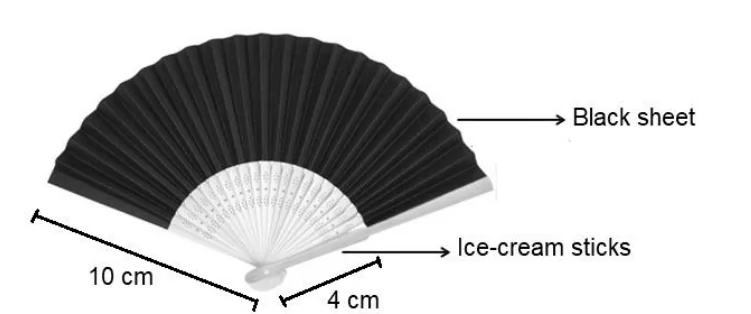
An Art and craft teacher prepared a fan which looked like the sector of a circle using ice-cream sticks and black sheet as shown in the given figure:
Diagram retained from the official paper.
Describe the figure
The original fan photograph is data-bearing and retained. Its outer radius is 10 cm; the unblackened inner sector has radius 4 cm. The black sheet forms an annular sector between these radii. The initial central angle is 60°, and the last OR part asks for a new angle.
Appeared in: 2026–27 · Basic · Official Sample
(i) The angle subtended at the centre of the sector is 60°. Find the area of one face of the fan. [1 mark]
Show answer and solution
Face area = cm² ≈ 52.38 cm².
The full face is a 60° sector of radius 10 cm.
Using π = , area = × × 10² = cm².
(ii) With the given sector angle of 60° at the centre, find area of black sheet used in the fan. [1 mark]
Show answer and solution
Black-sheet area = 44 cm².
Subtract the inner sector of radius 4 cm from the outer sector of radius 10 cm.
Using π = , area = × × (10² − 4²) = 44 cm².
(iii)(A) The boundary of the black sheet region on one face is to be covered by a designer tape. What length of tape is required? [2 marks]
Show answer and solution
Tape length = cm ≈ 26.67 cm.
The boundary contains both arcs and two radial edges of length 10 − 4 = 6 cm.
Using π = , total arc length = × 2 × × (10 + 4) = cm.
Tape length = + 6 + 6 = cm.
OR
(iii)(B) If 29.6 cm of designer tape is required to cover the boundary of the black sheet region on one face of the fan, evaluate the central angle of the sector. [2 marks]
Show answer and solution
New central angle = 72°.
Let the new central angle be θ; retain radii 10 cm and 4 cm.
Boundary = × 2π(10 + 4) + 2(10 − 4).
Using π = , 29.6 = + 12.
17.6 = , so θ = = 72°.
Basic4 marks · 1 + 1 + 2 · Accessible alternative
Case 20. Motion detector: accessible alternative to the fan case
A motion sensor (or motion detector) is an electronic device that is designed to detect and measure movement. The motion detector can detect movement over a sector of angle θ = 70° to a distance of 24 m.
The official accessible alternative is text-only; it has no original illustration. The monitored region is a sector with radius 24 m and central angle 70°. It is a separate printed variant of the sample’s fan case.
Appeared in: 2026–27 · Basic · Official Sample
Accessible alternative to the fan case in the same official sample paper; the passage and questions are different.
(i) Derive a relation between the length of arc l and the area of the sector A enclosed by it. [1 mark]
Show answer and solution
A = .
Arc length l = × 2πr.
Sector area A = × πr².
Therefore A = × l = , where r is the range.
(ii) How much area is monitored by motion detector? [1 mark]
Show answer and solution
Monitored area = 352 m².
Using π = , A = × × 24² = 352 m².
(iii)(A) To increase the area to be monitored by 50% with the same range of distance covered, what should be the angle? [2 marks]
Show answer and solution
New angle = 105°.
For a fixed radius, sector area is proportional to its angle.
New area = 1.5 times the original area.
New angle = 1.5 × 70° = 105°.
OR
(iii)(B) For θ = 91°, what range of distance is required for the detector to monitor 30% more area? [2 marks]
Show answer and solution
Required range = 24 m.
Let the new radius be R. New area is 1.3 times the original area.
πR² = 1.3 × π × 24².
Since 1.3 × 70 = 91, this simplifies to R² = 24².
Taking the positive radius gives R = 24 m.
The increased angle already provides the 30% increase in area.
Questions students ask
How do I choose between sector area and segment area?
A sector is bounded by two radii and an arc. A segment is bounded by a chord and an arc. For a minor segment, subtract the triangle between the radii from the corresponding sector.
What is the difference between arc length and sector perimeter?
Arc length counts only the curved edge. A sector’s perimeter also includes its two radii. For a semicircle, include the diameter as well as the semicircular arc.
Why do I add the two radii when finding an annular-sector perimeter?
The two curved boundaries have lengths based on the outer radius R and inner radius r, so add those arc lengths. The two straight edges each have length R − r. The windmill and fan cases use this boundary.
Why is the grass cost ₹35,000 in the square-house case?
Only two segments are shaded for grass, with total area 700 m². At ₹50 per square metre the cost is ₹35,000. The OR part asks for all remaining land, which includes all four outside segments.
Why does the playground fencing cost include the divider?
The official marking scheme counts the full rectangle and the semicircular arc. This includes the straight playground–parking divider once. Case 13 states that boundary model beside its solution.
Why can I not always subtract just the two circle areas?
Subtracting whole-circle areas gives a complete annulus. For an annular sector, multiply that difference by θ/360. For a segment, subtract a triangle from a sector instead.
Which value of π should I use?
Follow a value printed in the question. Where the source leaves it unstated, these solutions show the chosen value, usually 22/7. The flower-bed solution uses π = 3.14 and √3 = 1.73 to reproduce the scheme’s displayed approximations.
Why keep the radius unrounded?
Squaring a rounded radius can change an area or final cost. Retain the exact fraction or unrounded r² and round only the requested final answer.
Can I use the previous angle in an OR alternative?
Only if the alternative keeps it. For the fan’s tape-length OR, the angle is unknown. For the sprinkler’s second alternative, the original 80° stays fixed. Read each condition separately.
Do I need both OR alternatives in the examination?
Answer one alternative where OR is printed. Both are solved here for practice. Follow the marks beside the question: the playground case uses 1 + 2 + 1, while the other selected cases use 1 + 1 + 2.
All answers are present before filters run. Both OR alternatives are listed for practice.
How to approach a case study
Read the full passage and identify the named region or boundary.
Mark the radius, diameter and central angle; read the shading and labels rather than measuring the drawing.
Write the required formula, substitute the given values and simplify one step per line.
Keep OR conditions separate, check units and round only at the end.
About these questions and solutions
Selected official CBSE cases, with exact repeats merged and original passages, illustrations, marks and OR choices retained.
Solutions prepared by Team TutorVertex in NCERT style; source-specific interpretations and rounding differences are explained beside the affected answers.
Official sources — View papers and marking schemesCase 1 sources
2023 · Basic · main · 430/6/1 · Q38 — Official question-paper archive · Official marking schemeQuestion file: MATHEMATICS_BASIC/430_6_1_Maths Basic.pdf Marking-scheme file: Math_Basic/430_6_1.pdf Question PDF page 23; marking-scheme PDF page 18.
2023 · Basic · main · 430/6/2 · Q37 — Official question-paper archive · Official marking schemeQuestion file: MATHEMATICS_BASIC/430_6_2_Maths Basic.pdf Marking-scheme file: Math_Basic/436 -6-2.pdf Question PDF page 21; marking-scheme PDF page 16.
2023 · Basic · main · 430/6/3 · Q36 — Official question-paper archive · Official marking schemeQuestion file: MATHEMATICS_BASIC/430_6_3_Maths Basic.pdf Marking-scheme file: Math_Basic/430-6-3.pdf Question PDF page 19; marking-scheme PDF page 14.
Case 2 sources
2025 · Basic · main · 430(B) · Q38 — Official question-paper archive · Official marking schemeQuestion file: 241_Mathematics_Basic/430 B_Maths Basic for Visually Impaired candiddates.pdf Marking-scheme file: Math/241 Mathematics Basic/X_241_Mathematics Basic_MS_430 B.pdf Question PDF page 23; marking-scheme PDF page 16.
Case 3 sources
2025 · Standard · main · 30/1/1 · Q37 — Official question-paper archive · Official marking schemeQuestion file: 041_Mathematics_Standard/30-1-1_Mathematics Standard.pdf Marking-scheme file: Math/041 Mathematics Standard/X_MS_041_Mathematics Standard_30-1-1_2024-25.pdf Question PDF page 25; marking-scheme PDF page 17.
2025 · Standard · main · 30/1/2 · Q36 — Official question-paper archive · Official marking schemeQuestion file: 041_Mathematics_Standard/30-1-2_Mathematics Standard.pdf Marking-scheme file: Math/041 Mathematics Standard/X_MS_041_Mathematics Standard_30-1-2_2024-25.pdf Question PDF page 23; marking-scheme PDF pages 15, 16.
2025 · Standard · main · 30/1/3 · Q38 — Official question-paper archive · Official marking schemeQuestion file: 041_Mathematics_Standard/30-1-3_Mathematics Standard.pdf Marking-scheme file: Math/041 Mathematics Standard/X_MS_041_Mathematics Standard_30-1-3_2024-25.pdf Question PDF page 27; marking-scheme PDF page 18.
Case 4 sources
2025 · Standard · supplementary · 30(B)/S · Q38 — Official question-paper archive · Official marking schemeQuestion file: Maths_Standard/30(B)-S Maths Standard Blind.pdf Marking-scheme file: MATHEMATICS_STANDARD/MS_X_041_Mathematics_30(B)-S_2024-25.pdf Question PDF page 23; marking-scheme PDF page 16.
2026 · Standard · second board examination · 30/7/1 · Q38 — Official question-paper archive · Official marking schemeQuestion file: Mathmatics_Std/30-7-1_Maths Std_E2_10_2026.pdf Marking-scheme file: Mathematics_Standard/Mathematics Standard-041 E2 (Set 30-7-1).pdf Question PDF page 27; marking-scheme PDF pages 22, 23.
2026 · Standard · second board examination · 30/7/2 · Q37 — Official question-paper archive · Official marking schemeQuestion file: Mathmatics_Std/30-7-2_Maths Std_E2_10_2026.pdf Marking-scheme file: Mathematics_Standard/Mathematics Standard-041 E2 (Set 30-7-2).pdf Question PDF page 25; marking-scheme PDF pages 21, 22.
2026 · Standard · second board examination · 30/7/3 · Q36 — Official question-paper archive · Official marking schemeQuestion file: Mathmatics_Std/30-7-3_Maths Std_E2_10_2026.pdf Marking-scheme file: Mathematics_Standard/Mathematics Standard-041 E2 (Set 30-7-3).pdf Question PDF page 23; marking-scheme PDF page 21.
Case 7 sources
2023 · Basic · main · 430/1/1 · Q37 — Official question-paper archive · Official marking schemeQuestion file: MATHEMATICS_BASIC/430_1_1_Maths Basic.pdf Marking-scheme file: Math_Basic/430_1_1.pdf Question PDF page 21; marking-scheme PDF pages 17, 18.
2023 · Basic · main · 430/1/2 · Q38 — Official question-paper archive · Official marking schemeQuestion file: MATHEMATICS_BASIC/430_1_2_Maths Basic.pdf Marking-scheme file: Math_Basic/430_1_2.pdf Question PDF page 23; marking-scheme PDF page 18.
2023 · Basic · main · 430/1/3 · Q36 — Official question-paper archive · Official marking schemeQuestion file: MATHEMATICS_BASIC/430_1_3_Maths Basic.pdf Marking-scheme file: Math_Basic/430_1_3.pdf Question PDF page 19; marking-scheme PDF page 16.
Case 8 sources
2023 · Basic · main · 430/2/1 · Q36 — Official question-paper archive · Official marking schemeQuestion file: MATHEMATICS_BASIC/430_2_1_Maths Basic.pdf Marking-scheme file: Math_Basic/430_2_1.pdf Question PDF page 23; marking-scheme PDF page 19.
2023 · Basic · main · 430/2/2 · Q38 — Official question-paper archive · Official marking schemeQuestion file: MATHEMATICS_BASIC/430_2_2_Maths Basic.pdf Marking-scheme file: Math_Basic/430_2_2.pdf Question PDF page 27; marking-scheme PDF page 19.
2023 · Basic · main · 430/2/3 · Q38 — Official question-paper archive · Official marking schemeQuestion file: MATHEMATICS_BASIC/430_2_3_Maths Basic.pdf Marking-scheme file: Math_Basic/430_2_3.pdf Question PDF page 27; marking-scheme PDF page 21.
Case 9 sources
2023 · Basic · main · 430/6/1 · Q36 — Official question-paper archive · Official marking schemeQuestion file: MATHEMATICS_BASIC/430_6_1_Maths Basic.pdf Marking-scheme file: Math_Basic/430_6_1.pdf Question PDF pages 19, 21; marking-scheme PDF page 16.
2023 · Basic · main · 430/6/2 · Q38 — Official question-paper archive · Official marking schemeQuestion file: MATHEMATICS_BASIC/430_6_2_Maths Basic.pdf Marking-scheme file: Math_Basic/436 -6-2.pdf Question PDF pages 21, 23; marking-scheme PDF pages 17, 18.
2023 · Basic · main · 430/6/3 · Q37 — Official question-paper archive · Official marking schemeQuestion file: MATHEMATICS_BASIC/430_6_3_Maths Basic.pdf Marking-scheme file: Math_Basic/430-6-3.pdf Question PDF pages 21, 23; marking-scheme PDF pages 15, 16.
Case 10 sources
2023 · Basic · supplementary · 430/C/1 · Q36 — Official question-paper archive · Official marking schemeQuestion file: Maths_Basic/430_C_1 Mathematics Basic.pdf Marking-scheme file: Mathematics_Basic/241_C_1.pdf Question PDF page 23; marking-scheme PDF page 16.
2023 · Basic · supplementary · 430/C/2 · Q37 — Official question-paper archive · Official marking schemeQuestion file: Maths_Basic/430_C_2 Mathematics Basic.pdf Marking-scheme file: Mathematics_Basic/241_C_2.pdf Question PDF pages 25, 27; marking-scheme PDF page 18.
2023 · Basic · supplementary · 430/C/3 · Q37 — Official question-paper archive · Official marking schemeQuestion file: Maths_Basic/430_C_3 Mathematics Basic.pdf Marking-scheme file: Mathematics_Basic/241_C_3.pdf Question PDF page 25; marking-scheme PDF page 16.
Case 11 sources
2024 · Basic · main · 430/3/1 · Q37 — Official question-paper archive · Official marking schemeQuestion file: MATHEMATICS_BASIC/430-3-1MATHEMATICS (BASIC).pdf Marking-scheme file: Mathematics/X_241_MS_430_3_1_Unsigned.pdf Question PDF pages 21, 23; marking-scheme PDF page 18.
2024 · Basic · main · 430/3/2 · Q38 — Official question-paper archive · Official marking schemeQuestion file: MATHEMATICS_BASIC/430-3-2MATHEMATICS (BASIC).pdf Marking-scheme file: Mathematics/X_241_MS_430_3_2_Unsigned.pdf Question PDF pages 23, 25; marking-scheme PDF page 19.
2024 · Basic · main · 430/3/3 · Q36 — Official question-paper archive · Official marking schemeQuestion file: MATHEMATICS_BASIC/430-3-3MATHEMATICS (BASIC).pdf Marking-scheme file: Mathematics/X_241_MS_430_3_3_Unsigned.pdf Question PDF pages 19, 21; marking-scheme PDF page 16.
Case 12 sources
2025 · Standard · main · 30/4/1 · Q36 — Official question-paper archive · Official marking schemeQuestion file: 041_Mathematics_Standard/30-4-1_Mathematics Standard.pdf Marking-scheme file: Math/041 Mathematics Standard/X_MS_041_Mathematics Standard _30-4-1_2024-25_.pdf Question PDF page 13; marking-scheme PDF page 16.
2025 · Standard · main · 30/4/2 · Q38 — Official question-paper archive · Official marking schemeQuestion file: 041_Mathematics_Standard/30-4-2_Mathematics Standard.pdf Marking-scheme file: Math/041 Mathematics Standard/X_MS_041_Mathematics Standard_30-4-2_2024-25_.pdf Question PDF page 15; marking-scheme PDF page 19.
2025 · Standard · main · 30/4/3 · Q37 — Official question-paper archive · Official marking schemeQuestion file: 041_Mathematics_Standard/30-4-3_Mathematics Standard.pdf Marking-scheme file: Math/041 Mathematics Standard/X_MS_041_Mathematics Standard_30-4-3_2024-25_.pdf Question PDF page 15; marking-scheme PDF page 18.
Case 13 sources
2023 · Standard · main · 30/4/1 · Q38 — Official question-paper archive · Official marking schemeQuestion file: MATHEMATICS_STANDARD/30_4_1 Maths Standard.pdf Marking-scheme file: Maths_Standard/MS 041_30-4-1 Mathematics 2022-23.pdf Question PDF page 15; marking-scheme PDF pages 22, 23.
2023 · Standard · main · 30/4/2 · Q37 — Official question-paper archive · Official marking schemeQuestion file: MATHEMATICS_STANDARD/30_4_2 Maths Standard.pdf Marking-scheme file: Maths_Standard/MS 041_30-4-2 Mathematics 2022-23.pdf Question PDF page 15; marking-scheme PDF pages 20, 21.
2023 · Standard · main · 30/4/3 · Q36 — Official question-paper archive · Official marking schemeQuestion file: MATHEMATICS_STANDARD/30_4_3 Maths Standard.pdf Marking-scheme file: Maths_Standard/MS 041_30-4-3 Mathematics 2022-23.pdf Question PDF page 13; marking-scheme PDF pages 20, 21.
Case 14 sources
2024 · Basic · main · 430/1/3 · Q36 — Official question-paper archive · Official marking schemeQuestion file: MATHEMATICS_BASIC/430-1-3MATHEMATICS (BASIC).pdf Marking-scheme file: Mathematics/X_241_MS_430_1_3_Unsigned.pdf Question PDF page 13; marking-scheme PDF page 17.
2024 · Basic · main · 430/1/2 · Q38 — Official question-paper archive · Official marking schemeQuestion file: MATHEMATICS_BASIC/430-1-2MATHEMATICS (BASIC).pdf Marking-scheme file: Mathematics/X_241_MS_430_1_2_Unsigned.pdf Question PDF page 15; marking-scheme PDF page 18.
Archive naming/numbering note: the members named 430-1-1 and 430-1-3 reproduce the same case pages and both display paper code 430/1/3. This paper is counted once. The corresponding 430/1/3 marking scheme gives this case’s working under Q37 (printed p. 17), while the question paper numbers it Q36.
Case 15 sources
2025 · Standard · main · 30/5/1 · Q36 — Official question-paper archive · Official marking schemeQuestion file: 041_Mathematics_Standard/30-5-1_Mathematics Standard.pdf Marking-scheme file: Math/041 Mathematics Standard/X_MS_041_Mathematics Standard_30-5-1_2024-25.pdf Question PDF page 19; marking-scheme PDF page 14.
2025 · Standard · main · 30/5/2 · Q38 — Official question-paper archive · Official marking schemeQuestion file: 041_Mathematics_Standard/30-5-2_Mathematics Standard.pdf Marking-scheme file: Math/041 Mathematics Standard/X_MS_041_Mathematics Standard_30-5-2_2024-25.pdf Question PDF page 23; marking-scheme PDF page 17.
2025 · Standard · main · 30/5/3 · Q37 — Official question-paper archive · Official marking schemeQuestion file: 041_Mathematics_Standard/30-5-3_Mathematics Standard.pdf Marking-scheme file: Math/041 Mathematics Standard/X_MS_041_Mathematics Standard_30-5-3_2024-25.pdf Question PDF page 21; marking-scheme PDF page 16.
Case 16 sources
2025 · Standard · main · 30/6/1 · Q36 — Official question-paper archive · Official marking schemeQuestion file: 041_Mathematics_Standard/30-6-1_Mathematics Standard.pdf Marking-scheme file: Math/041 Mathematics Standard/X_MS_041_Mathematics Standard_30-6-1_2024-25.pdf Question PDF page 19; marking-scheme PDF page 16.
2025 · Standard · main · 30/6/2 · Q38 — Official question-paper archive · Official marking schemeQuestion file: 041_Mathematics_Standard/30-6-2_Mathematics Standard.pdf Marking-scheme file: Math/041 Mathematics Standard/X_MS_041_Mathematics Standard_30-6-2_2024-25.pdf Question PDF page 23; marking-scheme PDF pages 18, 19.
2025 · Standard · main · 30/6/3 · Q37 — Official question-paper archive · Official marking schemeQuestion file: 041_Mathematics_Standard/30-6-3_Mathematics Standard.pdf Marking-scheme file: Math/041 Mathematics Standard/X_MS_041_Mathematics Standard_30-6-3_2024-25.pdf Question PDF page 21; marking-scheme PDF pages 19, 20.
Case 17 sources
2025 · Basic · main · 430/5/1 · Q37 — Official question-paper archive · Official marking schemeQuestion file: 241_Mathematics_Basic/430-5-1_Mathematics Basic.pdf Marking-scheme file: Math/241 Mathematics Basic/X_241_Mathematics Basic_MS_430_5_1.pdf Question PDF page 21; marking-scheme PDF pages 16, 17.
2025 · Basic · main · 430/5/2 · Q38 — Official question-paper archive · Official marking schemeQuestion file: 241_Mathematics_Basic/430-5-2_Mathematics Basic.pdf Marking-scheme file: Math/241 Mathematics Basic/X_241_Mathematics Basic_MS_430_5_2.pdf Question PDF page 23; marking-scheme PDF pages 17, 18.
2025 · Basic · main · 430/5/3 · Q36 — Official question-paper archive · Official marking schemeQuestion file: 241_Mathematics_Basic/430-5-3_Mathematics Basic.pdf Marking-scheme file: Math/241 Mathematics Basic/X_241_Mathematics Basic_MS_430_5_3.pdf Question PDF pages 19, 21; marking-scheme PDF pages 15, 16.
Case 18 sources
2025–26 · Basic · Official sample · Q37 — Official sample question paper · Official marking schemeQuestion file: MathsBasic-SQP.pdf Marking-scheme file: MathsBasic-MS.pdf Question PDF page 10; marking-scheme PDF page 11.
Case 19 sources
2026–27 · Basic · Official sample · Q36 — Official sample question paper · Official marking schemeQuestion file: MathsBasic-SQP.pdf Marking-scheme file: MathsBasic-MS.pdf Question PDF page 7; marking-scheme PDF page 9.
Case 20 sources
2026–27 · Basic · Official sample · accessible alternative · Q36 — Official sample question paper · Official marking schemeQuestion file: MathsBasic-SQP.pdf Marking-scheme file: MathsBasic-MS.pdf Question PDF page 7; marking-scheme PDF page 10.