Surface Areas and Volumes: Class 10 Case Study Previous Year Questions with Answers
These case studies ask you to identify exposed surfaces, combine volumes and compare capacities. Separate the component solids and mark their radii and heights before choosing a formula. Try each part, then open its worked solution.
28 distinct cases · 66 board-paper appearances + 2 official-sample appearances Solutions prepared by Team TutorVertex Verified by Siddharth Sir · Last reviewed 27 October 2026
Key results
What is required?
Relationship
Cylinder
Curved area = 2πrh; total area = 2πr(h + r); volume = πr²h.
Cone
Slant height l = √(r² + h²); curved area = πrl; volume = πr²h.
Sphere and hemisphere
Sphere: area = 4πr², volume = πr³. Hemisphere: curved area = 2πr², total area = 3πr², volume = πr³.
Cuboid and cube
Cuboid: area = 2(Lb + bh + hL), volume = Lbh. Cube of edge a: area = 6a², volume = a³.
Joined or hollow objects
Add component volumes; subtract cavities. Count only surfaces requested in the question, excluding hidden joined faces for exposed-area questions.
Capacity and cost
1 cm³ = 1 mL; 1000 cm³ = 1 L. Cost = required area or volume × stated rate.
Here r is a radius, h is perpendicular height and l is cone slant height; L and b are cuboid length and breadth, and a is a cube edge. Use inner dimensions for capacity and outer dimensions for fitting or external area. The value of π used is stated in each solution.
Both OR alternatives are solved for practice; answer one where OR is printed. Follow each case’s marks, including the older 2022 term-based patterns.
Find a case
Showing all 28 cases
No cases match these filters. Try another combination or reset the filters.
Tents and coverings
Standard4 marks · 3 + 1
Case 1. A circus tent with stitching wastage
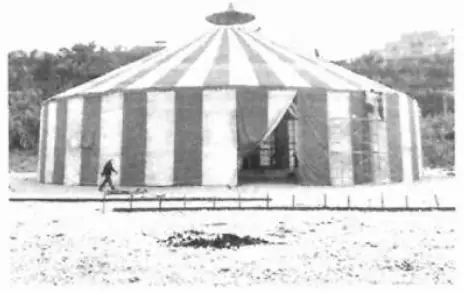
A ‘circus’ is a company of performers who put on shows of acrobats, clowns etc. to entertain people started around 250 years back, in open fields, now generally performed in tents. One such ‘Circus Tent’ is shown below.
The tent is in the shape of a cylinder surmounted by a conical top. If the height and diameter of cylindrical part are 9 m and 30 m respectively and height of conical part is 8 m with same diameter as that of the cylindrical part, then find:
Photograph retained from the official paper.
Describe the figure
The original circus-tent photograph is retained. The cylinder has radius 15 m and height 9 m; the cone has the same radius and perpendicular height 8 m. The tent has no fabric floor. Part (2) adds 30 m² of stitching wastage.
Appeared in: 2022 · Standard · Main
Related setup: Case 2 uses different tent dimensions and asks about floor area and air volume.
(1) Find the area of the canvas used in making the tent. [3 marks]
Show answer and solution
Canvas area = 1650 m².
Radius r = = 15 m.
Cone slant height l = √(15² + 8²) = 17 m.
Canvas area = curved area of cylinder + curved area of cone.
Area = 2πrh + πrl = π × 15 × (2 × 9 + 17) = 525π m².
Using π = , area = 1650 m². The floor and the joined circular face are excluded.
(2) Find the cost of the canvas bought for the tent at the rate ₹200 per sq m, if 30 sq m canvas was wasted during stitching. [1 mark]
Show answer and solution
Cost = ₹3,36,000.
Canvas to be bought = 1650 + 30 = 1680 m².
Cost = 1680 × 200 = ₹3,36,000.
Standard4 marks · 1 + 1 + 2
Case 2. A circus tent: cloth, floor and air
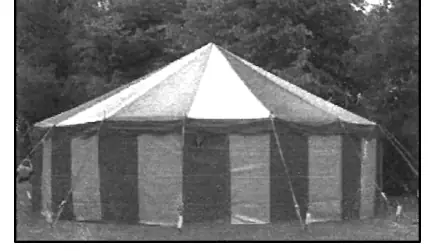
The word ‘circus’ has the same root as ‘circle’. In a closed circular area, various entertainment acts including human skill and animal training are presented before the crowd.
A circus tent is cylindrical upto a height of 8 m and conical above it. The diameter of the base is 28 m and total height of tent is 18.5 m.
Photograph retained from the official paper.
Describe the figure
The source tent photograph is retained. The common radius is 14 m. The cylinder height is 8 m, while the full tent height is 18.5 m. The cone height must therefore be found by subtraction.
Appeared in: 2024 · Standard · Main
Related setup: Case 1 adds stitching wastage and a fabric cost.
(i) Find slant height of the conical part. [1 mark]
Show answer and solution
Slant height = 17.5 m.
Cone height = 18.5 − 8 = 10.5 m and radius = = 14 m.
l = √(14² + 10.5²) = √306.25 = 17.5 m.
(ii) Determine the floor area of the tent. [1 mark]
Show answer and solution
Floor area = 616 m².
The floor is a circle of radius 14 m.
Using π = , area = πr² = × 14² = 616 m².
(iii)(a) Find area of the cloth used for making tent. [2 marks]
Show answer and solution
Cloth area = 1474 m².
The cloth covers the cylinder’s curved side and the cone’s curved side.
Area = 2πrh + πrl, where r = 14 m, h = 8 m and l = 17.5 m.
Using π = , area = × 14 × (16 + 17.5) = 1474 m².
Do not include the floor or the circle where the solids join.
OR
(iii)(b) Find total volume of air inside an empty tent. [2 marks]
Show answer and solution
Air volume = 7084 m³.
Air occupies both the cylindrical and conical parts.
Volume = πr²h + πr²H, with h = 8 m and H = 10.5 m.
Using π = , volume = 616 × (8 + ) = 7084 m³.
Standard4 marks · 2 + 2 · Accessible alternative
Case 3. Two fabrics for Kumbh Mela tents
For the Kumbh Mela, Uttar Pradesh Government prescribed the following for the contractors to pitch the tents.
Each tent must be of cylindrical base of radius 21 m and height 5 m, surmounted by a conical part of height 20 m. The cylindrical part must have a white coloured thick fabric costing ₹60 per square meter, while the conical part must have PVC coated blue fabric costing ₹70 per square meter.
The accessible paper is text-only. Both components have radius 21 m. The cylindrical fabric and conical fabric have different rates. The requested fabric covers the curved surfaces, without a floor.
Appeared in: 2023 · Standard · Supplementary
(a) How much blue PVC (in sq m) is required and what will be its total cost? [2 marks]
Show answer and solution
Blue PVC = 1914 m²; cost = ₹1,33,980.
Cone slant height l = √(21² + 20²) = √841 = 29 m.
Using π = , blue area = πrl = × 21 × 29 = 1914 m².
Cost = 1914 × 70 = ₹1,33,980.
(b) How much white fabric (in sq m) is required and what will be its total cost? [2 marks]
Show answer and solution
White fabric = 660 m²; cost = ₹39,600.
Using π = , cylinder curved area = 2πrh.
Area = 2 × × 21 × 5 = 660 m².
Cost = 660 × 60 = ₹39,600.
Standard4 marks · 1 + 1 + 2
Case 4. A metallic grain silo
Metallic silos are used by farmers for storing grains. Farmer Girdhar has decided to build a new metallic silo to store his harvested grains. It is in the shape of a cylinder mounted by a cone.
Dimensions of the conical part of a silo are: radius of base = 1.5 m; height = 2 m. Dimensions of the cylindrical part of a silo are: radius = 1.5 m; height = 7 m.
The source sample case has no illustration. The cone and cylinder share radius 1.5 m. The cone height is 2 m and the cylinder height is 7 m. Use the slant height only for the cone’s curved area.
Appeared in: 2024–25 · Standard · Official Sample
(i) Calculate the slant height of the conical part of one silo. [1 mark]
Show answer and solution
Slant height = 2.5 m.
l = √(r² + h²) = √(1.5² + 2²) = √6.25 = 2.5 m.
(ii) Find the curved surface area of the conical part of one silo. [1 mark]
Show answer and solution
Cone curved area = m² ≈ 11.79 m².
Using π = , curved area = πrl = × 1.5 × 2.5 = m².
The displayed decimal is rounded from the exact fraction.
(iii)(A) Find the cost of metal sheet used to make the curved cylindrical part of one silo at the rate of ₹2000 per m². [2 marks]
Show answer and solution
Cost = ₹1,32,000.
Using π = , cylinder curved area = 2πrh.
Area = 2 × × 1.5 × 7 = 66 m².
Cost = 66 × 2000 = ₹1,32,000.
OR
(iii)(B) Find the total capacity of one silo to store grains. [2 marks]
Show answer and solution
Capacity = m³ ≈ 54.21 m³.
Capacity = cylinder volume + cone volume.
V = π × 1.5² × 7 + π × 1.5² × 2 = 17.25π m³.
Using π = , V = m³ ≈ 54.21 m³.
Joined solids and exposed surfaces
Basic4 marks · 2 + 2
Case 5. Casting 50 cone-and-hemisphere toys
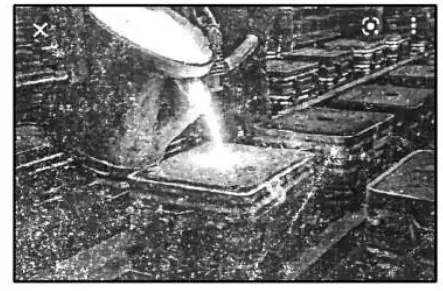
A company deals in casting and moulding of metal on orders received from its clients.
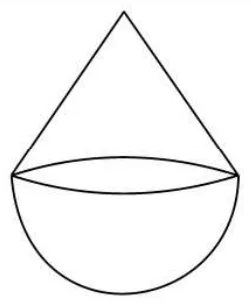
In one such order, company is supposed to make 50 toys in the form of a hemisphere surmounted by a right circular cone of the same base radius as that of hemisphere. If the radius of the base of the cone is 21 cm and height is 28 cm, answer the following:
Photograph retained from the official paper.Diagram retained from the official paper.
Describe the figure
The source casting photograph and toy diagram are both retained. Each toy joins a cone of height 28 cm to a hemisphere of radius 21 cm, along their common circular base.
Appeared in: 2022 · Basic · Main
(a) Find the volume of 50 toys. [2 marks]
Show answer and solution
Volume of 50 toys = 16,17,000 cm³.
Volume of one toy = πr³ + πr²h.
V = π × 21² × (2 × 21 + 28) = 10290π cm³.
Using π = , one toy uses 32340 cm³.
Volume of 50 toys = 50 × 32340 = 16,17,000 cm³.
(b) Find the ratio of the volume of hemisphere to the volume of cone. [2 marks]
Show answer and solution
Hemisphere : cone = 3 : 2.
Ratio = (πr³) : (πr²h).
Cancel the common factor πr² to obtain 2r : h.
Ratio = 42 : 28 = 3 : 2.
Standard4 marks · 1 + 1 + 2 · Accessible alternative
Case 6. A clay cylinder with a hemispherical top
To make the teaching-learning process easier, creative and innovative, a teacher brings clay in the classroom to teach the topic of mensuration. She forms a cylinder of radius 2.1 cm and height 5 cm with the clay and put a hemisphere of same radius on its top in such a way that the base of hemisphere covers the top of cylinder.
Using the above information, and π = 22/7, find:
The accessible paper contains no case illustration. A hemisphere of radius 2.1 cm covers the entire top of a cylinder with radius 2.1 cm and height 5 cm. The cylinder’s lower circular base remains exposed.
Appeared in: 2025 · Standard · Main
Related setup: Case 21 reshapes a clay cylinder into a sphere; this case joins a hemisphere to a cylinder instead.
(a) Find the volume of cylinder so formed. [1 mark]
Show answer and solution
Cylinder volume = 69.3 cm³.
V = πr²h = × 2.1² × 5 = 69.3 cm³.
(b) Find the volume of hemispherical part. [1 mark]
Show answer and solution
Hemisphere volume = 19.404 cm³.
V = πr³ = × × 2.1³ = 19.404 cm³.
(c)(i) Find the surface area of the complete solid. [2 marks]
Show answer and solution
Exposed surface area = 107.58 cm².
The exposed surfaces are the cylinder’s curved side, its lower base and the hemisphere’s curved surface.
Area = 2πrh + πr² + 2πr² = 2πrh + 3πr².
Area = 2 × × 2.1 × 5 + 3 × × 2.1² = 107.58 cm².
The joined circular faces are internal and are not counted.
OR
(c)(ii) Find the surface area of the cylindrical part, if hemisphere is not put on it. [2 marks]
Show answer and solution
Cylinder total surface area = 93.72 cm².
Without the hemisphere, both circular ends of the cylinder are included.
Area = 2πrh + 2πr² = 2πr(h + r).
Area = 2 × × 2.1 × (5 + 2.1) = 93.72 cm².
Basic4 marks · 1 + 1 + 2
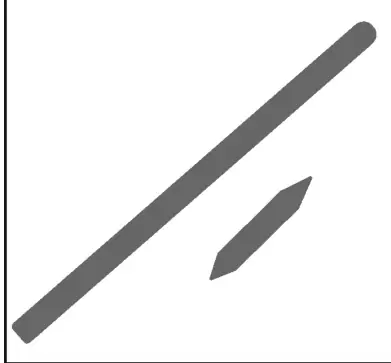
Case 7. Wood used for Gilli Danda
‘Gilli Danda’ is a very popular traditional game of India which is played with two wooden sticks — the larger one is called ‘Danda’ and smaller one ‘Gilli’.
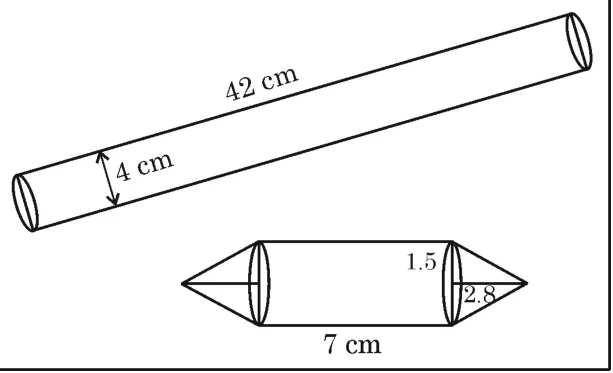
‘Danda’ — It is cylindrical in shape with diameter 4 cm and length 42 cm.
Gilli — It is cylindrical in middle with identical conical ends of same radius 1.5 cm and length 2.8 cm. The length of cylindrical part is 7 cm.
Illustration retained from the official paper.Diagram retained from the official paper.
Describe the figure
The original stick illustration and dimensioned diagram are retained. Danda is a cylinder of radius 2 cm and length 42 cm. Gilli has a radius-1.5 cm cylinder of length 7 cm and two cones, each of height 2.8 cm. The 14 cm log is a separate given for part (iii)(a).
Appeared in: 2026 · Basic · Main
(i) Find the volume of wood used in making both the conical parts of Gilli. [1 mark]
Show answer and solution
Volume of both cones = 13.2 cm³.
Using π = , volume = 2 × πr²h.
Volume = 2 × × × 1.5² × 2.8 = 13.2 cm³.
(ii) Find the volume of wood used in making cylindrical part of Gilli. [1 mark]
Show answer and solution
Cylinder volume = 49.5 cm³.
Using π = , V = πr²h = × 1.5² × 7 = 49.5 cm³.
(iii)(a) A cylindrical log of wood of radius 1.5 cm and length 14 cm is used to make Gilli. Find the volume of the wood scrapped. [2 marks]
Show answer and solution
Wood scrapped = 36.3 cm³.
Log volume = × 1.5² × 14 = 99 cm³.
Gilli volume = 13.2 + 49.5 = 62.7 cm³.
Wood scrapped = 99 − 62.7 = 36.3 cm³.
OR
(iii)(b) Find the total surface area of Danda. [2 marks]
Show answer and solution
Danda surface area = cm² ≈ 553.14 cm².
Use Danda’s radius 2 cm and length 42 cm, rather than Gilli’s dimensions.
Total area of a closed cylinder = 2πr(h + r).
Using π = , area = 2 × × 2 × (42 + 2) = cm².
Basic4 marks · 1 + 1 + 2
Case 8. A solid mushroom with a hemispherical cap
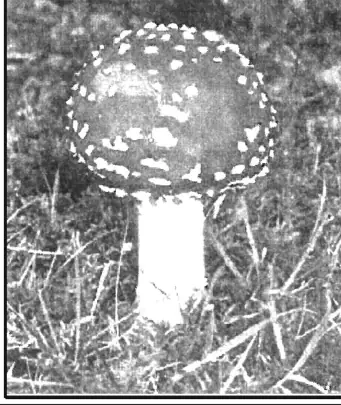
There are many varieties of mushrooms available in the world. One such mushroom ‘Amanita muscaria’ has a upper part which is like red cap (hemispherical) and lower part is like white stem (cylindrical).
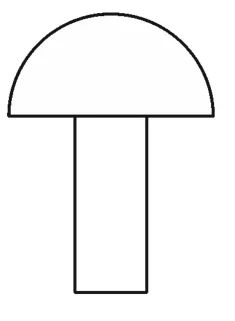
The hemispherical cap’s radius = 3 cm and cylindrical stem is 2 cm high with diameter 1.4 cm. Considering mushroom a solid object, answer the following questions:
Photograph retained from the official paper.Diagram retained from the official paper.
Describe the figure
The source mushroom photograph and outline diagram are retained. The cap is a solid hemisphere of radius R = 3 cm. The centred cylindrical stem has radius r = 0.7 cm and height 2 cm. Its attachment hides a circular patch under the cap, while the rest of the cap’s flat underside and the stem’s bottom remain exposed.
Appeared in: 2026 · Basic · Main
(i) What is the total height of a mushroom? [1 mark]
Show answer and solution
Total height = 5 cm.
A hemisphere’s height equals its radius: 3 cm.
Total height = cap height + stem height = 3 + 2 = 5 cm.
(ii) Find the volume of the stem. [1 mark]
Show answer and solution
Stem volume = 3.08 cm³.
Stem radius r = = 0.7 cm.
Using π = , V = πr²h = × 0.7² × 2 = 3.08 cm³.
(iii)(a) Determine the volume of 7 such mushrooms. [2 marks]
Show answer and solution
Volume of 7 mushrooms = 417.56 cm³.
One mushroom has volume πR³ + πr²h.
Using π = , one mushroom has volume + 3.08 cm³.
Volume of 7 = 7 × ( + 3.08) = 417.56 cm³.
OR
(iii)(b) Find the total surface area of 7 such mushrooms. [2 marks]
Show answer and solution
Total exposed area = 655.6 cm².
For one mushroom, count the cap’s curved surface, uncovered flat underside, stem’s curved side and stem’s lower base.
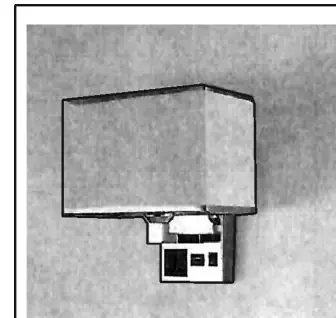
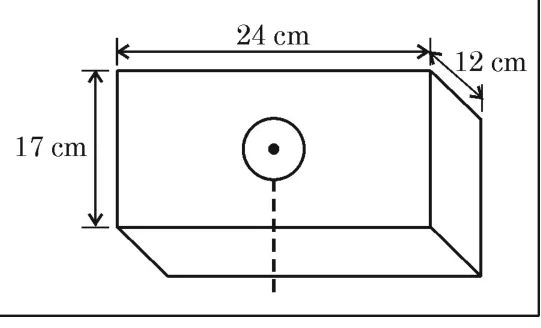
A wall mounted lamp, made of fabric, is shown below. Lamp has cuboidal shape, open from top and bottom. A spherical bulb of diameter 7 cm is latched with a very thin rod. (Ignore the rod while making calculations.)
Dimensions of the cuboid are 24 cm × 12 cm × 17 cm.
Photograph retained from the official paper.Diagram retained from the official paper.
Describe the figure
The lamp photograph and dimensioned diagram are both retained. The cuboid has horizontal dimensions 24 cm by 12 cm and height 17 cm. It is open at both top and bottom. The bulb has diameter 7 cm. The 2 cm folds in part (iii)(a) apply at both horizontal edges.
Appeared in: 2026 · Standard · Main
(i) Find the surface area of the bulb. [1 mark]
Show answer and solution
Bulb surface area = 154 cm².
Bulb radius = = 3.5 cm.
Using π = , area = 4πr² = 4 × × 3.5² = 154 cm².
(ii) What could be the maximum diameter of the bulb if at least 1 cm space is left from each side? [1 mark]
Show answer and solution
Maximum diameter = 10 cm.
The shortest internal dimension is 12 cm.
Leave 1 cm on each of its two opposite sides.
Maximum diameter = 12 − 1 − 1 = 10 cm.
(iii)(a) Find the area of the fabric used if there is a fold of 2 cm on top and bottom edges. [2 marks]
Show answer and solution
Fabric area = 1512 cm².
Fabric height before folding = 17 + 2 + 2 = 21 cm.
The fabric wraps around the four lateral faces; top and bottom stay open.
Required width around the cuboid = 2(24 + 12) = 72 cm.
Fabric area = 72 × 21 = 1512 cm².
OR
(iii)(b) Find the space available inside the lamp. [2 marks]
Show answer and solution
Available space = cm³ ≈ 4716.33 cm³.
Available space = cuboid volume − spherical bulb volume, ignoring the rod.
Cuboid volume = 24 × 12 × 17 = 4896 cm³.
Using π = , bulb volume = × × 3.5³ = cm³.
Difference = 4896 − = cm³.
Standard4 marks · 1 + 1 + 2
Case 10. A rolling pin made from three cylinders
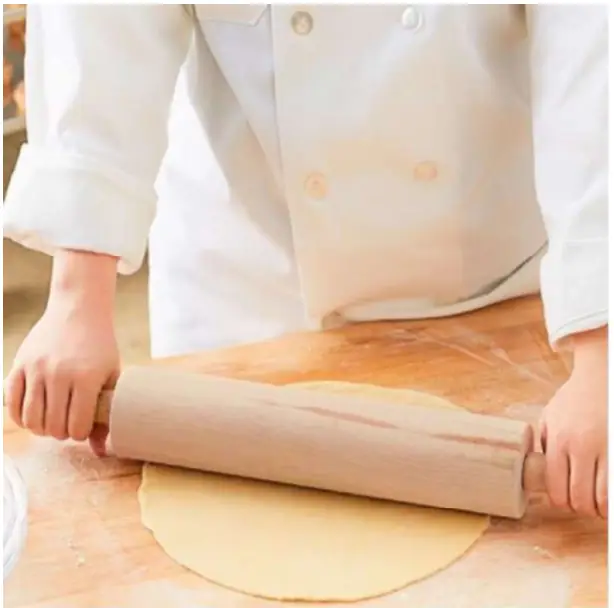
A skilled carpenter decided to craft a special rolling pin for the local baker. He carefully joined three cylindrical pieces of wood — two small ones on the ends and one larger in the centre to create a perfect tool. The baker loved the rolling pin, as it rolled out the smoothest dough for breads and pastries.
The length of the bigger cylindrical part is 12 cm and diameter is 7 cm and the length of each smaller cylindrical part is 5 cm and diameter is 2.1 cm.
Photograph retained from the official paper.Diagram retained from the official paper.
Describe the figure
The baker photograph and dimensioned rolling-pin diagram are retained. The central cylinder has radius 3.5 cm and length 12 cm. Each of the two small end cylinders has radius 1.05 cm and length 5 cm. These questions ask for named component areas and volumes.
Appeared in: 2025 · Standard · Main
(i) Find the volume of the bigger cylindrical part. [1 mark]
Show answer and solution
Volume = 462 cm³.
Using π = , V = πr²h = × 3.5² × 12 = 462 cm³.
(ii) Find the curved surface area of the bigger cylindrical part. [1 mark]
Show answer and solution
Curved area = 264 cm².
Using π = , area = 2πrh = 2 × × 3.5 × 12 = 264 cm².
(iii)(a) Find the ratio of the volume of the bigger cylindrical part to the total volume of the two smaller identical cylindrical parts. [2 marks]
Show answer and solution
Required ratio = 40 : 3.
Total volume of small parts = 2 × × 1.05² × 5 = 34.65 cm³.
Ratio = 462 : 34.65 = 46200 : 3465 = 40 : 3.
This is equivalent to the scheme’s 3080 : 231, reduced to lowest terms.
OR
(iii)(b) Find the sum of the curved surface areas of the two identical smaller cylindrical parts. [2 marks]
Show answer and solution
Combined curved area = 66 cm².
Each small radius is = 1.05 cm.
Using π = , combined curved area = 2 × 2πrh.
Area = 2 × 2 × × 1.05 × 5 = 66 cm².
Basic4 marks · 1 + 1 + 2 · Accessible alternative
Case 11. The hemispherical dome and cuboidal top of Sanchi Stupa
The great Stupa at Sanchi is one of the oldest stone structures in India which was originally made by Emperor Ashoka. It is basically a big hemispherical dome with a cuboidal structure mounted on it.
The accessible source is text-only. Treat each subpart’s dimensions separately: the dome height is 21 m in part (i), its radius is 14 m in part (ii), and the cuboidal top measures 8 m by 6 m by 4 m in part (iii).
Appeared in: 2023 · Basic · Supplementary
(i) What is the volume of the hemispherical dome, if its height is 21 m? Use π = 22/7. [1 mark]
Show answer and solution
Dome volume = 19404 m³.
A hemisphere’s height equals its radius, so r = 21 m.
V = πr³ = × × 21³ = 19404 m³.
(ii) What is the area of plastic cloth required to cover the hemispherical dome, if radius of its base is 14 m? [1 mark]
Show answer and solution
Cloth area = 1232 m².
Use the new radius 14 m for this subpart.
The cloth covers the dome’s curved surface.
Using π = , area = 2πr² = 2 × × 14² = 1232 m².
(iii)(a) If the dimensions of the cuboidal top are 8 m × 6 m × 4 m, then what is the surface area of this cuboidal top? [2 marks]
Show answer and solution
Cuboid total surface area = 208 m².
The scheme asks for the cuboid’s own total surface area.
This is not a calculation of the exposed area of the complete joined stupa.
OR
(iii)(b) What is the volume of the cuboidal top of dimensions given in part (iii)? [2 marks]
Show answer and solution
Cuboid volume = 192 m³.
Volume = lbh = 8 × 6 × 4 = 192 m³.
Standard4 marks · 1 + 1 + 2
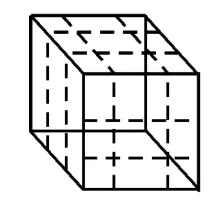
Case 12. A Rubik’s cube and an ice-cream at a fair
On a Sunday your parents took you to a fair. You could see lot of toys displayed and you wanted them to buy a Rubik’s cube and a strawberry ice-cream for you. Based on the information given above, answer the following questions:
Diagram retained from the official paper.Illustration retained from the official paper.
Describe the figure
Both original drawings are retained: a Rubik’s cube and an ice-cream. Use each subpart’s own edge or radius. Part (i) uses cube edge 6 cm, part (ii) uses 7 cm, and the OR uses two separate cubes of edge 4 cm.
Appeared in: 2026 · Standard · Main
(i) Find the length of the diagonal of Rubik’s cube if each edge measures 6 cm. [1 mark]
Show answer and solution
Space diagonal = 6√3 cm.
For cube edge a, the face diagonal is a√2.
By Pythagoras, space diagonal = √((a√2)² + a²) = a√3.
With a = 6 cm, the diagonal is 6√3 cm.
(ii) Find the volume of Rubik’s cube if the length of the edge is 7 cm. [1 mark]
Show answer and solution
Volume = 343 cm³.
Use edge 7 cm in this subpart.
Volume = a³ = 7³ = 343 cm³.
(iii)(a) What is the curved surface area of hemisphere (ice-cream) if the base radius is 7 cm? [2 marks]
Show answer and solution
Hemisphere curved area = 308 cm².
Only the curved hemispherical surface is requested.
Using π = , area = 2πr² = 2 × × 7² = 308 cm².
OR
(iii)(b) If two cubes of edges 4 cm are joined end-to-end, then find the surface area of the resulting cuboid. [2 marks]
Case 13. A jumbo pencil with a sharpened conical tip
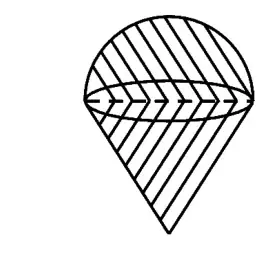
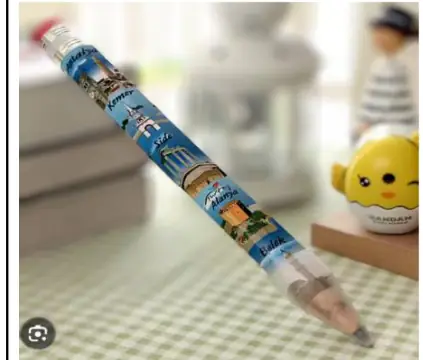
Rinku was very happy to receive a fancy jumbo pencil from his best friend Rohan on his birthday. Pencil is a basic writing tool, when sharpened its shape is a combination of cylinder and cone as given in the picture.
Cylindrical pencil with conical head is a common shape worldwide since ages. Commonly pencils are made up of wood and plastic but we should promote pencils made up of eco-friendly material (many options available in the market these days) to save environment.
The dimensions of Rinku’s pencil are given as follows: length of cylindrical portion is 21 cm. Diameter of the base is 1 cm and height of the conical portion is 1.2 cm.
Photograph retained from the official paper.
Describe the figure
The original decorative-pencil photograph is retained. The geometric model has cylinder radius 0.5 cm and length 21 cm, joined to a cone of the same radius and perpendicular height 1.2 cm. The opposite circular end remains exposed.
Appeared in: 2024–25 · Basic · Official Sample
(i) Find the slant height of the sharpened part. [1 mark]
Show answer and solution
Slant height = 1.3 cm.
Radius r = = 0.5 cm; perpendicular height h = 1.2 cm.
l = √(r² + h²) = √(0.5² + 1.2²) = √1.69 = 1.3 cm.
(ii) Find curved surface area of sharpened part, in terms of π. [1 mark]
Show answer and solution
Curved area = 0.65π cm².
The sharpened part is a cone.
Its curved area = πrl = π × 0.5 × 1.3 = 0.65π cm².
(iii)(A) Find the total surface area of the pencil, in terms of π. [2 marks]
Show answer and solution
Correct exposed surface area = 21.9π cm².
Exposed area = cylinder curved area + cone curved area + one circular base.
Cone curved area = 0.65π cm²; exposed circular base = π × 0.5² = 0.25π cm².
Total = (21 + 0.65 + 0.25)π = 21.9π cm².
Source note: the 2024–25 Basic sample scheme, PDF and printed p. 7, prints 6.15π, using π × 0.5 × 0.5 × 21 for the cylinder’s curved area. Using 2πrh with the stated radius 0.5 cm and length 21 cm gives the exposed total 21.9π cm².
OR
(iii)(B) The pencil’s total height decreases by 8.2 cm after sharpening it many times. What is the volume of the cylindrical part of the shortened pencil, in terms of π? [2 marks]
Show answer and solution
Cylindrical volume = 3.2π cm³.
Following the sample’s model, the sharpened tip keeps height 1.2 cm.
Initial total height = 21 + 1.2 = 22.2 cm.
New total height = 22.2 − 8.2 = 14 cm.
New cylinder length = 14 − 1.2 = 12.8 cm.
Volume = πr²h = π × 0.5² × 12.8 = 3.2π cm³.
Cavities and hollow objects
Basic4 marks · 2 + 2
Case 14. Five carrot-shaped cavities in a wooden toy
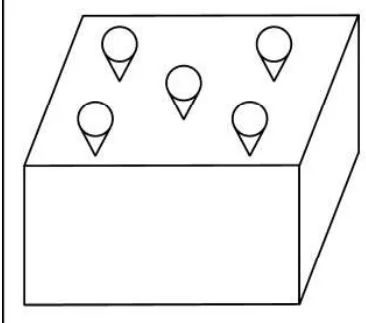
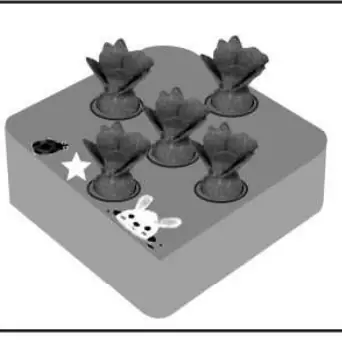
A solid cuboidal toy is made of wood. It has five cone shaped cavities to hold toy carrots.
The dimensions of the toy are: cuboid — 10 cm × 10 cm × 8 cm. Each cone carved out — radius = 2.1 cm and height = 6 cm.
Diagram retained from the official paper.Illustration retained from the official paper.
Describe the figure
The original toy diagram and photograph are retained. The wooden block measures 10 cm by 10 cm by 8 cm. Five equal conical cavities each have radius 2.1 cm and depth 6 cm.
Appeared in: 2022 · Basic · Main
(1) Find the volume of wood taken out in making these depressions. [2 marks]
Show answer and solution
Wood removed = 138.6 cm³.
Each depression is a cone of radius 2.1 cm and height 6 cm.
Using π = , total removed volume = 5 × πr²h.
Volume = 5 × × × 2.1² × 6 = 138.6 cm³.
(2) Find the volume of wood in the entire toy. [2 marks]
Show answer and solution
Wood remaining = 661.4 cm³.
Original cuboid volume = 10 × 10 × 8 = 800 cm³.
Wood remaining = 800 − 138.6 = 661.4 cm³.
Basic4 marks · 1 + 1 + 2
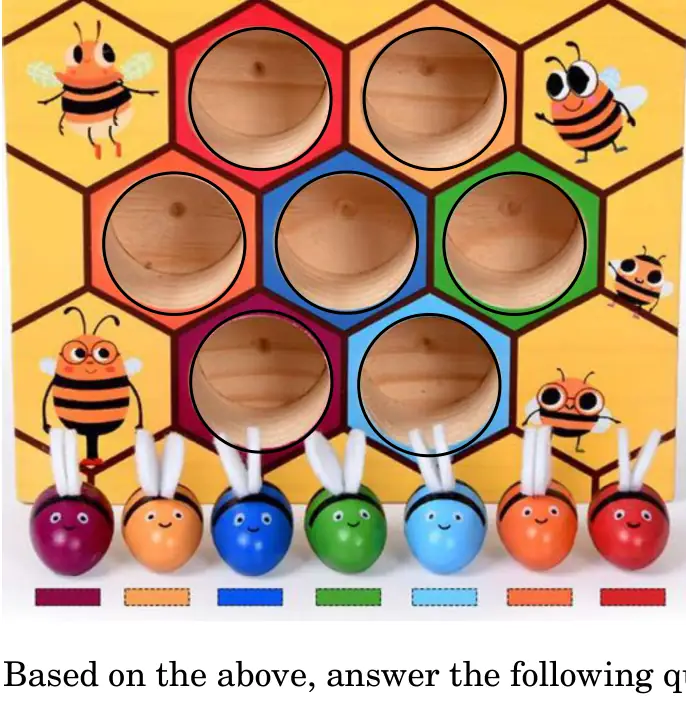
Case 15. A wooden bee toy with seven cylindrical hollows
A wooden toy is shown in the picture. This is a cuboidal wooden block of dimensions 14 cm × 17 cm × 4 cm. On its top there are seven cylindrical hollows for bees to fit in. Each cylindrical hollow is of height 3 cm and radius 2 cm.
Photograph retained from the official paper.
Describe the figure
The original bee-toy photograph is retained. Seven equal cylindrical hollows open into the top face of a 14 cm by 17 cm by 4 cm cuboid. Each hollow has radius 2 cm and depth 3 cm.
Appeared in: 2023 · Basic · Main
(i) Find the volume of wood carved out to make one cylindrical hollow. [1 mark]
Show answer and solution
One hollow volume = cm³ ≈ 37.71 cm³.
Using π = , V = πr²h = × 2² × 3 = cm³.
(ii) Find the lateral surface area of the cuboid to paint it with green colour. [1 mark]
Show answer and solution
Cuboid lateral area = 248 cm².
Lateral area includes only the four vertical rectangular faces.
Area = 2(l + b)h = 2(14 + 17) × 4 = 248 cm².
(iii)(a) Find the volume of wood in the remaining cuboid after carving out seven cylindrical hollows. [2 marks]
Show answer and solution
Wood remaining = 688 cm³.
Cuboid volume = 14 × 17 × 4 = 952 cm³.
Volume of seven hollows = 7 × = 264 cm³.
Wood remaining = 952 − 264 = 688 cm³.
OR
(iii)(b) Find the surface area of the top surface of the cuboid to be painted yellow. [2 marks]
Show answer and solution
Top wooden area = 150 cm².
Subtract the seven circular openings from the top rectangle.
Using π = , area = 14 × 17 − 7 × × 2².
Area = 238 − 88 = 150 cm².
Standard4 marks · 1 + 1 + 2
Case 16. A golf ball with hemispherical dimples
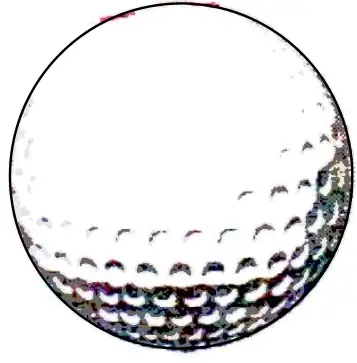
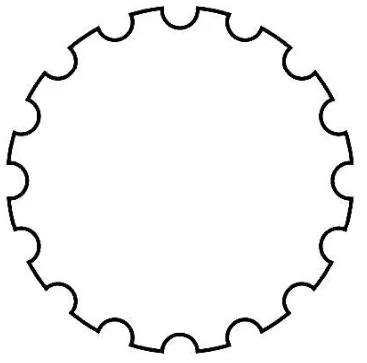
A golf ball is spherical with about 300–500 dimples that help increase its velocity while in play. Golf balls are traditionally white but available in colours also. In the given figure, a golf ball has diameter 4.2 cm and the surface has 315 dimples (hemi-spherical) of radius 2 mm.
Illustration retained from the official paper.Diagram retained from the official paper.
Describe the figure
Both source panels are retained: the golf-ball illustration and a cross-section of its hemispherical dimples. The ball radius is 21 mm and each dimple radius is 2 mm. Each circular opening is replaced by a curved hemispherical surface.
Appeared in: 2023 · Standard · Main
(i) Find the surface area of one such dimple. [1 mark]
Show answer and solution
One dimple curved area = mm² ≈ 25.14 mm².
Convert the ball diameter: 4.2 cm = 42 mm, so its radius is 21 mm.
The dimple has radius r = 2 mm. Its exposed surface is curved.
Using π = , area = 2πr² = 2 × × 2² = mm².
(ii) Find the volume of the material removed for one dimple. [1 mark]
Show answer and solution
One dimple volume = mm³ ≈ 16.76 mm³.
Using π = , hemisphere volume = πr³.
V = × × 2³ = mm³.
(iii)(a) Find the total surface area exposed to the surroundings. [2 marks]
Show answer and solution
Exposed area = 9504 mm².
Area = full sphere area − circular openings + curved dimple areas.
Area = 4π × 21² − 315π × 2² + 315 × 2π × 2².
Area = (1764 − 1260 + 2520)π = 3024π mm².
Using π = , exposed area = 9504 mm².
The flat opening discs are not additional exposed surfaces.
OR
(iii)(b) Find the volume of the golf ball. [2 marks]
Show answer and solution
Material volume = 33528 mm³.
Material volume = sphere volume − volume of 315 dimples.
V = π × 21³ − 315 × π × 2³.
Using π = , V = 38808 − 5280 = 33528 mm³.
Basic4 marks · 1 + 1 + 2
Case 17. A singing bowl and its cylindrical mallet
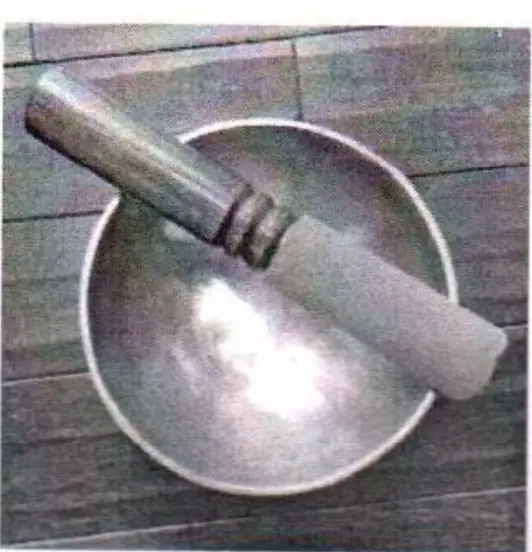
Singing bowls (hemispherical in shape) are commonly used in sound healing practices. Mallet (cylindrical in shape) is used to strike the bowl in a sequence to produce sound and vibration.
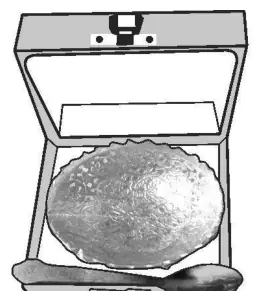
One such bowl is shown here whose dimensions are: hemispherical bowl has outer radius 6 cm and inner radius 5 cm. Mallet has height of 10 cm and radius 2 cm.
Photograph retained from the official paper.
Describe the figure
The source photograph shows the bowl and mallet. The hemispherical metal bowl has outer radius 6 cm and inner radius 5 cm. The separate cylindrical mallet has radius 2 cm and height 10 cm. Use π = 3.14 throughout this case.
Appeared in: 2023 · Basic · Main
(i) Find the volume of the mallet. [1 mark]
Show answer and solution
Mallet volume = 125.6 cm³.
V = πr²h = 3.14 × 2² × 10 = 125.6 cm³.
(ii) Find the inner surface area of the singing bowl. [1 mark]
Show answer and solution
Inner surface area = 157 cm².
The inner curved hemisphere has radius 5 cm.
Area = 2πr² = 2 × 3.14 × 5² = 157 cm².
(iii)(a) Find the volume of metal used in the singing bowl. [2 marks]
Show answer and solution
Metal volume = cm³ ≈ 190.49 cm³.
Subtract the inner hemisphere from the outer hemisphere.
V = π(R³ − r³).
V = × 3.14 × (6³ − 5³) = cm³.
Rounding to two decimal places gives 190.49 cm³.
OR
(iii)(b) Find total surface area of the mallet. (Use π = 3.14.) [2 marks]
Show answer and solution
Mallet total surface area = 150.72 cm².
Both circular ends and the curved side are included.
Case 18. A hemispherical bowl packed in a cuboidal box
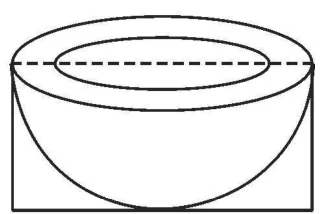
A hemispherical bowl is packed in a cuboidal box. The bowl just fits in the box. Inner radius of the bowl is 10 cm. Outer radius of the bowl is 10.5 cm.
Photograph retained from the official paper.Diagram retained from the official paper.
Describe the figure
The source photograph and packing diagram are retained. The outer radius 10.5 cm determines the box dimensions. The inner radius 10 cm determines capacity. The top rim is an annulus between these two radii.
Appeared in: 2025 · Basic · Main
(i) Find the dimensions of the cuboidal box. [1 mark]
Show answer and solution
Box dimensions = 21 cm × 21 cm × 10.5 cm.
The box length and breadth equal the bowl’s outer diameter: 2 × 10.5 = 21 cm.
The box height equals the hemisphere’s outer radius: 10.5 cm.
(ii) Find the total surface area of the cuboidal box. [1 mark]
(iii)(a) Find the difference between the capacity of the bowl and the volume of the cuboidal box. Use π = 3.14. [2 marks]
Show answer and solution
Positive volume difference = cm³ ≈ 2537.17 cm³.
Bowl capacity uses the inner radius 10 cm.
Capacity = × 3.14 × 10³ = cm³.
Box volume = 21 × 21 × 10.5 = cm³.
Positive difference = − = cm³.
The box volume is larger; this difference is not the volume of metal in the bowl.
OR
(iii)(b) The inner surface of the bowl and the thickness is to be painted. Find the area to be painted. [2 marks]
Show answer and solution
Painted area = cm² ≈ 660.79 cm².
Count the inner curved surface and the flat annular rim.
Area = 2πr² + π(R² − r²) = π(R² + r²).
The π = 3.14 instruction is printed in the volume alternative. The 2025 Basic 430/6/1 scheme, PDF pp. 17–18, uses 3.14 there and for this painting alternative.
Area = × (10.5² + 10²) = cm².
Capacity, packing and volume comparisons
Standard4 marks · 2 + 2
Case 19. Khurja pottery: filling jars and displacement
Khurja is a city in the Indian state of Uttar Pradesh famous for the pottery. Khurja pottery is traditional Indian pottery work which has attracted Indians as well as foreigners with a variety of tea-sets, crockery and ceramic tile works. A huge portion of the ceramics used in the country is supplied by Khurja and is also referred as ‘The Ceramic Town’.
One of the private schools of Bulandshahr organised an Educational Tour for class 10 students to Khurja. Students were very excited about the trip. Following are the few pottery objects of Khurja.
Students found the shapes of the objects very interesting and they could easily relate them with mathematical shapes viz sphere, hemisphere, cylinder etc. Maths teacher who was accompanying the students asked following questions:
Photograph retained from the official paper.Diagram retained from the official paper.
Describe the figure
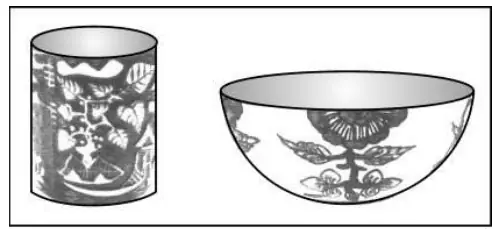
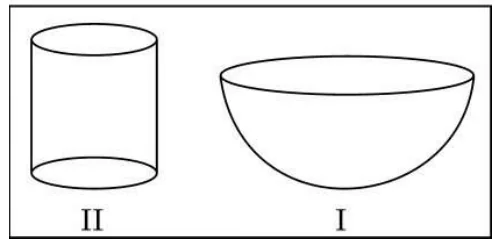
The pottery photograph and source diagram are retained. Object I is a hemispherical bowl of internal radius 9 cm. Object II is a cylindrical jar of radius 1.5 cm and height 4 cm. The funnel in part (b) has the same height and diameter as the jar.
Appeared in: 2022 · Standard · Main
(a) A hemispherical bowl of internal radius 9 cm is full of water. This water is to be filled in cylindrical jars of radius 1.5 cm and height 4 cm. How many jars are needed? [2 marks]
Show answer and solution
Number of jars = 54.
Bowl capacity = π × 9³ = 486π cm³.
One jar capacity = π × 1.5² × 4 = 9π cm³.
Number of jars = = 54.
(b) A cylindrical jar of radius 1.5 cm and height 4 cm is full of water. A conical funnel of the same height and diameter is immersed in it. Find the volume of water that flows out. [2 marks]
Show answer and solution
Overflow volume = cm³ ≈ 9.43 cm³.
Use the displacement model intended in the source: the immersed cone displaces its volume.
Overflow = πr²h = π × 1.5² × 4 = 3π cm³.
Using π = , overflow = cm³.
Standard4 marks · 2 + 2 · Accessible alternative
Case 20. An industrial tank with a conical bottom
Conical bottom tanks in which an inverted cone at the bottom is surmounted by a cylinder of same diameter, are very advantageous in industry, specially where getting every last drop from the tank is important.
Vikas designed a conical bottom tank where the height of the conical part is equal to its radius and the height of the cylindrical part is two times of its radius. The tank is closed from the top.
The accessible paper is text-only. The inverted cone and cylinder share radius r. The cone height is r and the cylinder height is 2r. The cylinder and cone volumes add for the full tank capacity.
Appeared in: 2022 · Standard · Main
(a) Find the volume of the tank if its radius is 3 m. [2 marks]
Show answer and solution
Tank volume = 198 m³.
With r = 3 m, cylinder height = 6 m and cone height = 3 m.
V = πr²(2r) + πr²(r).
V = π × 3² × 6 + π × 3² × 3 = 63π m³.
Using π = , V = 198 m³.
(b) Find the ratio of the volume of the cylindrical part to the volume of the conical part. [2 marks]
Show answer and solution
Cylinder : cone = 6 : 1.
Cylinder volume = πr² × 2r = 2πr³.
Cone volume = πr³.
Ratio = 2 : = 6 : 1.
Basic4 marks · 2 + 2 · Accessible alternative
Case 21. Reshaping a clay cylinder into a sphere
To make the teaching-learning process easier, creative and innovative, a teacher brings clay in the classroom to teach the topic of mensuration. She forms a cylinder of radius 6 cm and height 8 cm with the clay. Later on, she reshaped the same into a sphere. Based on the above, answer the following:
This text-only accessible case is from the 2022 term-based examination. It is historical practice in volume conservation during reshaping. The cylinder has radius 6 cm and height 8 cm, and no clay is lost.
Appeared in: 2022 · Basic · Main
Historical 2022 term-based practice: this item uses conservation of volume when reshaping clay. Related setup: Case 6 joins a hemisphere to a cylinder with different dimensions.
(a) Find the radius of the sphere so formed. [2 marks]
Show answer and solution
Sphere radius = 6 cm.
Let R be the sphere radius. Since no clay is lost, the volumes are equal.
πR³ = π × 6² × 8 = 288π.
R³ = 216, so R = 6 cm.
(b) Find the ratio of the total surface area of the cylinder to that of the sphere. [2 marks]
Show answer and solution
Cylinder area : sphere area = 7 : 6.
Cylinder total area = 2π × 6 × (8 + 6) = 168π cm².
Sphere area = 4π × 6² = 144π cm².
Ratio = 168 : 144 = 7 : 6.
Standard4 marks · 1 + 2 + 1
Case 22. Coffee served in cylindrical and hemispherical cups
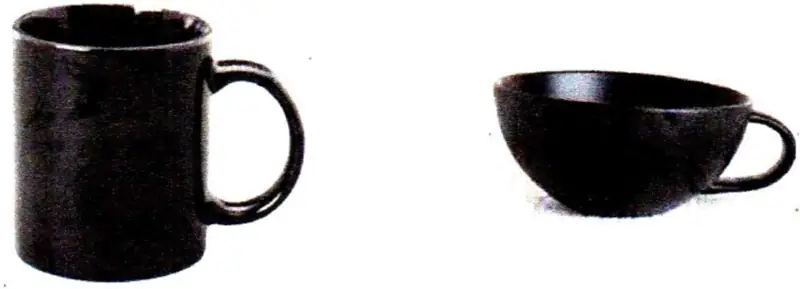
In a coffee shop, coffee is served in two types of cups. One is cylindrical in shape with diameter 7 cm and height 14 cm and the other is hemispherical with diameter 21 cm.
Photograph retained from the official paper.
Describe the figure
Both original cup photographs are retained. The cylindrical cup has radius 3.5 cm and height 14 cm. The hemispherical cup has radius 10.5 cm. Capacity uses the ideal cup dimensions given in the question.
Appeared in: 2023 · Standard · Main
Related setup: Case 25 compares two coffee cups with different dimensions and subparts.
(i) Find the area of the base of the cylindrical cup. [1 mark]
Show answer and solution
Base area = 38.5 cm².
Using π = , base area = πr² = × 3.5² = 38.5 cm².
(ii)(a) Find the capacity of the hemispherical cup. [2 marks]
Show answer and solution
Hemispherical cup capacity = 2425.5 cm³.
Radius = = 10.5 cm.
Using π = , V = πr³ = × × 10.5³ = 2425.5 cm³.
OR
(ii)(b) Find the capacity of the cylindrical cup. [2 marks]
Show answer and solution
Cylindrical cup capacity = 539 cm³.
Radius = = 3.5 cm.
Using π = , V = πr²h = × 3.5² × 14 = 539 cm³.
(iii) Find the curved surface area of the cylindrical cup. [1 mark]
Show answer and solution
Curved area = 308 cm².
Using π = , area = 2πrh = 2 × × 3.5 × 14 = 308 cm².
Standard4 marks · 1 + 2 + 1
Case 23. Milk packets, cartons and a cylindrical cup
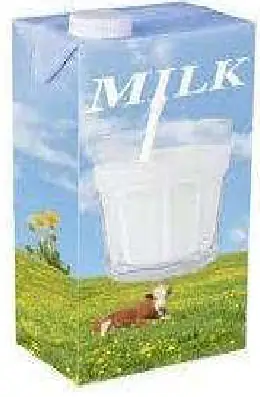
Tamper-proof tetra-packed milk guarantees both freshness and security. This milk ensures uncompromised quality, preserving the nutritional values within and making it a reliable choice for health-conscious individuals.
500 mL milk is packed in a cuboidal container of dimensions 15 cm × 8 cm × 5 cm. These milk packets are then packed in cuboidal cartons of dimensions 30 cm × 32 cm × 15 cm.
Photograph retained from the official paper.Illustration retained from the official paper.Diagram retained from the official paper.
Describe the figure
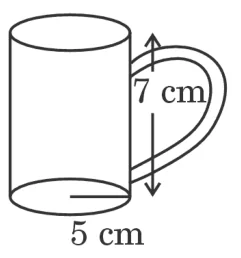
All three original panels are retained: a box photograph, milk-packet illustration and cup diagram. The cup has radius 5 cm and height 7 cm; the 5 cm line goes from the centre to the rim. A packet contains 500 mL of milk; its given outside dimensions have volume 600 cm³. The packet’s outer volume is larger than the milk it holds.
Appeared in: 2024 · Standard · Main
(i) Find the volume of the cuboidal carton. [1 mark]
Show answer and solution
Carton volume = 14400 cm³.
Volume = lbh = 30 × 32 × 15 = 14400 cm³.
(ii)(a) Find the total surface area of one milk packet. [2 marks]
Show answer and solution
Packet surface area = 470 cm².
Area = 2(lb + bh + hl).
Area = 2(15 × 8 + 8 × 5 + 5 × 15) = 470 cm².
OR
(ii)(b) How many milk packets can be packed in one carton? [2 marks]
Show answer and solution
Number of packets = 24.
Align the packet edges 15 cm, 8 cm and 5 cm with carton edges 30 cm, 32 cm and 15 cm.
Number along the three directions = , and .
Total = 2 × 4 × 3 = 24 packets.
The arrangement confirms the packets fit; the 500 mL milk content is not the packet’s outside volume.
(iii) Find the capacity of the cylindrical cup shown, of radius 5 cm and height 7 cm. [1 mark]
Show answer and solution
Cup capacity = 550 mL.
The diagram gives radius 5 cm, not diameter.
Using π = , V = πr²h = × 5² × 7 = 550 cm³.
Since 1 cm³ = 1 mL, capacity = 550 mL.
Basic4 marks · 1 + 1 + 2
Case 24. Balls in a cuboidal play-pool box
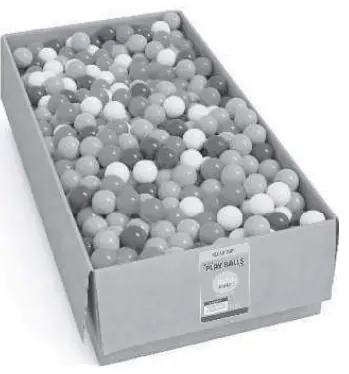
Playing in a ball pool is good entertainment for kids. Suhana bought 600 new balls of diameter 7 cm to fill in the pool for her kids. The cuboidal box containing 600 balls has dimensions 42 cm × 91 cm × 50 cm (l × b × h).
Photograph retained from the official paper.
Describe the figure
The original ball-pool photograph is retained. There are 600 balls, each of radius 3.5 cm. The box is 42 cm by 91 cm by 50 cm. The lowermost-layer OR uses the square-grid arrangement intended in the marking scheme.
Appeared in: 2025 · Basic · Main
(i) Find the volume of one ball. [1 mark]
Show answer and solution
One ball volume = cm³ ≈ 179.67 cm³.
Radius = = 3.5 cm.
Using π = , V = πr³ = × × 3.5³ = cm³.
(ii) Find the surface area to be painted if 10 balls are painted. [1 mark]
Show answer and solution
Painted area = 1540 cm².
Area of 10 spheres = 10 × 4πr².
Using π = , area = 10 × 4 × × 3.5² = 1540 cm².
(iii)(a) Find the empty space in the box containing 600 balls. [2 marks]
Show answer and solution
Empty space = 83300 cm³.
Box volume = 42 × 91 × 50 = 191100 cm³.
Volume of 600 balls = 600 × = 107800 cm³.
Empty space = 191100 − 107800 = 83300 cm³.
OR
(iii)(b) The lowermost layer covers the base edge to edge when balls are placed evenly adjacent to each other. (A) How much area is covered by one ball? (B) How many balls are in the lowermost layer? [2 marks]
Show answer and solution
Square-cell area = 49 cm²; lowermost layer = 78 balls.
The scheme uses a square grid: allocate one diameter-by-diameter cell to each ball.
Cell area = 7 × 7 = 49 cm². This is not the circular projection area or a contact area.
Balls along the two base edges = = 6 and = 13.
Number in the lowermost layer = 6 × 13 = 78.
Basic4 marks · 1 + 1 + 2 · Accessible alternative
Case 25. Comparing the capacities of two coffee cups
In a coffee shop, coffee is served in two types of cups. One is cylindrical in shape with diameter 8 cm and height 7 cm and the other is hemispherical with diameter 14 cm.
The accessible paper is text-only. The cylindrical cup has radius 4 cm and height 7 cm, while the hemispherical cup has radius 7 cm. Use the ideal thin-wall cup dimensions intended in the question.
Appeared in: 2026 · Basic · Main
Related setup: Case 22 uses different cup dimensions and questions.
(i) Find the outer curved surface area of the cylindrical cup. [1 mark]
Show answer and solution
Cylinder curved area = 176 cm².
Using π = , area = 2πrh = 2 × × 4 × 7 = 176 cm².
(ii) Find the inner surface area of the hemispherical cup. [1 mark]
Show answer and solution
Hemisphere inner area = 308 cm².
Using π = , area = 2πr² = 2 × × 7² = 308 cm².
(iii)(a) Find the difference in capacities of the two cups. [2 marks]
Show answer and solution
Capacity difference = cm³ ≈ 366.67 cm³.
Hemisphere capacity = × × 7³ = cm³.
Cylinder capacity = × 4² × 7 = 352 cm³.
Difference = − 352 = cm³.
OR
(iii)(b) Find the total quantity of coffee in two cylindrical cups and one hemispherical cup. [2 marks]
Show answer and solution
Total coffee = cm³ ≈ 1422.67 cm³.
Two cylindrical cups contain 2 × 352 = 704 cm³.
One hemispherical cup contains cm³.
Total = 704 + = cm³.
Standard4 marks · 1 + 1 + 2
Case 26. A tabletop leafy-ball fountain
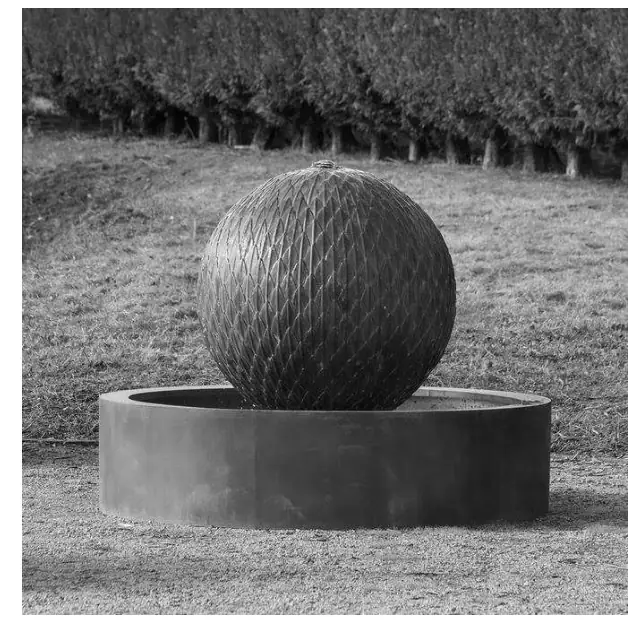
A model of Leafy Ball Fountain is made to be kept on the tabletop. Water gently cascades down the ball into a decorative cylindrical pool where it is recycled.
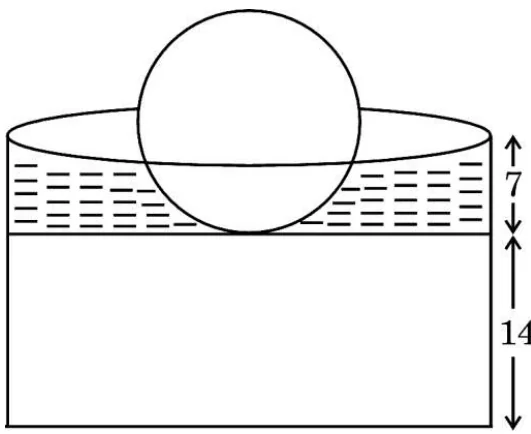
The diameter of spherical ball is 21 cm. Cylindrical pool: outer diameter 50 cm and inner diameter 40 cm. Height of solid base is 14 cm. Height of water filled is 7 cm.
Photograph retained from the official paper.Diagram retained from the official paper.
Describe the figure
The source fountain photograph and dimensioned diagram are retained. The ball radius is 10.5 cm, pool inner radius 20 cm and outer radius 25 cm. The solid base height is 14 cm with 7 cm water depth above it. The volume alternative follows the scheme’s one-third-of-ball-volume model.
Appeared in: 2026 · Standard · Main
(i) Find the total height of the model. [1 mark]
Show answer and solution
Model height = 35 cm.
Total height = solid base height + ball diameter = 14 + 21 = 35 cm.
(ii) Find the volume of the spherical ball. [1 mark]
Show answer and solution
Ball volume = 4851 cm³.
Radius = = 10.5 cm.
Using π = , V = πr³ = × × 10.5³ = 4851 cm³.
(iii)(a) If one-third of the ball is submerged in the water, find the volume of water filled in the pool. [2 marks]
Show answer and solution
Water volume = 7183 cm³.
The 2026 Standard 30/3/1 scheme, PDF p. 22, subtracts one-third of the ball’s volume from the inner cylinder volume. We follow that volume model here.
Cylinder volume up to water level = π × 20² × 7 = 8800 cm³, using π = .
Displaced volume = = 1617 cm³.
Water volume = 8800 − 1617 = 7183 cm³.
This uses the stated one-third-volume condition; it does not derive a spherical-cap volume from the drawing.
OR
(iii)(b) Find the sum of the outer curved surface area of the cylindrical pool and the surface area of the spherical ball. [2 marks]
Show answer and solution
Sum of the named areas = 4686 cm².
The cylinder’s full height is 14 + 7 = 21 cm.
Using π = , outer cylinder curved area = 2π × 25 × 21 = 3300 cm².
Whole ball surface area = 4π × 10.5² = 1386 cm².
Sum = 3300 + 1386 = 4686 cm².
The question asks for these complete component areas, rather than just the ball surface above water.
Basic4 marks · 1 + 2 + 1
Case 27. Water in a tumbler and a drinking straw
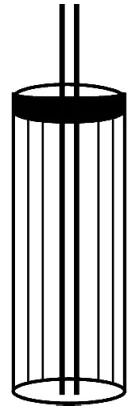
Tarini bought a glass tumbler which is cylindrical in shape with inner height 21 cm and inner diameter 7 cm. It has a straw of length 24 cm and inner diameter 1 cm. Tarini filled the tumbler with water leaving 1 cm space from the top.
Diagram retained from the official paper.
Describe the figure
The original tumbler-and-straw illustration is retained. Tumbler inner radius is 3.5 cm and inner height 21 cm, but water depth is 20 cm. Straw inner radius is 0.5 cm and length 24 cm. The tumbler is open at the top.
Appeared in: 2026 · Basic · Second Board Examination
(i) Find the volume of water in the tumbler. [1 mark]
Show answer and solution
Initial water volume = 770 cm³.
Water height = 21 − 1 = 20 cm.
Using π = , V = πr²h = × 3.5² × 20 = 770 cm³.
(ii)(a) Tarini fills the straw completely with water seven times and drinks it. Find the volume of water left in the tumbler. [2 marks]
Show answer and solution
Water remaining = 638 cm³.
One full straw holds π × 0.5² × 24 = 6π cm³.
Using π = , seven straws hold 7 × = 132 cm³.
Water remaining = 770 − 132 = 638 cm³.
OR
(ii)(b) Find the total inner surface area of the tumbler. [2 marks]
Show answer and solution
Inner surface area = 500.5 cm².
Count the inside curved wall and the circular bottom, without a top lid.
Area = 2πrh + πr².
Using π = , area = 2 × × 3.5 × 21 + × 3.5² = 500.5 cm².
(iii) Find the inner curved surface area of the straw. [1 mark]
Show answer and solution
Straw inner curved area = cm² ≈ 75.43 cm².
Use the straw’s inner radius 0.5 cm and full length 24 cm.
Using π = , area = 2πrh = 2 × × 0.5 × 24 = cm².
Basic4 marks · 1 + 1 + 2
Case 28. Medicine in a capsule with hemispherical ends
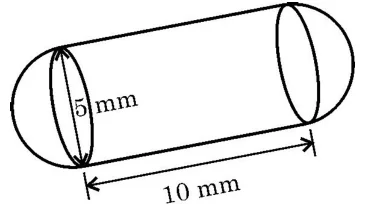
A hospital stores medicine capsules shaped like cylinders with hemispherical ends. Each capsule has length of the cylindrical part of 10 mm and a diameter of 5 mm.
Diagram retained from the official paper.
Describe the figure
The original capsule diagram labels the cylindrical part as 10 mm long and the radius as 2.5 mm. Two hemispherical ends together form a sphere. The OR wording “capsule length is doubled” is interpreted in the official scheme as doubling the cylindrical part.
Appeared in: 2026 · Basic · Second Board Examination
(i) Find the total surface area of the capsule. [1 mark]
Show answer and solution
Capsule surface area = mm² ≈ 235.71 mm².
Radius r = = 2.5 mm; cylinder length h = 10 mm.
Exposed area = cylinder curved area + two hemisphere curved areas.
(ii) Find the volume of medicine the capsule can hold. [1 mark]
Show answer and solution
Capsule capacity = mm³ ≈ 261.90 mm³.
Capacity = cylinder volume + volume of a sphere.
V = πr²h + πr³ = π × 2.5² × 10 + π × 2.5³.
Using π = , V = mm³.
(iii)(a) If medicine costs ₹0.05 per mm³, find the cost of medicine in one capsule. [2 marks]
Show answer and solution
Cost ≈ ₹13.10.
Use the exact capacity before rounding.
Cost = × 0.05 = rupees ≈ ₹13.10.
OR
(iii)(b) How much extra medicine, in volume, can be stored in the capsule if the capsule length is doubled? [2 marks]
Show answer and solution
Scheme interpretation: extra volume = mm³ ≈ 196.43 mm³.
The 2026 second-board Basic schemes double the cylindrical length from 10 mm to 20 mm, keeping the radius and end caps unchanged: 430/8/1, PDF pp. 18–19; 430/8/2, p. 16; 430/8/3, p. 18.
Extra volume = πr²(20 − 10).
Using π = , extra = × 2.5² × 10 = mm³.
Wording note: the original end-to-end length is 10 + 5 = 15 mm. If that full length were doubled to 30 mm, the new cylindrical length would be 25 mm, giving extra volume mm³ ≈ 294.64 mm³. The primary answer follows the printed scheme’s cylindrical-length interpretation.
Questions students ask
How do I decide between surface area and volume?
Paint, cloth and wrapping normally need area in square units. Material, water and capacity need volume in cubic units. Identify exactly what is requested before selecting the formula.
Why are joined circular bases excluded from exposed surface area?
The circular faces where two solids join are internal. Count the outside boundary once. A free circular base, uncovered annular underside or rim must still be counted when it is exposed.
When do I use cone slant height?
Use slant height l for cone curved area πrl. Use perpendicular height h for cone volume. For a right circular cone, l² = r² + h².
Does an open cup have two circular ends?
No. The inner surface of an open cylindrical cup includes its curved wall and one circular bottom. A straw’s curved-area question excludes its open ends.
Which radius should I use for a thick bowl?
Use the inner radius for capacity and inner painting, the outer radius for packing dimensions, and both radii for shell volume or the annular rim. The packed-bowl case demonstrates all three.
Why is the golf-ball surface not just 4πR²?
Each dimple removes a circular patch from the original sphere and adds a curved hemispherical surface. Subtract the openings before adding the dimple surfaces.
What does area covered by one ball mean in the pool case?
The official square-grid model assigns a 7 cm by 7 cm cell to each ball, giving 49 cm² and 78 cells on the base. That allocation is different from the ball’s circular projection or physical contact area.
Why does the pencil solution differ from the official sample scheme?
The Basic 2024–25 sample scheme, PDF and printed p. 7, prints 6.15π, using π × 0.5 × 0.5 × 21 for the cylinder’s curved area. With radius 0.5 cm and length 21 cm, 2πrh = 21π, so the exposed total is 21π + 0.65π + 0.25π = 21.9π cm².
What is doubled in the capsule OR question?
The scheme doubles the 10 mm cylindrical part, keeping the hemispherical ends unchanged. The source wording says capsule length; the solution also explains the different result if the full end-to-end length is doubled.
Should I round each component before adding?
Keep exact fractions and π expressions until the last step. Use a value of π printed in the question; otherwise the chosen value is stated. Rounding intermediate volumes can alter the final cost.
Do I answer both OR alternatives?
Answer one where OR is printed. Both are solved here for practice. Follow the marks beside each part: this selection includes 1 + 1 + 2, 1 + 2 + 1, 2 + 2 and 3 + 1 patterns.
Scheme interpretation: extra volume = mm³ ≈ 196.43 mm³.
All answers are present before filters run. Both OR alternatives are listed for practice.
How to approach a case study
Read the full passage and identify the solids and the quantity requested.
Mark the radius, diameter, perpendicular height and any open or joined faces; use stated measurements rather than measuring the drawing.
Write the required formula, substitute the given values and simplify one step per line.
Keep OR conditions separate, check units and round only at the end.
About these questions and solutions
Selected official CBSE cases, with exact repeats merged and original passages, illustrations, marks and OR choices retained.
Solutions prepared by Team TutorVertex in NCERT style; source-specific interpretations and corrections are explained beside the affected answers.
Official sources — View papers and marking schemesCase 1 sources
2022 · Standard · main · 30/2/1 · Q14 — Official question-paper archive · Official marking schemeQuestion file: Math_S/30-2-1 Maths Standard.pdf Marking-scheme file: Mathematic_Standard/WithQuestion_041_30_2_1_Mathematics.pdf Question PDF page 15; marking-scheme PDF page 12.
2022 · Standard · main · 30/2/2 · Q14 — Official question-paper archive · Official marking schemeQuestion file: Math_S/30-2-2 Maths Standard.pdf Marking-scheme file: Mathematic_Standard/WithQuestion_041_30_2_2_Mathematics.pdf Question PDF page 15; marking-scheme PDF page 12.
2022 · Standard · main · 30/2/3 · Q14 — Official question-paper archive · Official marking schemeQuestion file: Math_S/30-2-3 Maths Standard.pdf Marking-scheme file: Mathematic_Standard/WithQuestion_041_30_2_3_Mathematics.pdf Question PDF page 15; marking-scheme PDF page 11.
Case 2 sources
2024 · Standard · main · 30/2/1 · Q37 — Official question-paper archive · Official marking schemeQuestion file: MATHEMATICS_STANDARD/30-2-1(Mathematics Standard).pdf Marking-scheme file: Mathematics_Standard/MS 041_30-2-1 Mathematics 2023-24.pdf Question PDF page 21; marking-scheme PDF page 21.
2024 · Standard · main · 30/2/2 · Q36 — Official question-paper archive · Official marking schemeQuestion file: MATHEMATICS_STANDARD/30-2-2(Mathematics Standard).pdf Marking-scheme file: Mathematics_Standard/MS 041_30-2-2 Mathematics 2023-24.pdf Question PDF page 21; marking-scheme PDF pages 19, 20.
2024 · Standard · main · 30/2/3 · Q37 — Official question-paper archive · Official marking schemeQuestion file: MATHEMATICS_STANDARD/30-2-3(Mathematics Standard).pdf Marking-scheme file: Mathematics_Standard/MS 041_30-2-3 Mathematics 2023-24.pdf Question PDF pages 21, 23; marking-scheme PDF pages 22, 23.
Case 3 sources
2023 · Standard · supplementary · 30(B) · Q38 — Official question-paper archive · Official marking schemeQuestion file: Maths_Standard/30_C_B Mathematics Standard.pdf Marking-scheme file: Mathematics_Standard/041_30-C-B.pdf Question PDF page 23; marking-scheme PDF pages 18, 19.
Case 4 sources
2024–25 · Standard · Official sample · Q38 — Official sample question paper · Official marking schemeQuestion file: MathsStandard-SQP.pdf Marking-scheme file: MathsStandard-MS.pdf Question PDF page 8; marking-scheme PDF pages 8, 9.
Case 5 sources
2022 · Basic · main · 430/4/1 · Q14 — Official question-paper archive · Official marking schemeQuestion file: Math_B/430-4-1 Maths Basic.pdf Marking-scheme file: Mathematics basic/Maths Basic Paper code 430.4.1.pdf Question PDF page 11; marking-scheme PDF page 7.
2022 · Basic · main · 430/4/2 · Q14 — Official question-paper archive · Official marking schemeQuestion file: Math_B/430-4-2 Maths Basic.pdf Marking-scheme file: Mathematics basic/241_430_4_2_Mathematics (Basic).pdf Question PDF page 11; marking-scheme PDF page 7.
2022 · Basic · main · 430/4/3 · Q14 — Official question-paper archive · Official marking schemeQuestion file: Math_B/430-4-3 Maths Basic.pdf Marking-scheme file: Mathematics basic/241_430_4_3_Mathematics (Basic).pdf Question PDF page 11; marking-scheme PDF page 8.
Case 6 sources
2025 · Standard · main · 30(B) · Q37 — Official question-paper archive · Official marking schemeQuestion file: 041_Mathematics_Standard/30 B_Maths Std for Visually Impaired.pdf Marking-scheme file: Math/041 Mathematics Standard/X_MS_041_Mathematics Standard_30 (B)_2024-25.pdf Question PDF page 21; marking-scheme PDF page 15.
2024–25 · Basic · Official sample · Q38 — Official sample question paper · Official marking schemeQuestion file: MathsBasic-SQP.pdf Marking-scheme file: MathsBasic-MS.pdf Question PDF page 8; marking-scheme PDF page 7.
Case 14 sources
2022 · Basic · main · 430/2/1 · Q14 — Official question-paper archive · Official marking schemeQuestion file: Math_B/430-2-1 Maths Basic.pdf Marking-scheme file: Mathematics basic/Maths Basic paper code 430.2.1.pdf Question PDF page 11; marking-scheme PDF page 6.
2022 · Basic · main · 430/2/2 · Q14 — Official question-paper archive · Official marking schemeQuestion file: Math_B/430-2-2 Maths Basic.pdf Marking-scheme file: Mathematics basic/Maths Basic Paper code 430.2.2.pdf Question PDF page 11; marking-scheme PDF page 6.
2022 · Basic · main · 430/2/3 · Q14 — Official question-paper archive · Official marking schemeQuestion file: Math_B/430-2-3 Maths Basic.pdf Marking-scheme file: Mathematics basic/Maths Basic Paper code 430.2.3.pdf Question PDF page 11; marking-scheme PDF page 6.
Case 15 sources
2023 · Basic · main · 430/2/1 · Q38 — Official question-paper archive · Official marking schemeQuestion file: MATHEMATICS_BASIC/430_2_1_Maths Basic.pdf Marking-scheme file: Math_Basic/430_2_1.pdf Question PDF page 27; marking-scheme PDF page 22.
2023 · Basic · main · 430/2/2 · Q36 — Official question-paper archive · Official marking schemeQuestion file: MATHEMATICS_BASIC/430_2_2_Maths Basic.pdf Marking-scheme file: Math_Basic/430_2_2.pdf Question PDF page 23; marking-scheme PDF page 17.
2023 · Basic · main · 430/2/3 · Q37 — Official question-paper archive · Official marking schemeQuestion file: MATHEMATICS_BASIC/430_2_3_Maths Basic.pdf Marking-scheme file: Math_Basic/430_2_3.pdf Question PDF page 25; marking-scheme PDF page 20.
Case 16 sources
2023 · Standard · main · 30/5/1 · Q36 — Official question-paper archive · Official marking schemeQuestion file: MATHEMATICS_STANDARD/30_5_1_Maths Standard.pdf Marking-scheme file: Maths_Standard/MS 041_30-5-1 Mathematics 2022-23.pdf Question PDF page 21; marking-scheme PDF pages 24, 25.
2023 · Standard · main · 30/5/2 · Q37 — Official question-paper archive · Official marking schemeQuestion file: MATHEMATICS_STANDARD/30_5_2_Maths Standard.pdf Marking-scheme file: Maths_Standard/MS 041_30-5-2 Mathematics 2022-23.pdf Question PDF page 23; marking-scheme PDF pages 27, 28.
2023 · Standard · main · 30/5/3 · Q37 — Official question-paper archive · Official marking schemeQuestion file: MATHEMATICS_STANDARD/30_5_3_Maths Standard.pdf Marking-scheme file: Maths_Standard/MS 041_30-5-3 Mathematics 2022-23.pdf Question PDF page 23; marking-scheme PDF pages 26, 27.
Case 17 sources
2023 · Basic · main · 430/5/1 · Q37 — Official question-paper archive · Official marking schemeQuestion file: MATHEMATICS_BASIC/430_5_1_Maths Basic.pdf Marking-scheme file: Math_Basic/430_5_1.pdf Question PDF pages 21, 23; marking-scheme PDF page 17.
2023 · Basic · main · 430/5/2 · Q36 — Official question-paper archive · Official marking schemeQuestion file: MATHEMATICS_BASIC/430_5_2_Maths Basic.pdf Marking-scheme file: Math_Basic/430_5_2.pdf Question PDF page 19; marking-scheme PDF page 15.
2023 · Basic · main · 430/5/3 · Q36 — Official question-paper archive · Official marking schemeQuestion file: MATHEMATICS_BASIC/430_5_3_Maths Basic.pdf Marking-scheme file: Math_Basic/430_5_3.pdf Question PDF pages 19, 21; marking-scheme PDF page 13.
Case 18 sources
2025 · Basic · main · 430/6/1 · Q37 — Official question-paper archive · Official marking schemeQuestion file: 241_Mathematics_Basic/430-6-1_Mathematics Basic.pdf Marking-scheme file: Math/241 Mathematics Basic/X_241_Mathematics Basic_MS_430_6_1.pdf Question PDF pages 21, 23; marking-scheme PDF pages 17, 18.
2025 · Basic · main · 430/6/2 · Q36 — Official question-paper archive · Official marking schemeQuestion file: 241_Mathematics_Basic/430-6-2_Mathematics Basic.pdf Marking-scheme file: Math/241 Mathematics Basic/X_241_Mathematics Basic_MS_430_6_2.pdf Question PDF page 21; marking-scheme PDF page 16.
2025 · Basic · main · 430/6/3 · Q38 — Official question-paper archive · Official marking schemeQuestion file: 241_Mathematics_Basic/430-6-3_Mathematics Basic.pdf Marking-scheme file: Math/241 Mathematics Basic/X_241_Mathematics Basic_MS_430_6_3.pdf Question PDF page 23; marking-scheme PDF page 18.
Case 19 sources
2022 · Standard · main · 30/4/1 · Q14 — Official question-paper archive · Official marking schemeQuestion file: Math_S/30-4-1 Maths Standard.pdf Marking-scheme file: Mathematic_Standard/041_30_4_1_Mathematics (Standard).pdf Question PDF page 11; marking-scheme PDF pages 11, 12.
2022 · Standard · main · 30/4/2 · Q13 — Official question-paper archive · Official marking schemeQuestion file: Math_S/30-4-2 Maths Standard.pdf Marking-scheme file: Mathematic_Standard/041_30_4_2_Mathematics (Standard).pdf Question PDF page 9; marking-scheme PDF pages 10, 11.
2022 · Standard · main · 30/4/3 · Q14 — Official question-paper archive · Official marking schemeQuestion file: Math_S/30-4-3 Maths Standard.pdf Marking-scheme file: Mathematic_Standard/041_30_4_3_Mathematics (Standard).pdf Question PDF page 11; marking-scheme PDF pages 11, 12.
Case 20 sources
2022 · Standard · main · 30/B/5 · Q14 — Official question-paper archive · Official marking schemeQuestion file: Math_S/30-B-5 Maths Std. for VI candidates.pdf Marking-scheme file: Mathematic_Standard/041_30_B_5_Math (Standard) (For VI).pdf Question PDF page 11; marking-scheme PDF page 9.
Case 21 sources
2022 · Basic · main · 430/B/5 · Q14 — Official question-paper archive · Official marking schemeQuestion file: Math_B/430-B-5 Maths Basic for VI candidates.pdf Marking-scheme file: Mathematics basic/Maths Basic Paper code 430.B.5.pdf Question PDF page 11; marking-scheme PDF page 6.
Case 22 sources
2023 · Standard · main · 30/2/1 · Q37 — Official question-paper archive · Official marking schemeQuestion file: MATHEMATICS_STANDARD/30_2_1_Maths Standard.pdf Marking-scheme file: Maths_Standard/MS 041_30-2-1 Mathematics 2022-23.pdf Question PDF page 21; marking-scheme PDF page 19.
2023 · Standard · main · 30/2/2 · Q38 — Official question-paper archive · Official marking schemeQuestion file: MATHEMATICS_STANDARD/30_2_2_Maths Standard.pdf Marking-scheme file: Maths_Standard/MS 041_30-2-2 Mathematics 2022-23.pdf Question PDF page 23; marking-scheme PDF page 20.
2023 · Standard · main · 30/2/3 · Q36 — Official question-paper archive · Official marking schemeQuestion file: MATHEMATICS_STANDARD/30_2_3_Maths Standard.pdf Marking-scheme file: Maths_Standard/MS 041_30-2-3 Mathematics 2022-23.pdf Question PDF page 19; marking-scheme PDF page 18. The scheme labels this case Q37; the question paper labels it Q36.
Case 23 sources
2024 · Standard · main · 30/4/1 · Q38 — Official question-paper archive · Official marking schemeQuestion file: MATHEMATICS_STANDARD/30-4-1(Mathematics Standard).pdf Marking-scheme file: Mathematics_Standard/Marking scheme 30 4 1.pdf Question PDF page 23; marking-scheme PDF page 19.
2024 · Standard · main · 30/4/2 · Q36 — Official question-paper archive · Official marking schemeQuestion file: MATHEMATICS_STANDARD/30-4-2(Mathematics Standard).pdf Marking-scheme file: Mathematics_Standard/Marking scheme 30 4 2.pdf Question PDF page 19; marking-scheme PDF pages 17, 18.
2024 · Standard · main · 30/4/3 · Q37 — Official question-paper archive · Official marking schemeQuestion file: MATHEMATICS_STANDARD/30-4-3(Mathematics Standard).pdf Marking-scheme file: Mathematics_Standard/Marking scheme 30 4 3.pdf Question PDF page 21; marking-scheme PDF pages 18, 19.
Case 24 sources
2025 · Basic · main · 430/4/1 · Q37 — Official question-paper archive · Official marking schemeQuestion file: 241_Mathematics_Basic/430-4-1_Mathematics Basic.pdf Marking-scheme file: Math/241 Mathematics Basic/X_241_Mathematics Basic_MS_430_4_1.pdf Question PDF page 15; marking-scheme PDF page 17.
2025 · Basic · main · 430/4/2 · Q37 — Official question-paper archive · Official marking schemeQuestion file: 241_Mathematics_Basic/430-4-2_Mathematics Basic.pdf Marking-scheme file: Math/241 Mathematics Basic/X_241_Mathematics Basic_MS_430_4_2.pdf Question PDF page 15; marking-scheme PDF pages 16, 17.
2025 · Basic · main · 430/4/3 · Q36 — Official question-paper archive · Official marking schemeQuestion file: 241_Mathematics_Basic/430-4-3_Mathematics Basic.pdf Marking-scheme file: Math/241 Mathematics Basic/X_241_Mathematics Basic_MS_430_4_3.pdf Question PDF page 13; marking-scheme PDF page 17.